Ari Armstrong's Web Log (Main) | Archives | Terms of Use
Getting Over Jesus: Finding Meaning and Morals without God
Full text of Ari Armstrong's 2023 book.
by Ari Armstrong, Copyright © 2026
This book originally was published in October, 2023. I published this html version of the book at AriArmstrong.com on December 13, 2025. I retain the copyright. No part of this book may be reproduced elsewhere without my explicit permission. If you wish to help financially support this work, please purchase a paperback or ebook through Amazon, join my Patreon, or donate through PayPal. For additional essays and other materials on the topic, see the book's landing page. Thank you for reading, —Ari Armstrong
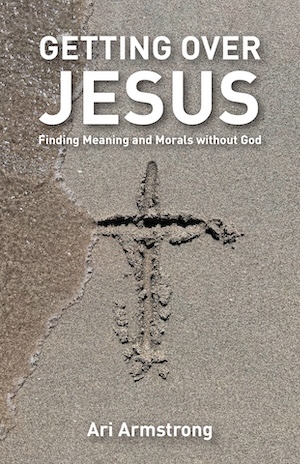
Getting Over Jesus
Finding Meaning and Morals without God
Ari Armstrong
Self in Society
Denver, Colorado
Self in Society
Denver, Colorado
Armstrong, Ari
Getting Over Jesus: Finding Meaning and Morals without God
Includes Index
Atheism, Religious Philosophy, Philosophy of Ethics & Morality
Designed by Jennifer Armstrong
Notes on the Text
All Bible references are from the New Revised Standard Version, Updated Edition, National Council of Churches of Christ in the United States of America (2021), via https://www.biblegateway.com/. I refer to authors of Biblical books as represented by those books, even when authorship is unknown or in doubt. Likewise, I quote Jesus as presented in the Bible without worrying about authenticity of the quotes. I discuss various stories of the Bible without always mentioning whether they are historically accurate or literally true (often they are not). I do not indicate line breaks in passages presented as poetic verse.
For other citations, in the print edition I use footnotes with complete publication information so that readers do not have to flip to multiple pages to hunt down the sources. In the ebook edition, I include complete citations in hyperlinked endnotes. I omit italics and other emphasis in quotes.
Usually when referring to a generic or hypothetical person, I use the terms “he,” “him,” and “his” in a gender-neutral sense. Uses of the singular “they” and of “oneself” and the like can be esthetically unpleasant and distracting, and “he or she” and comparable formulations are clunky and apparently inadequate anyway.
In the ebook edition, I include page references in subscripted brackets that correspond with the physical pages of the print version; obviously in a free-flowing ebook these numbers may appear anywhere on the screen.
To find additional essays and errata concerning this book, to contact the author, or to follow Ari’s work, please see AriArmstrong.com.
Acknowledgements
Jennifer Armstrong designed the cover and the interior of the print version. Jennifer Armstrong, Tom Welch, Rachel Miner, Anders Ingemarson, King Wiemann, Sharon Armstrong, and an anonymous reviewer offered helpful comments on earlier versions of the text. No one should assume that those listed here agree with me on any given point. Any remaining errors are solely the fault of Satan mine.
[Back Cover Text]
Does Christianity offer the pathway to a meaningful life, a glorious afterlife, and objective morality?
In this reflective critique rooted in personal experience, Ari Armstrong counters that we best find meaning through value-focused pursuits and loving relationships. Although Heaven and Hell are myths, we can and should focus on making the most of our lives on Earth. While religious faith delivers moral subjectivism, we can through reason discover a reality-based and genuinely objective morality.
Speaking primarily to young adults questioning their faith, Armstrong explores Christianity‘s defense mechanisms, the finality of death, the dangers of faith, the incoherence of supernaturalism, and other topics. He shows how people can live their best lives by rejecting faith and the supernatural in favor of reason and reality.
Ari Armstrong is the author of What‘s Wrong with Ayn Rand‘s Objectivist Ethics and Values of Harry Potter. He blogs at Self in Society and Colorado Pickaxe [now through AriArmstrong.com]. Ari lives with his family in Colorado, where he writes a political column and enjoys the outdoors.
Contents
2. Christianity’s Defense Mechanisms
The Devil Made Me Do It
Reason as Foolishness
Alleged Hatred of God
The Threat of Hell
The Ultimate Guilt Trip
3. Death without God
Religion Can Make Death Worse
A Healthy Approach to Death
Get to Living
Appreciate Loved Ones
4. Meaning in the Natural World
God and Meaning
Surrender Versus Meaning
The Value of Self-Talk
Pascal’s Hole
Universal Gratitude
Made of Star Stuff
Ad Astra
Social Beings
The Meaning of Work
Making the World a Better Place
5. Morals without God
The Possibility of Moral Progress
Conscious Caring Creatures
The Problem of Conflicting Interests
Moral Reasoning and Value Integration
Social Morality
A Life-Based Standard
Ethical Intuitionism
Natural Goodness
6. The Dangers of Faith
Blind Faith Versus Deserved Loyalty
Faith as Parasitical on Reason
The Moral Imperative of Reason
Pascal’s Wager
7. Societal Hazards of Christian Morality
The Bible Tells Me So
Death and Torture for Jesus
Christian Toleration
Authoritarians for Jesus
Christianity and Individualism
Christian Apocalypse
8. Individual Hazards of Christian Morality
Christian Passivity
Christian Excuse-Making
Christian Abuse and Dominance
Heavenly Eunuchs
The Eye in the Sky
The Benefits of Christian Sociality
Morals Grounded in Reality
9. The Incoherence of Supernaturalism
God as Space Alien
Imagining God
The Realm of Perfection
Dualism as Incoherent
Movement and Movers
Natural Free Will
Experiential Dualism
10. The Religious Animal?
The Hamer Gene
The Self-Transcendence Scale
The Rational Animal
11
1. My Journey to Secularism
To Christians, the central problem of human existence is to reunify with God after the fall of Adam and Eve. God sent his son Jesus to be born as a human and then to suffer and die at the hands of humans for the atonement of human sin. Those who accept Jesus as savior will have their sins washed away, find peace with God, and reap eternal life in Heaven with God and with all of their (saved) loved ones.
Why would anyone want to give that up? Why would anyone want to get over Jesus, separate himself from God, and give up Heaven for an eternity of suffering in Hell?
That problem is one I struggled with for a long time. The basic answer, I eventually came to see, is that the supernaturalist doctrines of Christianity are false, and we should strive to believe what is true rather than what is false. God does not exist, the supernatural realm does not exist, there is no Heaven or Hell, Jesus was a man and not a (son of a) god. Moreover, as human beings, we live our best lives by embracing reality and pursuing reality-based values. We properly ground our morals in reality, not in some mystical fantasy or in ancient books of mythology—especially ones, such as the Christian Bible, that excuse such horrors as slavery and genocide.
Stating such conclusions is easy; proving them is hard. Showing why the doctrines of religion are false and why a secular alternative promises a better life are the aims of this book.
The title, Getting Over Jesus, is a reference to the Biblical idea that the Christian church—and by extension individual Christians—are in some sense married to Jesus. As Paul writes, “I promised you in marriage to one husband, to present you as a chaste virgin to Christ” 12 (2 Corinthians 11:2). I advocate a break-up with Jesus, but this break-up is not like a normal one between two individuals. Christians think that they are “married” not to the historical figure of Jesus but to Jesus the divine being, the Son of God, who watches over them and communes with them. If the supernatural realm does not exist, then there is not actually any such being with whom to break up. The break-up to which I refer, then, is with your own commitment to an imaginary being.
Here I hope to help orient readers to my views by briefly recounting my own journey from Christian faith to secular atheism.
I grew up in a deeply religious home. Before I was born, both my parents participated in a local Bible college (since defunct) in western Colorado. My parents divorced when I was very young. My father was less religious than my mother and became less so over time. He remained an influence and exposed me to secular ideas, but I grew up with my mother and visited my father only occasionally. My maternal grandfather, also a deep influence on me, was an elder in a local independent Protestant church, where my family long was active.
As a child, I attended regular Sunday church services as well as extra Bible studies and Christian youth groups. My church also hosted occasional revival meetings, where traveling preachers and missionaries would fan the flames of parishioners’ faith. One fellow, a musician, was especially popular and returned several times; he sang (among other favorites) “Don’t Try to Make a Monkey Out of Me,” a humorous critique of the theory of biological evolution.1
My church, along with several others in the area, ran (and still runs) a Christian youth camp. I attended week-long camps most summers of my childhood. Those days were filled with preaching, Bible studies, and communal religious singing, all of which had a powerful effect on me. An ice-cold creek runs through the campground, and a small wall of rocks helped create a pool large enough for baptisms. Sometimes preachers would baptize several 13 children—those who had stepped forward to be saved—in sequence. One time we took religious literature to a local town and went in pairs or small groups to proselytize to the community. (I don’t remember having much luck with that.)
I was baptized in the dedicated baptismal behind the main stage of my family’s church (which was considerably warmer than the camp creek). In my church, baptism by immersion—getting completely dunked—was a big deal. At one point some members of the church became involved in a discussion about whether Catholics could make it into Heaven. Some people argued forcefully that Catholics would not go to Heaven, partly because they were baptized by sprinkling as infants, rather than by immersion as mature moral agents. Others argued, somewhat less forcefully, that God wasn’t such a stickler for the rules, and Catholics would make it past the Pearly Gates if their hearts were in the right place. Thankfully, at the time I didn’t pay much attention to which of my friends were Catholic, so I didn’t have to worry about the practical implications of the debate.
I struggled to be in the world but not of the world (see 1 John 2:15–17 and John 15:19). I listened to rock music in high school, but I restricted my collection to Christian artists such as Amy Grant and White Heart. I remember listening, with some skepticism but mostly with fear, to a tape claiming that Satanic backmasking was prevalent in rock music. Of course artists such as KISS (rumored to stand for “Knights in Satan’s Service”) were a problem, but even the Beatles supposedly did this. I remember feeling extremely creeped out as I listened to John Lennon (I think it was) sing, backwards, “Wake me up dead man,” or at least something that sounded a little like that. (For those interested, Wikipedia has an entry on backmasking.)
I also struggled with whether masturbation was a sin. Unlike most Catholics, who oppose masturbation (at least officially), in my Protestant circles it was an open question (although not 14 much discussed).2 I read a self-help guide for Christian youth that suggested the practice is okay so long as one does not fantasize about others while doing it. Obviously sex with another person prior to marriage was out.
I took seriously Jesus’s exhortation to spread the Gospel (see Matthew 28:19). I hectored friends and family members to go to church. In high school a friend asked me to help convert another of his friends. The three of us met, and I did my best to present the argument from design and the reasons why I thought God’s impact on people’s lives provided evidence that God exists. I had read books about how gang members had repented and given their lives to Jesus, and, to me, stories such as these, along with claims of supernatural encounters from people I personally knew, offered compelling reasons to accept the reality of the Christian God.
In many ways my church was fundamentalist. It was not even an open question in my church whether homosexuality was acceptable—it was taken as obvious that it was a sin (this was in the 1970s and ’80s, long before the widespread acceptance of gay marriage). Likewise, no one in my church even entertained the idea (at least out loud) that abortion in any circumstance might be okay. As a high schooler, I wrote a letter to the local paper arguing that abortion should be outlawed. People in my church frequently derided the theory of evolution, and I never heard anyone in church endorse that theory. Some people thought the Earth was just a few thousand years old. Others thought that it was considerably older yet held that God created all of Earth’s living things more or less as they are now. In high school, somehow I convinced the principal at my public school to allow a debate between a Creationist who lived in the area and a science teacher who argued for evolution.
That my church was relatively extreme in its commitment to Biblical literalism probably made it easier for my growing doubts 15 eventually to go more naturally in the direction of atheism than of a watered-down religion. I read the Bible and took it seriously. I thought the Bible was the literal word of God, not a flawed document that we could read selectively or reinterpret at will. I thought my religious doctrines were literally true, not just “metaphorically true” (whatever that means). For me, then, Christianity was an all-or-nothing proposition: It either was true or it wasn’t. I had no interest in a Christianity in name only.
My doubts sprouted in late high school and grew over time. My father was a fan of the novelist and atheist Ayn Rand, and he introduced me to her work. (I remember one time when I was younger that he read Anthem to me to put me to sleep—that didn’t work very well given the brutal flogging scene in the story.) I read Atlas Shrugged and other works by Rand in high school. Two main things about Rand’s brand of atheism struck me: She held that knowledge derives from reason grounded in perceptual evidence, and she held that proper moral values derive from reality. Although I have since come to disagree with important aspects of Rand’s moral theory (see my book, What’s Wrong with Ayn Rand’s Objectivist Ethics, Eversol Press, 2018), the broader point that I got from her is that we don’t need religion to derive moral principles. Indeed, religion, with its reliance on faith and authority, undermines morality.
My path from fundamentalist Christianity to atheism was a rocky one. In high school, I struggled with the fear that my doubts were demonically inspired (as I discuss in the next chapter). Then, still in high school, I decided that I could square Christianity with reason and with a rational morality. Indeed, I wrote a major paper as a high school senior in which I argued that the doctrines of Christianity and the philosophy of Ayn Rand can be reconciled. Christianity can be rationally demonstrated, I argued, as by the argument from design. What about ethics? Is not Rand’s vision of rational self-interest the antithesis of Christian sacrifice? Not so fast, I argued. Ultimately it is in a person’s self-interest to get to Heaven. Further, although Jesus’s death on the cross usually is cast as the epitome of self-sacrifice, more deeply God had an interest in reconciling with humanity. In retrospect my arguments did not hold up, but I made a strong effort 16 to harmonize my divergent beliefs. I remain proud of that paper—my first real foray into serious intellectual matters.
One important event on my path to disbelief was a religious revival for high schoolers that I attended in Denver. Teens from all over the region came. The preachers were emotionally powerful, and by the end of a long session many young people went forward to be saved or to rededicate themselves to Jesus. By that point many or most people in the room were crying tears mingling guilt, sorrow, ecstasy, and catharsis. Then it struck me: These evangelists were experts in manipulating people’s emotions. This event was not fundamentally about the children thinking clearly about what was true and what was best for their lives; it was about them getting sucked into a powerful emotional experience. What we find emotionally compelling, I realized, might not be true.
In high school, still deeply influenced by the preachers I met at church camp, I seriously entertained the possibility of becoming a preacher when I grew up. I went on a tour of various religious colleges with an eye toward keeping that option open and, more broadly, toward sustaining my faith. I applied to college while still a serious Christian, yet, by the time I attended college, my doubts had grown considerably. Although I went to a religiously affiliated college (Pepperdine), by the time I left I had become more or less an atheist. For a few years after college I sometimes entertained the idea that we can conceive of “God” basically as all of existence (along Spinoza’s lines). Ironically, the required college courses in religious history, where I learned more about how Judaic and Christian traditions developed, nurtured my budding atheism. It seemed increasingly likely to me that humans invented religion, that man created God rather than the other way around.
I came to realize that the promises of Christianity are an illusion. Christianity is myth, not literal truth. Jesus was a person who lived and died—and who became the basis of an elaborate mythology—not a supernatural being whose sacrifice allows people to live forever. Although people can create better or worse lives for themselves on Earth, there is no supernatural Heaven or Hell where souls dwell after the death of the body. We should be honest with ourselves about the nature of reality.
17 Moreover, I came to see that countless Christians have needlessly tormented themselves or others because of their religious faith. Many Christians have suffered pointless fear and guilt over their intellectual doubts about their faith, their pursuit of Earthly values, or their sexual lives (especially if gay). Because religious tenets rest on faith rather than fact and thus cannot be rationally squared with reality or proved superior to conflicting dogmas, Christians waged centuries of religious warfare and persecuted and slaughtered nonviolent “sinners” including “witches,” homosexuals, heretics, and heathens. Adherents to many other religions and nonreligious dogmas also have brutalized others, but that hardly excuses such actions among Christians.
Christianity, at least as normally believed and practiced, promotes conformity to dogma, submission to authority in certain contexts, at least a partial betrayal of Earthly values for the fantasy of life after death, a false confidence that God will make our lives and our societies work out for the best if we are faithful, and a dangerous longing for the end of the world when Jesus supposedly returns.
I came to realize that we do not need to imagine a God in order to lead fulfilled and meaningful lives. Insofar as people get real values from their religion, generally it is because of what they do for themselves and what people do for each other. We can retain those values without the mystical scaffolding. And, insofar as religion encourages people to believe nonsense or to sacrifice their values or the values of others for some alleged divine plan, we are far better off without it.
Although I had my personal struggles transitioning from a dedicated Christian to a confident atheist, eventually I forged a life in which I became comfortable with myself and my new perspective and excited about the journey to align my beliefs with reality to the best of my abilities. Eventually I conceived of this book to offer some guideposts for others struggling with their faith.
In this book, I do not focus primarily on formal arguments for and against the existence of God, although I discuss some of those arguments. Plenty of such books exist already. For the most part, religious people are not religious because they have carefully weighed the arguments for and against their religious doctrines. Rather, they are religious first, and then they rationalistically embrace arguments 18 that seem to buttress their faith.3 They start with their conclusion and “prove” it by whatever means seem convenient.
This book is intended not as a handbook of academic proofs, but as a guide for people struggling through the often-lonely borderlands between the religious and the secular. It is intended to offer some guidance in working through the conceptual, psychological, ethical, and social challenges of questioning one’s faith. I know how hard it can be to abandon one’s faith. For years I struggled with agonizing self-doubt, guilt, and loneliness.
I wrote this book primarily for people who were raised Christian but who are questioning their faith. I most directly criticize the conservative Protestantism of the United States in which I was raised. Much of the book’s contents apply to other religious traditions, especially monotheistic ones. My aim is to help make the transition from religious belief to secularism a little easier and to help point the way toward finding truth, meaning, and morals in the natural world.
Secular readers, I hope, also can find value in the positive philosophic positions that I advance. As many others have noted, atheism per se is not a positive philosophy. It is only the negation of theism and, more broadly, of supernaturalism. Positive philosophic views, ones that say something about the nature of reality, the means to knowledge, and the basis of morality, do not derive from atheism even if they entail it. Atheism is not a philosophic primary. This is why I can and do vehemently disagree with some atheists. I join many atheists in promoting evidence-based reason, naturalism, the scientific method, and human flourishing. In this book I promote a particular sort of secularism.
19 Dedicated Christians who are not at all questioning their faith also might find value in this book, if only as an insight into how some atheists think or as a means to becoming a more effective apologist. I do not maintain any illusions that I can talk (or write) most people out of their faith. More generally, people strongly devoted to any ideology usually cannot be talked out of it. For example, if I wrote a book against Marxism, which I regard as a deeply flawed and vicious philosophy, I probably would not convince many dedicated Marxists to abandon their views. People who do change their basic beliefs usually spend years doing so. Nevertheless, perhaps some resolute theists will let themselves be open to having their faith shaken. Maybe some readers will remain Christian but will accommodate some of my views, which I would take as a partial win. I do encourage Christians who read this book with the aim of debunking it to engage seriously with my positions and to read my case charitably.
Over the course of this book I will discuss the meaning of life, the nature of faith, and the origins of ethics, among other topics. But, before we can have a serious discussion about such issues from a secular viewpoint, we need to be able to step back from Christian faith at least enough to see things from a different perspective. Facilitating that step back is the aim of the next chapter, which discusses the intellectual defense mechanisms of the Christian faith.20
2. Christianity’s Defense Mechanisms
I aim to examine the doctrines and practices of Christianity critically and to explore secular alternatives. To engage with me in this exercise, Christian readers must be open to such critical exploration of their faith. If you are religious, I ask that you try to look at your religious beliefs from a point of view outside those beliefs.
Unfortunately yet unsurprisingly, Christianity contains strands of doctrine that developed in order to protect the faith from outside criticism. These ideas act as the religion’s immune system by blocking or destroying invading ideas. These are Christianity’s defense mechanisms that evolved to thwart apostasy. Christianity has survived and thrived for over two millennia partly because of these mechanisms. To begin to think rationally about their religion, people raised within it need to learn to recognize these defense mechanisms. We begin with the idea of intellectual temptation.
The Devil Made Me Do It
I distinctly remember sitting in my room during high school (in the 1980s), struggling with my religious faith. I was profoundly afraid that my doubts about my religion were planted by Satan or his demonic minions. It is not as though I literally heard voices—I wasn’t schizophrenic or anything—but I thought, consistent with what I’d been taught my whole life, that the devil could plant seeds of doubt and tempt people to abandon their faith. I prayed that Jesus would save me from such temptation.
I had been taught that the supernatural realm—God and Satan, Heaven and Hell, angels and demons—was real. Demons were 21 not merely stories or mythology or metaphor; they existed, and they played an active role in the world. People raised in secular or nominally religious households may find it hard to believe that, in today’s world, many Christians believe in literal demons. But they do, and I did.
Satan as a tempter and trouble-maker is a common theme in the Bible. Satan tempts Eve to eat the Forbidden Fruit, staining all humankind with sin—something that Paul references (see 2 Corinthians 11:3). Satan tempts Job by making his life miserable. Peter refers to Satan as “a roaring lion” who tempts people’s faith (1 Peter 5:8). In the Gospels, Satan tempts Judas to betray Jesus (see Luke 22:3). As one contemporary American pastor summarizes, “Satan will tempt you by getting you to question the authority of God’s Word.”4 The world-famous evangelist Billy Graham asks whether “the devil is directly responsible for every doubt we have” about Christianity; he answers, “Not necessarily.”5 But the devil might be behind doubts, Graham implies, so a Christian has to worry about the possibility. To literalist Christians, Satan’s influence in the world and in people’s thoughts and actions is a concern of deadly seriousness.
Eventually, I realized that my concern with Satan tempting me presupposed the truth of Christianity (or at least of some religion). If Christianity is not true, then Satan does not exist, so obviously Satan does not cause my doubts. I realized that I had to step back to evaluate my religion without first assuming it to be true. That meant subjecting my doubts to rational scrutiny, not starting with the presumption that my doubts were demonically tainted.
The notion that Satan tempts people to doubt the truth of Christianity functions as a sort of ideological defense mechanism. A person who assumes that Satan causes such doubts tends to see all criticisms of the faith as suspicious and evil. Such a belief is self- 22 reinforcing. No doubt some literalist Christians would read this section and think that me explaining the idea of Satanic temptation as an ideological defense mechanism is just an especially clever form of Satanic temptation—Satan playing “3D chess” or the like. In this way people lock themselves into dogma.
People who advance beliefs that serve as ideological defense mechanisms usually do not think in those terms. A person who consciously recognizes a belief as such a mechanism is far less likely to hold that belief as true. What I think happens is that, over time, successful religious doctrines tend to survive and thrive partly because their advocates develop, as part of those doctrines, what in effect become defense mechanisms that hold people in the faith.6
I am not claiming that people who fear that they are tempted by Satan generally are motivated predominantly by that fear. Rather, people who have this fear experience it more or less powerfully at different times. Some people with this fear probably hold it mostly at a subconscious level. Nevertheless, for some people, fear of demonic temptation is real, if usually in the background.
If you have the fear that Satan is tempting you to doubt your faith, my basic advice is to think about everything we know living in the twenty-first century. You are aware of the astounding progress of science, and you know more about biology, psychology, and the brain than did practically anyone who lived in previous ages. Given everything that you know about the world and about yourself, what do you think is more likely: that Satan is causing you to doubt your religious faith or that the idea of Satanic temptation is a sort of ideological defense mechanism? Once you answer that question honestly, you will have escaped a large trap into which many religious people fall.
And if you are a modernist Christian who has never experienced the fear of Satanic temptation—the very notion might strike you as ridiculous—be aware that such a fear plagued many people in the 23 less-scientific past and continues to plague some people today. My point is not that such a fear is fundamentally what keeps people in their faith but that it plays some role in binding some people to their faith.
Reason as Foolishness
Paul makes the case in 1 Corinthians (1:17–31) that the senselessness of Christianity is its strength. He says Christ sent him to preach the Gospel, only “not with eloquent wisdom, so that the cross of Christ might not be emptied of its power.” He continues:
For the message about the cross is foolishness to those who are perishing, but to us who are being saved it is the power of God. For it is written, “I will destroy the wisdom of the wise, and the discernment of the discerning I will thwart.”
Where is the one who is wise? Where is the scholar? Where is the debater of this age? Has not God made foolish the wisdom of the world? For since, in the wisdom of God, the world did not know God through wisdom, God decided, through the foolishness of our proclamation, to save those who believe. For Jews ask for signs and Greeks desire wisdom, but we proclaim Christ crucified, a stumbling block to Jews and foolishness to Gentiles, but to those who are the called, both Jews and Greeks, Christ the power of God and the wisdom of God. For God’s foolishness is wiser than human wisdom, and God’s weakness is stronger than human strength. . . . God chose what is foolish in the world to shame the wise.
The effect of Paul’s attitude is to insulate Christians from self-criticism and the criticism of others. A Christian who takes Paul seriously on this point and who experiences doubts likely will think to himself, “I don’t understand this because I’m not equal to God’s wisdom.” If someone else criticizes his faith, he likely will think, “His ‘wise’ arguments prove only his foolishness; and, anyway, he is unsaved and therefore is going to Hell.” In effect, Paul excuses putting one’s fingers in one’s ears and retorting, “Nah, nah,” with an air of 24 self-righteous moral superiority. The idea that reasoned criticism of the faith is inherently foolish is another sort of ideological defense mechanism. It encourages Christians to presume that any criticism of their religion counts as evidence that it is true.
The grain of truth in Paul’s comments here is that accepted philosophic “wisdom” often turns out to be total nonsense. Thales thought that water was fundamental to all things (a clever idea at the time but wrong); Parmenides, that change is an illusion; Plato, that knowledge comes from remembrance of some past existence. More recently, many early Progressives advocated eugenics, Marx advocated Communism, behaviorists advocated callous parenting,7 and so on. But the proper response to the fact that our thinking can go wrong is not to give up reason as inherently foolish and accept apparent nonsense as truth; it is to correct our thinking through reason. The solution to nonsense is not to embrace some other brand of nonsense, but to strive through reason to make sense of things.
Notice that Christians who follow Paul’s line do not surrender all reason as foolishness; rather, they grasp at any apparent reason to believe their faith and reject as foolish any reason to doubt it. In effect, they play the game of “heads I win, tails you lose.” For them, reason is the slave of the faith.
We can see a good example of this trend in the work of Tertullian, the early Church Father. In his De Carne Christi, Tertullian is concerned with denouncing Marcion (among others), who denied “Christ’s flesh.” Tertullian is very much concerned to invoke reasons why Marcion is wrong. Not only does Marcion contradict himself, Tertullian argues, but he ignores the “testimony of the apostles” concerning Jesus’s fleshly nature. Tertullian quotes Paul’s passage about God shaming the wise, then adds: “The Son of God died: it is immediately credible—because it is silly. He was buried, and rose again: it is certain—because it is impossible.” Tertullian is not ruling out reason altogether here; indeed, he invokes numerous reasons to 25 embrace his position.8 Still, Tertullian follows Paul in claiming that human reason can go only so far in understanding the will of God, and that at a certain point the apparent foolishness or absurdity of the doctrine demonstrates its truth. This stance excuses Christians in dismissing as “foolish” any criticism that cuts too close, even as it gives them the veneer of reason.Alleged Hatred of God
Another self-reinforcing view embraced by many Christians is that people who claim not to believe that God exists actually are lying to themselves and to others. The idea here is that there is no such thing as honest disbelief in (the Christian) God. Rather, people who proclaim to disbelieve in God actually do believe in him, only they hate God and refuse to submit to God’s will. This presumption permits Christians to dismiss any criticism with the claim, “You’re just saying that because you are too corrupt to acknowledge God’s authority.” This is yet another ideological defense mechanism that presumes the truth of Christianity while refusing to allow any serious questioning of it.
The theme of rebellion against God runs deep in Christian doctrine—so deep that many Christians presume that any questioning of God’s existence springs from such rebellion. The Christian story begins with Satan’s rebellion against God. In Genesis 3, Eve, tempted by the serpent (often taken to be Satan), rebels against God by eating from the tree that reveals knowledge of good and evil. In Isaiah 14, the King of Babylon (again often taken to be Satan or a stand-in for Satan), after proclaiming, “I will raise my throne above the stars of God,” is instead brought down “to the depths of the Pit” (typically interpreted as Hell). In Ezekiel 28, God casts out the King of Tyre (or, Satan again) because of his sin, telling him, “Your heart was proud because of your beauty; you corrupted your wisdom for the sake of your splendor.”
26 By Paul’s account (Romans 1:18–32), people who turn away from God, motivated by their “ungodliness and injustice,” ignore the obvious truth that God exists. Here Paul invokes the argument from design, the claim that we can infer that God exists based on God’s creation. Paul presumes that the only possible motive for questioning God’s existence is rebellion against God and that the only possible result is to descend into idol-worship and evil of all sorts.
Today, Christians sometimes claim that purported atheists hate God, which proves that they actually believe that God exists.9 True, some people believe that God exists and hate God because they believe he has wronged them in some way (say, by allowing a loved one to die). But the claim that passionate atheists thereby demonstrate their belief in God is silly; a person can sensibly hold that belief in a non-existent being can be harmful. Genuine atheists do not hate God and are not angry with God—they believe there is no God—but they can hate the fact that some people embrace beliefs without evidence and that, motivated by their religion, people sometimes harm themselves or others.
For Christians to deal honestly with their religious beliefs, they need to not assume that any criticism of their faith stems from moral corruption. Assumed corruption here in effect treats disbelief in God’s existence as evidence that God exists. Many people sincerely believe that the idea of God is incoherent or that there is insufficient proof to demonstrate God’s existence. So long as Christians deny this and attribute criticism of their faith to moral corruption, they will be unable to turn a critical eye toward their own beliefs.
The Threat of Hell
Fear stops many Christians from questioning their faith. They are terrified that they will be tortured in Hell forever if their questions lead them to abandon their religious beliefs. This is a blunt yet effective sort of ideological defense mechanism. It promotes the belief, “I must believe this or I will suffer horribly.”
27 Yet, with a moment’s reflection, it should be obvious that, if the supernatural realm does not exist, then fear of Hell is baseless.10 Those who refuse to doubt Christianity out of a fear of Hell thereby presume that Christianity is true. To treat their religious beliefs with intellectual seriousness, Christians need to evaluate those beliefs rationally from a perspective outside their ideology.
Scaring yourself with the specter of Hell is bad enough; scaring children under your care is worse. Subjecting children to a fear of everlasting torture if they do not believe the “right” things is abusive—even if the adult also sincerely believes in Hell.11
I found that, once I realized that I could not reasonably evaluate the tenets of Christianity while presuming them to be true, and I became comfortable thinking in that way, my fear of burning in Hell quickly receded. Now I look back and find it hard to believe that I ever got so worked up by such a fear. Now I find the prospect of burning in Hell to be precisely as scary as the prospect of being struck by a lightning bolt from Zeus, smashed by Thor’s hammer, cursed by a witch, haunted by a ghost, stabbed by a unicorn horn, or run over by Santa’s sleigh—which is to say, not scary at all. Literature is filled with terrifying myths, but we can and should recognize them as myths.
The Ultimate Guilt Trip
Here in a nutshell is the Gospel: With the fall of Adam and Eve, all human beings fell into sin. (The Protestant church in which I grew up rejected the Catholic doctrine of original sin and yet held that 28 everyone does in fact sin, which usually amounts practically to the same thing.) By the Old Law, people could sacrifice animals to God to atone for their sins (at least partially). But then God became Man in the form of Jesus, and Jesus suffered and died a horrific death for our sins. The book of Hebrews (9:22 and 9:26) tells us that “without the shedding of blood there is no forgiveness of sins” and that Jesus came “to remove sin by the sacrifice of himself.” Jesus rose from the dead as we too, by accepting Jesus, will rise from the dead to join the tripartite Godhood in Heaven for blissful eternity. In sum, the gospel “is God’s saving power for everyone who believes” (Romans 1:16).
In the next chapter we’ll return to the promise of eternal life in Heaven; here I want to focus on Jesus’s crucifixion, a central event of Christian theology and, in the form of the cross, the dominant symbol of the religion.
For those who believe, as I once did, that Jesus died for their sins, the idea of Jesus willingly giving over his body to be brutally tortured and killed for our sake—as payment for our sins—evokes a profound sense of wonder and gratitude. We (humans) wronged God by sinning, and then God made up for our wrongdoing by sending his Son to live among us and to die a horrible death at human hands. It is a powerful story, as the success of Mel Gibson’s ultraviolent 2004 film The Passion of the Christ attests.
The story also effectively deters some people from questioning their faith. From the perspective of believers, those who reject Jesus’s gift (say, by denying the existence of God) are in effect spitting on Jesus. Christians who begin to doubt their faith, but who are not yet able to see beyond its walls, likely will think something like, “I’m being such an ungrateful jerk. Here Jesus came to Earth to suffer and die for my sins, and I can’t even remain faithful to him in return.” In this way, belief that Jesus was crucified to atone for our sins feeds the ultimate guilt trip, locking people into their faith by making them feel ungrateful for daring to question it.
One way to begin to escape this guilt trip is to realize that the story of Jesus’s crucifixion as atonement for our sins makes no sense. How could one person’s suffering make up for the wrongdoing of another person? Almost no one today thinks that an animal sacrifice 29 somehow makes up for a person’s wrongdoing;12 thinking that a human sacrifice might do so is all the more absurd.
Imagine the following scenario. A romantically involved couple gets into a fight, and the woman punches the man in the face. The man, in turn, takes out a knife, slices open his arm, and says, “I forgive you, and I atone for you punching me in the face by slicing open my arm.” We in the modern world would arrest the man as well as the woman for domestic abuse and perhaps also force the man into psychiatric treatment. We would strongly suspect that the man suffers from serious mental illness. Yet, when God acts similarly on a far grander scale (according to the story), his act becomes the centerpiece of the worldview of billions of people.
No doubt a belief in Jesus’s sacrificial crucifixion inspires many Christians to feel sorry for their sins, maintain a mindset of gratitude, and treat others better. If we ignore the bizarre theology behind sacrifices of the flesh (which are rooted in ancient bloody practices of animal and even human sacrifice), and take the story of Jesus’s crucifixion as an illustration of someone bearing harm for the benefit of someone else, we can see why so many people find the story inspiring. Similarly, when a parent protects his child from a violent thug or from some natural threat, even to the parent’s physical harm, we find the parent’s actions inspiring (despite the tragic outcome) for similar reasons.
If it were true that Jesus let himself be tortured and nailed to a cross so that you could draw close to God and live forever in bliss, that act would be without comparison the greatest thing that anyone ever did for you. But to accept that as true, we have to accept not only the existence of a supernatural realm, and not only bizarre theological claims about sacrifices of the flesh, but strange and unverifiable claims about historical events of two millennia ago.
I do not doubt (as some do) that a historical figure known as Jesus was crucified by the Romans, probably because the Romans saw 30 him, accurately or not, as part of a broader movement of violently rebellious Jews. (The Romans crucified many thousands of people.) The New Testament paints the Romans as unwitting victims of a Jewish plot to murder Jesus for religious reasons. But there is good reason to think that the New Testament was written as it was partly to make Christianity more palatable to the Roman world and little reason to think that its historical claims are remotely accurate.13
Those who think it was impossible for people to fabricate a story of Jesus’s resurrection and ascension to Heaven, two millennia ago, when almost everyone was steeped in superstition and mysticism and almost no one held to today’s standards of scientific evidence and historical accuracy, should consider how easily fabricated stories spread through social media in the early decades of the twenty-first century.14
We are trying to answer such questions as whether God or the supernatural realm exists, whether Jesus was the Son of God made flesh, and whether Heaven and Hell are real. The belief that Jesus died for our sins and gives us the possibility of eternal life with God and our loved ones, as emotionally powerful as that belief is for billions of people, presumes the reality of God and of Heaven. If we wish to evaluate those beliefs rationally, we cannot begin by assuming, out of a misplaced sense of guilt, that the story of Jesus’s crucifixion as atonement for our sins is true.
31 I have hardly exhausted the list of defense mechanisms within Christian doctrine. But the defenses reviewed so far are some of the most powerful ones that often prevent Christians from daring to question their faith, which usually has been instilled in them from birth. Recognizing these defense mechanisms for what they are can be an important first step toward a broader reevaluation of one’s religious faith.
Next we turn to what is perhaps the most powerful defense mechanism of Christianity: the belief that faith brings escape from death and an eternity of bliss with loved ones.
32
3. Death without God
What is the single most powerful draw of Christianity? In a discussion with a fellow atheist, I suggested that it is the belief that morality comes from God and that an atheistic world necessarily would descend into perversion and violence. My friend argued that it is the promise of eternal life. Sam Harris seems to agree with my friend; in a 2012 talk, Harris said, “The reality of death is absolutely central to religion. . . . Without death, faith-based religion would be unthinkable.”15
Although different Christians have different priorities, my friend is probably right that the allure of eternal life is what most attracts most Christians to their faith. Eternal life certainly was on Paul’s mind as he wrote to the early Christians about salvation, which entails the belief that the saved will escape death and rise to Heaven. Christians celebrate two religious events above all others: the birth of Jesus and the resurrection of Jesus. Probably the most-memorized line of the Bible is John 3:16: “For God so loved the world that he gave his only Son, so that everyone who believes in him may not perish but may have eternal life.”
As conceptual beings, we are able to understand death, including our own mortality, far more deeply than are members of any other species (most of which can’t grasp it at all). We experience profound sadness and loss when a loved one dies, as we realize that they have gone forever out of Earthly existence, and we will never see them in 33 this world again. We also can feel profound sadness over our own impending death, as we contemplate everything that we now enjoy on Earth that death will take from us.
The Christian doctrine of eternal life addresses several deep aspects of our psychology at once. It promises that we’ll see loved ones again who have “passed on,” assuages our fear of death, calms the religion-specific fear of Hell, and promises that we can vibrantly live forever in a happy place.
To someone raised Christian, someone taught from the first use of language that we and our loved ones (if we are saved) actually will not truly die but instead will live forever in Heaven, the notion that people might die a definitive death or, far worse, burn forever in Hell, can be terrifying. That terror can be so real and so pervasive that it can stop people from thinking critically about their faith.
But we need not face death in terror. I suggest that Christians who experience as terrifying the prospect of death without salvation try seriously to answer the following questions. What if the beliefs of Christianity are false, neither Heaven nor Hell exists (except as human myth), and death really is the end? What then would count as a healthy perspective on death?
I followed that line of thought and discovered that death is terrifying largely because of religious beliefs and that it is far less terrifying without religion. Of course I am sad—profoundly so—when loved ones die. And sometimes I am sad about the prospect of my own death, an emotion I try to use as motivation to live as rich and meaningful a life as possible. As many atheists have pointed out, the inevitability of death brings a sense of urgency to the task of living each day a successful life, one filled with love and other values. I will have more to say later about finding meaning in life without a belief in God or the supernatural. For now I ask only that you consider that such a life might be possible and contemplate what it is like to face death believing that it is possible—something that I and countless other atheists do every day.
Another friend of mine, also an atheist, died of cancer some years back. He fought his disease with all of his energy, yet, after a certain point, he realized that his prospects for long-term survival were dim. He said, and he meant it, that he did not worry about 34 his death. “What was it like before you were born” (or conscious)? he would ask (echoing Seneca).16 The answer is that it was not like anything; you simply were not there. “That’s what it will be like after you die.” My friend did not want to die, and he strived valiantly to beat his disease to extend his life. Yet he faced death, not with terror, but with proud affirmation that he had lived and would continue to live fully until he died.
Religion Can Make Death Worse
The belief in life after death is not the cure for terror in the face of death—it is a major cause of it. Those who realize that death is the end might fear dying, but they do not fear suffering after death. By contrast, religious beliefs in an afterlife create the fear of suffering after death, which in standard Christianity takes the form of torment in Hell.
Some people fear death because they think they might end up in Hell. As they approach death (in cases where they know it’s coming), some Christians spend vast amounts of time—often hours every day—reading the Bible and praying, partly in an effort to persuade themselves that they really will go to Heaven rather than Hell after they die. Often part of their motive is to stay right with God. Due to their fear of burning for all eternity if they are not saved, they want to be extra careful to become or remain saved toward the end.
True, some Christians face death serenely or even with excitement, genuinely confident that upon the death of the body they will enter a glorious Heaven. They are not worried about Hell at all—at least for themselves.
35 Even if the hope of Heaven is delusional, as I think it is, is there any harm in it? I think so. The belief in Heaven comes with the belief in an all-powerful God who created Heaven, and that belief can create additional problems for Christians when they lose a loved one. Some Christians become angry with God for allowing a loved one to die—after all, if God is all-powerful, then God could have miraculously intervened to prevent any given death. Such a view can be especially biting in the case of a loved one who dies young, as with a child who contracts cancer or dies in a car crash. Such thoughts have driven many Christians to bitterness.
Many Christians take comfort in the thought that their loved one is in Heaven enjoying the afterlife with God, and that someday they will die and go to Heaven to be reunited with loved ones. Yet such a seemingly comforting theological stance can create its own problems. Some Christians cut short their own healthy grieving process essentially by pretending that death is not real. Sometimes Christians claim to celebrate their loved one’s arrival in Heaven rather than mourn the death of the person and celebrate the memory of the person’s life on Earth. Rather than focus on how the memory and legacy of a loved one can continue to enrich their lives, some Christians increasingly abandon their Earthly values and wait to die or even long to die. Some Christians, torn between bitterness and longing, live with one foot in the grave, and thereby miss an opportunity to make the most out of the rest of their lives. Although such problems do not affect all Christians, and although comparable problems affect some nonreligious people, the particulars of Christian doctrine can exacerbate such problems.
More broadly, a belief in Heaven can encourage people to denigrate or abandon Earthly values, which after all are inconsequential in relation to an eternity in Heaven. In extreme forms this manifests as mortification of the flesh, as with self-beatings and severe deprivation. For example, Simeon Stylites lived for many years on top of a pillar and is honored as a saint for his self-abnegation. Today, few Christians would care to follow Simeon onto the pillar, yet some Christians sometimes treat their Earthly values less seriously because they expect their reward in Heaven. Religion sometimes denigrates sex and romantic love, to give another 36 example. Psychologist Jonathan Haidt surmises “the attempt to link love to God” rather than to a romantic partner, “and then to cut away the sex, is part of an elaborate defense against the gnawing fear of mortality.”17 The danger is that some Christians sometimes downplay, denigrate, or reject real values possible to them because they imagine eternal, infinitely better rewards in Heaven.
Notice that most Christians today in effect hedge their bets. If they fully believed that Heaven is real and that life after death is infinitely better than life on Earth, then they should desperately want to die as soon as possible. Consider Paul’s remark of Philippians 1:23: “My desire is to depart and be with Christ, for that is far better.” Church doctrine handles the problem of suicide by emphasizing the importance of Earthly service to God and by making suicide a sin, such that, if you kill yourself, you risk your Heavenly reward. Perhaps some Christians think themselves too weak-willed and flesh-bound to fully grasp the promise of Heaven. Yet it seems that many Christians are inordinately concerned with their quality of life on Earth, given that, according to their beliefs, Heaven is infinitely more important. The value of transient life on Earth weighed against an eternity in Heaven is literally nothing, except insofar as Earthly life is a means to Heaven. Someone who completely believed in Heaven should care not at all about the quality of Earthly life for its own sake.
Another huge problem for many Christians is that they think that many or most other people, often including many of their loved ones, friends, and associates, will burn in Hell for all eternity. That is an unpleasant prospect, even an agonizing one. The problem is especially acute in our pluralistic society of many religious faiths and a growing number of atheists.
True, Christians with a liberal view of salvation do not worry about other people going to Hell. (Many Christians don’t believe in a literal Hell, even if they believe in a literal Heaven.) But, for many Christians, fear about others’ salvation is a serious issue.
37 As I’ve mentioned, some people in my church didn’t even think Catholics would make it into Heaven. I don’t think that anyone in my church, at least among the leadership, would have granted that Mormons might make it.18 This was a live issue, given that I grew up in western Colorado, on the outskirts of Mormon country, and plenty of Mormons lived in town (including friends of mine). Popular in my church was the book The Kingdom of the Cults, which condemned the Latter-Day Saints (the Mormons), Jehovah’s Witnesses, and various other religious groups.19
Many Christians take the pragmatic stance that God will be lenient with basically good people and let them into Heaven, regardless of their personal beliefs and religious practices. They take the Biblical requirements for entering Heaven non-literally, but they do not (openly) doubt the existence of Heaven itself. Christians of this sort don’t have the same worries over doctrinal clashes that bother more-literalist Christians.
Christians who think that the particulars of one’s religious beliefs and practices matter very much for salvation necessarily see a large portion of humanity as damned—and worse, as a threat to others’ salvation. Such Christians, insofar as they treat their faith seriously, see as extremely important the mission to proselytize to others near and far. Historically, Christians saw heresy as a profound threat to people’s salvation and treated heretics accordingly. What concern is the mortal suffering of heretics in the context of others’ immortal 38 souls? Christian belief in salvation thus often becomes the basis for intolerance toward and even persecution of those who have “wrong” beliefs about salvation or who reject its possibility outright.A Healthy Approach to Death
Losing the belief in Heaven in favor of the secular belief in the finality of death can be disappointing, I concede. Consider this comparison. Say I read an article that I thought was reputable promising medical advances within the next few years that would allow people to extend their healthy lives by decades. I would be very excited about that, and I might start to think about additional plans I could pursue. Then, say, I discovered that the article was based on faulty science, and the promises had no basis in reality. I would feel a sense of loss and disappointment that I would not have those additional decades after all. Yet that would not cause me to fear the state of death, as in death the person goes out of existence and no longer experiences anything. I would continue to enjoy the years of life I do have.
What constitutes a healthy approach to death given a secular, reality-based worldview? I do not claim to break new ground here as I review what I see as the main elements of advice.
First, and most important, focus on the glorious wonder of life, not the fact that your life will end. In a way, we are extraordinarily privileged to be able to die, for that means that we are alive. Of all the matter in the universe, only an infinitesimal amount is organized into living beings. Approaching life with a profound sense of gratitude, as the Stoics at their best advised, is the key to focusing on your current life rather than your eventual death. Do not say, “I will die someday,” without also saying, “That means I am alive today.” Think about all the wonderful things you are able to do while you are alive: commune with friends, pursue interesting work, read novels and philosophy, watch your child develop (if you have a child), reach out to others with aid or kindness, rekindle a romance, wonder at the trees and the clouds and the stars, contribute in some small way to humanity’s betterment.
Second, do not fear the phantom of a miserable afterlife. As others have noticed, it is literally impossible to accurately imagine being dead, because imagination and thinking involve some 39 conscious awareness, and death precludes any awareness. So people tend to imagine themselves as somehow still alive in death, perhaps as a shadowy ghost floating in loneliness in some dark and dank place, observing the world around them from afar but unable to participate in it. Remember, you as a conscious person exist only while you are alive. After you die you will not experience anything, just as you did not experience anything before you were conceived (there was no “you”). This wisdom is sometimes condensed in a line often attributed to Mark Twain: “I do not fear death. I had been dead for billions and billions of years before I was born, and had not suffered the slightest inconvenience from it.”
Third, do not confuse the fear of dying with the fear of being dead. The blunt fact is that the process of dying is awful for many people. Some people die peacefully in their sleep after a long and healthy life, but such deaths are the exception rather than the rule. Many deaths involve brief but intense suffering, as with a heart attack; many involve prolonged suffering, as with terminal cancer. Thankfully, in the modern age, many health professionals specialize in helping people die with relative dignity and ease, and drugs take much of the pain out of dying. Still, there is no getting around the fact that the process of dying often involves pain and debility. Here again I think the Stoic attitude at its best is basically the right one: Remain grateful that you have lived, draw close to your loved ones, and bear the suffering before death with as much dignity as you can muster (and perhaps give yourself a quicker end to avoid immense suffering) as your final tribute to life.
Get to Living
I couldn’t help but chuckle through parts of Alex O’Connor’s Cosmic Skeptic podcast with Michael Shermer on the topic of death. O’Connor, a talented young college student and an atheist, said that he is “terrified of death.”20 Shermer laughingly replied, “You are, really? At [age] 20? Alex, chill out, man.” O’Connor asked, given the 40 “finality of death,” how people can “find this motivation to get out of bed in the morning.” He asked Shermer, “Does not that finality of death . . . terrify you, or make you think that maybe it’s not all worth it?” Shermer replied, in part, “You live now, today, and tomorrow, this week. This is it; make the most of it. Get up and get out and get going!” Shermer encouraged O’Connor to take reasonable care of his health and maybe even sign up for cryonics, but not to let a fear of death interfere with living.21
In his book about death and the efforts to avoid it, Shermer rightly dismisses the view that fear of death is the fundamental driver of human action, a view captured by Terror Management Theory. Shermer quotes sociologist Kevin McCaffree, who points out that people in more atheistic countries tend not to obsess about death but instead “choose to focus on aspects of life they can enjoy and exert control over.” Sure, we all worry about death and fear it to a degree, but an obsession with death and dying is a sort of mental and psychological disorder. Focus on life. As Shermer writes in his concluding paragraph, “Facing death—and life—with courage, awareness, and honesty can bring out the best in us and focus our minds on what matters most: gratitude and love.”22
Think of death this way: We face death because we are alive. We know that we will die because we are conceptual beings capable of contemplating the wonders of the universe and of the life in it. Almost none of the vast stuff of the universe partakes of life or of 41 consciousness. We do, and this is an extraordinary privilege. If death is the price we pay for life, then purchase a full share.23
Appreciate Loved Ones
Many Christians hope for an afterlife, not mainly because they fear dying, but because they profoundly miss loved ones who have died and whom they wish to see again. That’s understandable. We are a profoundly social species with capacities for empathy and caring engrained deeply in our psyches. We form intense bonds with loved ones (and even with pets) and mourn them profoundly when they are gone.
Some Christians, I think, imagine that they could not bear a world in which the death of a loved one meant the person’s permanent and irrevocable nonexistence. Yet, having abandoned my faith, I do not find the loss of a loved one to be fundamentally harder emotionally. I realize that a person who has died is gone forever and that I will never see the person again, and yet I am able to draw some comfort by remembering the ways in which the person positively impacted me and the broader world.
People commonly say that someone who has died continues on in some sense in the lives of others. This notion is not merely a comforting fantasy; people really can affect the world around them in ways that outlast their lifespans. My grandparents, now gone for many years, continue to play a role in how I live my life, because I remember their lessons and their example. And I will teach my son, who never met my grandparents, important lessons that they taught me. In that way, a part of my grandparents will live on in him. Similarly, we can enrich the lives of friends, neighbors, and even strangers.
42 The best way to deal with the death of loved ones is to deeply appreciate our loved ones while they are alive as well as when they are gone, and to make aspects of their lives a meaningful part of our own lives. That way, when a loved one dies, in a very real sense we carry a part of the person with us.
Even in the face of death, we can create meaning in life. We can live, and we can love. We further explore these themes in the coming chapters.
43
4. Meaning in the Natural World
If there is no God, how can we find meaning in a cold and uncaring universe? Some people cannot bear to believe in a universe that is not ordered by God, and so they do not believe in it.
But what is strange is not the belief that there is meaning in a universe without God, but the belief that life can have meaning only if there is a God. Would your love for your spouse, your children, and your friends somehow lose its meaning if there were no God? The interest you find in your work and hobbies? The beauty of art and music? Your concern for yourself, your family, your society, humanity at large?
The fear that life without God would lose its meaning depends on the prior assumption that only God can make life meaningful. If we challenge the assumption, we also challenge the basis of the fear.
I believe, as most secularists believe, that the universe as we know it began with a tremendous explosion billions of years ago (I don’t think the universe came from nothing) and that the Earth formed around four and a half billion years ago. Single-celled life developed three to four billion years ago, then more-complex (eukaryotic) life, then multi-celled life, then mammals a couple hundred million years ago, then primates, then modern humans around a quarter-million years ago.
According to this standard scientific account, we are the product of natural forces, including natural selection in evolution, not the creations of some supernatural entity. Many Christians accept the truth of evolution, yet they profess to find the universe meaningful only because (they say) evolution is part of God’s grand design and 44 God has a purpose for our lives. But we don’t need to invoke God at all in this process in order to find our lives meaningful.
Meaning arises in the context of people—living, conscious, conceptual beings—pursuing values. In a lifeless universe, there are no values at all. The universe as such has no consciousness, no goals, no values. So of course our lives are meaningless to the universe, just as our lives are meaningless to a given rock or planet or galaxy. The universe has no capacity to experience meaning. The question, what is the meaning of our lives to the universe, is senseless. We can sensibly ask only what is the meaning of our lives to us.
Simple life forms pursue values in the sense of striving after the things they need to live and reproduce, but they have no consciousness with which to experience meaning. Complex living creatures (dogs, elephants, ducks, iguanas) consciously pursue values and find certain things, such as social interactions, meaningful. Only people have the capacity to contemplate the meaning of life as such.
As rational, conceptual beings, we can find meaning not only in isolated values but in the progression of our lives as a whole. As I’ve pointed out, “What distinguishes human beings from other caring conscious creatures is that people can choose what [values] to pursue based on complex rational calculations about how their values fit together” into a unified life.24 Humans are the only beings in the universe (that we know of) who can conceive of their lives as a whole, so we are the only beings to whom the issue of the meaning of life is relevant.
The meaning of life is not something fundamentally “out there,” originating apart from us. It is something we create in our own lives by pursuing our values, including those oriented to developing our minds, and by using our minds to plan the long-range scope of our lives. We build meaningful lives by pursuing a career and other major goals, by forming tight social bonds, by taking interest in hobbies and 45 recreation, by discovering our place in the universe, by contributing your verse to the human pageant.25
God and Meaning
Christians ask whether our lives can be meaningful in a universe without God. But let us flip the question: Why would we need a God in order to find our lives meaningful? The idea that only a God can give our lives meaning makes no sense once we dig into it. We’ll start with less-plausible arguments and move to more-plausible ones.
Consider the possibility that our lives have meaning because (according to religious beliefs) God created us. Even if it were the case that some god created us, surely it is not the case that one conscious being creating another is what gives meaning to the created being’s life. Consider the film Blade Runner (1982), in which humans create human-like androids to serve as slaves. Would it make sense for an android to say, “The meaning of my life is to serve as a slave because I was created by humans to be a slave?” Of course not. Likewise, merely the (stipulated) fact that God created us cannot be what gives our lives meaning.
Nor can we sensibly say that meaning in our lives comes from God telling us what that meaning is. We would not accept any other person dictating to us the meaning of our lives, even if that person were extremely powerful. The exceptions are people who join cults, and the rest of us judge cults as dangerous and unhealthy. People born under authoritarian regimes, such as North Korea, might find it necessary to pretend that the meaning of their lives derives from their leaders’ commands. No doubt some people who live under such regimes suffer a sort of Stockholm syndrome and come to sincerely believe that the meaning of their lives comes from their political leaders. But we do not regard such “meaning” as authentic or healthy. Likewise, it cannot be the case that God telling us what is meaningful is what makes it so.
46 Some people seem to have the idea that life could be meaningful only if it lasted forever, but clearly that’s wrong. We live always in the current moment. The past is part of my awareness only in the form of memories and artifacts; the future, only in the form of planning and anticipation. A balanced person finds a way to make his current moment a bridge between his past and future, but he lives on that bridge in terms of his conscious experience. If we similarly experienced only the current moment in Heaven, as I think Christians tend to assume, then in that respect our existence would not be fundamentally different than it is on Earth. If we thought that our existence could have meaning only if we somehow escaped time as we know it, then that would imply that we cannot achieve a meaningful life on Earth, a notion that Christians generally reject.
Perhaps the worry is that we can achieve a meaningful life only if we do not have to face death, but that I know by experience to be false. If anything, my sadness over my eventual death enhances rather than makes impossible the meaning I find in my life, for I seek to hold every good moment dear and to strive for my values.26 Anyway, usually I am not consciously aware of death at all, as thoughts of it usually recede as my attention turns to my active values.
The more-plausible theological position is that God created us in his image, with a spark of the divine, and we live according to our nature by acting more godlike and by bringing ourselves into harmony with God. Yet this position, although better than the possibilities previously discussed, rests on several wildly implausible assumptions: that God exists, that the supernatural realm exists, that humans uniquely among the animals are partly supernatural, that our normal values related to our lives and our loves can become meaningful only by reference to the supernatural, and that uniquely supernatural-oriented activities bring meaning to our lives that we cannot otherwise achieve.
47 I agree with many Christians insofar as they follow the Aristotelian view that finding meaning in life comes with living according to our nature. The key here is discovering what is our nature. Aristotle’s ideal of eudaimonia—“living well and doing well” or success and happiness broadly conceived—is essentially a naturalist doctrine free of supernaturalist assumptions. I agree with Aristotle (and with other Aristotelians) that our capacity for reason is the most important aspect of our nature—a view which discounts neither our capacity for self-deception nor the role that our evolved biology plays in our feelings and capacities. Thus, finding meaning in life and achieving a broadly happy life means, most fundamentally, living as rational beings. What that implies in theory and practice is the (proper) subject of ethics.
A deist would claim that we have a nature because of the way that God set the universe in motion, so in some sense living up to our nature accords with God’s general plan. But, by this doctrine, whether a person believes in a deity is entirely beside the point in terms of ethics. We discover our nature through natural reason, not through religious faith, making ethics fundamentally a rational science. Anyway, Christians hardly are satisfied with deistic beliefs; they think that living morally and finding meaning in life depend on creating a specific sort of relationship with a personal God.
Christians no less than atheists face the burden of showing where meaning comes from. I have met the burden by indicating how meaning derives from living according to our nature as conscious, caring, rational beings. There is nothing left that we need religion to explain. For Christians to demonstrate that meaning derives from a personal relationship with God, they need to show not only that my case is wrong, but that God exists, that specifically the God of Christianity exists, and that finding meaning in life is impossible without a personal relationship with Jesus. Christians have not successfully demonstrated even one of those points, much less all of them. The fact that many atheists obviously find their lives meaningful readily disproves the Christian case.
Some Christians will deny that atheists truly can find their lives meaningful, which will surprise those atheists who in fact lead meaningful lives. Others will say atheists can find meaning only 48 insofar as they unintentionally honor their divine (super)natures. Such Christians might say that people can find greater meaning in life by intentionally honoring their divine aspect. Again, let them prove this divinity.
True, many Christians sincerely believe that their lives are meaningful, or at least more meaningful, because of their religious beliefs and practices. How do I make sense of that? Bluntly, I think such Christians are confused about why their lives are meaningful. Although they think that God uniquely gives their lives meaning, what actually enhances the meaning of their lives are things that many people get without religion: a sense of purpose and strong social connections. In other words, the particular ways that a committed Christian experiences meaning are indeed linked to that person’s religious beliefs and practices, but other people can experience meaning comparably through different beliefs and practices. There is nothing special about Christianity in that respect. That a Christian can experience a meaningful life hardly means that a person must be Christian to experience a meaningful life.
Pretty much anyone strongly devoted to an ideology and related social movement similarly experiences meaning in life. If Christians can claim to find meaning because of their doctrines, then so can Muslims, Hindus, Marxists, and environmentalists.
Here we must consider that the quality of one’s intellectual commitments ultimately can affect the meaning that one finds in life. Undoubtedly the 9/11 hijackers found some corrupted meaning in their demented act—up until the moment when they incinerated themselves and thousands of other people. Ultimately, a person tends to find the most meaning in life by believing things that are true and by forging his values accordingly. Insofar as Christians base their lives’ meaning on false doctrines and on values stemming from those doctrines, they are more likely to reach poor outcomes and to become disillusioned and disappointed in life. Moreover, embracing false doctrines often involves some level of self-deception, which undercuts a person’s capacity to find life meaningful. Although Christians and people of many religious faiths can lead highly meaningful lives, they could lead even more meaningful lives if they rationally embraced true beliefs about the universe and their place in it.
49 We don’t need the divine to make life meaningful. Ayn Rand eloquently captures why in her 1968 introduction to her novel The Fountainhead, where she argues that “a rational view of life” rather than a faith-based one most fully supports the “height, uplift, nobility, reverence, grandeur, which pertain to the realm of man’s values, but which religion has arrogated to itself.”27
Surrender Versus Meaning
In important ways Christianity encourages people to behave in ways that make their lives less meaningful. Generally, we find meaning in our lives to the degree that we take an active role in shaping and pursuing our values and our lives. Usually, we worry about people who hand the reins of their lives to others. Yet Christianity, at least in some variants, encourages people to surrender control of their lives to God—which means, in practice, to their emotional attachment to whatever they imagine or are told God wants them to do.
“Let go and let God” is a popular expression in some Christian circles. The phrase was the main lyric of a pop song that a woman performed at a church camp I attended as a child and that I subsequently listened to many times on tape (“Let go and let God do it for you!”). According to one typical contemporary Christian, letting go and letting God means that we should “stop striving.” Rather than actively forge and pursue our values, we should “surrender control, wait and trust in God’s plan.”28 How are we to know God’s plan? Usually such Christians talk about God “speaking” to them, which means they notice how God influences their thoughts and feelings, and showing them “signs,” which means they notice little clues that God plants indicating his plans for a person’s life.
The Bible offers some support for the idea that people should let God run their lives. Part of the Lord’s Prayer is, “Your [God’s] will be done” (Matthew 6:10). Jesus advises, “Do not worry about your life, 50 what you will eat or what you will drink, or about your body, what you will wear.” He says, “Look at the birds of the air: they neither sow nor reap nor gather into barns, and yet your heavenly Father feeds them” (see Matthew 6:25–34).
Some Christians take Jesus’s advice to mean that we should passively surrender control of our lives to God. Taken literally, Jesus seems to be saying that people should stop worrying about their physical needs altogether and depend on God to provide. Hardly any Christian takes such advice literally—or they quickly would go bankrupt and hungry—but Christians do often think that they should stop planning their own lives in important ways and hand over control to God. But we are human beings, not birds of the air or lilies of the field. We can create meaning in our lives only by acting as human beings—as rational actors who can conceive and enact long-range plans for our lives considered as a whole—not by acting as bird-brained animals or as vegetation.29
We can interpret Jesus more sensibly here to mean that we should not unduly be concerned about physical things and that we should not obsess about eating particular foods or wearing particular clothes (say, the hottest new sneakers).
Jesus echoes the Stoics with his advice implied in the question, “And which of you by worrying can add a single hour to your span of life?” (Matthew 6:27). Pointless worry obviously is counterproductive. The problems come when Christians fail to distinguish necessary and useful planning from pointless worrying and when they give up on the former, expecting God to bail them out.
What it means to grow up into an adult is to assume active responsibility for our lives. Children depend on the comfort of stuffed animals and invisible friends; adults depend primarily on their own judgment (which often involves evaluating the advice of others). Usually, when adults depend fundamentally on others to 51 plan or guide their lives, we think that they suffer from psychological problems. In some cases, people look for a substitute for their parents, as with people who seek fulfillment in a controlling spouse; or they join a cult; or they stalk someone who they imagine loves them. Surrendering control of your life is profoundly unhealthy psychologically and dangerous practically. These dynamics do not change fundamentally when a person surrenders control of his life to an imagined God.
Practically speaking, a person who surrenders control to God actually does one of two things: He goes by his emotions, imagining that God “speaks” to him through his thoughts and feelings, or he goes by the advice of an authority figure, someone who claims to represent God on Earth. The problem is that our emotions can mislead us, as they can fall prey to error and bias (insofar as our emotions arise from our conscious or implicit judgments), and authorities can be mistaken about what is best for us or can maliciously mislead us to serve their own ends. The men who flew jet planes into the World Trade Center also surrendered their lives to (their imagined) God.
Thankfully, the Bible does not preach only surrender. A wonderful passage from Proverbs (6:6–11), a passage that can inspire anyone, encourages people to act independently, work hard, and plan for their futures:
Go to the ant, you lazybones; consider its ways, and be wise. Without having any chief or officer or ruler, it prepares its food in summer and gathers its sustenance in harvest. How long will you lie there, O lazybones? When will you rise from your sleep? A little sleep, a little slumber, a little folding of the hands to rest, and poverty will come upon you like a robber, and want, like an armed warrior.
Rest and recreation are essential to a healthy life; here the point is that rest and recreation should supplement productive effort, not displace it. Insofar as Christians take such passages to heart and avoid the call of some Christians to “stop striving” after Earthly values, they will avoid the potential problems discussed in this section and forge meaningful lives.
52
The Value of Self-Talk
Asking God what you should do in your life can have real benefit, not because God answers, but because the attempt to commune with God often promotes self-talk that helps a person forge his values. Talking things over with friends and with trusted colleagues can serve a similar purpose. Insofar as a person develops such self-talk rationally and does not succumb to emotionalism, it is a tool for pursuing values as part of a meaningful life. People are far better off when they recognize self-talk for what it is, rather than imagine that a supernatural being is feeding part of their internal mental conversations. We should recognize that the little voice in our head is a product of our own minds, not the demands or advice of some all-powerful and all-knowing being whom we should feel obligated to obey.
Charting the best course for our lives is hard work. Moral principles apply to everyone, while the particular ways in which a person lives according to sound moral principles varies by individual. You cannot just copy someone else’s successful life, although other people’s successes can inspire and inform you in various ways. Will you be a dentist or a writer or a construction worker or a medical researcher or a pilot? Where will you live? Will you work for someone else or strike out on your own? Whom will you marry and when, and will you have children? What will you pursue for hobbies and recreation and art? Whom will you seek as friends? In the countless details of your life, you have to make decisions, and hopefully you will do so in a way that best fits your values together into your life as a whole. Making successful decisions, especially when it comes to the big choices in life, typically involves deep introspection and self-reflection.
Self-talk—talking things over with yourself (or even with an imaginary friend such as God)—can help you put ideas on the table for consideration, mull over the pros and cons of various possible actions, and figure out what really matters to you. Self-talk often can reveal unhealthy emotional attachments, including attachments to the unhelpful advice and expectations of others, for what they are. Deep introspection through self-talk even can help you reorient your life in fundamental ways, as by consciously rejecting some ideology in favor of new ideas, switching careers, or getting a divorce when 53 unhappily married. Big decisions can be scary and risky, and self-talk can help people avoid foolish risks and embrace sensible changes.
Christians who treat prayer to God much as secularists treat introspection and self-talk probably will not see themselves in the picture that I paint of someone who surrenders control of his life. Religion can mean quite different things to different people. I hope that Christians who keep their faith at least remain on the lookout for ways that religious beliefs can tempt people not to take seriously their lives and values. People who abandon their faith can continue to introspect in healthy ways as well as seek the counsel of people they trust. If I am right, then Christians who think that God has been helping them live their lives really have been doing that work themselves. Understanding the nature of our introspective work can help us do it better.
Pascal’s Hole
“All men seek happiness” as their highest good, Blaise Pascal writes.30 But happiness can be hard to come by. People generally fail to find happiness in worldly things, Pascal says; “the infinite abyss can only be filled by an infinite and immutable object, that is to say, only by God Himself.” People often paraphrase Pascal to say that people have a “God-shaped hole.”
Although Pascal makes several mistakes here, he correctly observes that people cannot find happiness fundamentally in external objects or pursuits. “Some seek good in authority, others in scientific research, others in pleasure,” Pascal writes, but none of these things by itself brings happiness.
Yet Pascal commits essentially the same error that he criticizes. He sees happiness basically as the “filling” of an “abyss” or hole by something external to the person, only he thinks this external thing must be God rather than something transient or worldly.
54 Contra Pascal, happiness is not fundamentally about a person being filled up by something; it is fundamentally about a person doing the internal mental and psychological work to develop worthy values and a virtuous character. Fundamentally, a person who finds happiness and meaning develops them from within. Happiness is not something you find outside yourself; it is something you work to achieve.31
In my experience, Christians are not unusually happy people. Indeed, those Christians who expect God to make them happy tend not to find much happiness—although many such Christians become good at wearing a mask of happiness to hide their pain. Meanwhile, although some atheists are miserable, most of the atheists I personally know lead deeply happy and meaningful lives flowing from personal virtues and filled with love, friendship, and worthwhile pursuits.
True, most Christians lead genuinely happy and meaningful lives, and they typically attribute their happiness to God. Yet we easily can explain their happiness without assuming the reality of a supernatural being or even a fundamental relationship between their belief in such a being and their happiness. Christians often develop the sorts of moral virtues, constructive mental habits, healthy social ties, and productive pursuits through which many atheists also find happiness.
Pascal makes another important error: He assumes the specific things of a person’s life must be irrelevant to his true happiness. He claims that people “nearer the truth” look for a “universal good” that does “not consist in any of the particular things which can only be possessed by one man.” Rather, Pascal says, the “true good” is something that “all can possess at once, without diminution and without envy, and which no one can lose against his will.” Pascal supposes that God fits this bill.
It is true neither that a person can find happiness fundamentally outside himself nor that a person’s particular values—his marriage partner, friends, career, hobbies, and possessions—are irrelevant to his happiness. Rather, a happy person builds an inner life in harmony 55 with outer values. Although happiness does not come fundamentally from outside us, it does depend largely on the people and things that we meaningfully incorporate into our lives. Thus, although a person cannot find happiness just by pursuing a career or art or other worldly values, for a basically happy person such values contribute to and help constitute his happiness.
Universal Gratitude
A given of pop psychology is that people who express gratitude tend to live happier, more meaningful lives.32 A belief in God can promote a sense of gratitude insofar as the believer regularly gives thanks to God for life’s joys and values. Notably, the benefits of such expressions of gratitude are entirely independent of whether God exists.
Without believing in God, we can cultivate a sense of gratitude and an expression of that gratitude toward the people who make a positive difference in our lives. We can say thank you to our spouses and business associates, write letters of appreciation to people who have helped or inspired us, and so on.
People with a general sense of gratitude toward God regarding their Earthly life (as opposed to gratitude only for a longed-for life after death) see God as creating the context for their Earthly happiness. Gratitude of this kind is universal; the grateful person is grateful for everything, for life itself. Is this sort of gratitude possible to the atheist, who holds that unconscious natural laws of physics and evolution generated the conditions for his life?
The German theologian Otto Pfleiderer thought that an atheist could not experience such universal gratitude. He thought that a Darwinian materialist could not possibly revere “a reasonable and 56 benevolent universe,”33 because only a God-created universe could be reasonable or benevolent. Yet a godless universe might be “reasonable” in the sense that it is structured by natural laws discernible by human reason and “benevolent” in the sense that the universe (at least a small corner of it) is fit for human life. In that sense an atheist can recognize a benevolent universe.
The atheistic writer Ayn Rand upheld such a “benevolent universe premise,” as philosophers Allan Gotthelf and Gregory Salmieri explain. Rand did not think that “benevolence is an attribute of [a universal] consciousness,” of course; rather, she meant “that the universe is such that happiness is achievable for human beings, and that an individual can rationally expect to achieve it if he forms rational values and works consistently to discover and implement the means to them.”34 This does not mean that natural tragedy and human oppression are impossible. Rather, it means that, normally, natural tragedies are rare and often possible to overcome and that human oppression can be minimized in a rational social system.
Rand’s benevolent universe premise is comparable to the anthropic principle as described by Richard Dawkins. “We live on a planet that is friendly to our kind of life,” Dawkins explains, because we evolved to live on Earth, and because “our planet necessarily has to be” an “evolution-friendly” one, as demonstrated by the fact that evolution took place here. Moreover, “It follows from the fact of our existence that the laws of physics must be friendly enough to allow life to arise.”35 The space scientist Robert Zubrin rightly points out that the anthropic principle is not a very deep scientific explanation 57 of things,36 yet it draws our attention to the fact that our home in the universe is by its nature hospitable to us.
Usually, we express gratitude to someone who has helped or inspired us in some way. Yet we can also develop a universalized sense of gratitude or deep appreciation for our lives as such. An atheist can look up at the night sky, or through the leaves of a forest into the sunlight, or into the colorful hues of a sunset, or at glorious photographs of our galaxy and beyond,37 or into the cellular structure of life through a microscope, or at the skyline of Manhattan through a jet window, and whisper, with full knowledge that no one else will hear, “Thank you for my life.”
Made of Star Stuff
Some Christians seem to think that, looking up at the stars or down into a delicate flower, we can experience a sense of awe and wonder only if we believe in a God and if that God actually exists. Such is not the case. We can experience awe toward life and the universe because we are conscious, conceptual beings who can consider the nature of the universe and of our place in it, and because things can make a difference to us.
“Does the universe in itself have meaning?” is a meaningless question. Meaning arises only in the context of the lives and goals of conscious creatures. A lifeless universe could have no meaning. People who say that God gives the universe and our lives meaning imagine that the universe and our lives are meaningful to God. By this view, God imbues the universe with meaning, and it has meaning only in relation to God’s plans. Once we recognize that meaning arises in the context of conscious beings pursuing values, we can see that the universe and our lives can be meaningful to us. Even if there were a God who found the universe and our lives meaningful, part of what would make the universe and our lives meaningful to us is our own 58 understanding of the universe and of our place in it. The universe has no meaning to a stone or an asteroid or a planet or a solar system. My life has no meaning to those things. But those things, and my life, can have meaning for me.
Some theists might respond by pointing out that meaning as I’m describing it is fleeting. The things that have meaning to me will lose that meaning when I die (even if they remain meaningful to others). If it is the case that the universe eventually will suffer heat death, and all life goes out of existence (and I hope that’s not the case), the universe will again be devoid of meaning. But such facts and hypotheses do not alter the nature of meaning or diminish the meaning that we now experience. If anything, you should find things more meaningful because you are aware of how rare and precious a thing meaning is.
True, the universe is vast. Estimates indicate the universe contains as many as 200 billion galaxies and that our galaxy, the Milky Way, contains hundreds of billions of stars.38 The volume of our sun could fit over a million Earths, the mass of the sun is some 333,000 times that of Earth, and the sun is around 99.8 percent of the total mass of the solar system.39 The mass of the Earth is around six-trillion gigatons, whereas the mass of all life on Earth is around 550 gigatons, of which human beings compose around 0.06 gigatons.40 There are over 8 billion people in the world, and around 117 billion people have ever lived.41 The universe as we know it is perhaps 13.7 billion 59 years old, and you will live perhaps a hundred years. Truly, you are but a speck in the universe.
Yet these facts do not imply that you should feel that your existence is meaningless. Indeed, the fact that you can understand such things is an aspect of what makes your life meaningful.
We are intimately connected to the broader universe. Most of the light that we perceive comes from the nuclear reactions of stars. When we look up at the night sky, we physically commune with the stars; their light penetrates our eyes and causes profound changes in our brains. We partake in the universe.
Moreover, elements of the universe are within us and we are part of the universe. As Carl Sagan put the point in Cosmos:
Our planet, our society, and we ourselves are built of star stuff. . . . We are, in a very deep sense, tied to the cosmos. . . . The lives and deaths of the stars seem impossibly remote from human experience, and yet we’re related in the most intimate way to their life cycles. The very matter that makes us up was generated long ago and far away in red giant stars. . . . The evolution of life is driven by mutations. They are caused partly by natural radioactivity and cosmic rays. . . generated in the spectacular deaths of massive stars thousands of light-years distant. . . . It makes good sense to revere the sun and the stars, because we are their children.42
As Sagan also pointed out, the long process of biological evolution led eventually to us, beings who “learned to use tools and fire and language.” Sagan continued, “Star stuff, the ash of stellar alchemy, had emerged into consciousness. We are a way for the cosmos to know itself. We are creatures of the cosmos and have always hungered to know our origins, to understand our connection with 60 the universe.”43 This emergence of consciousness does not mean that the cosmos as a whole gains some sort of mystic self-awareness, but that a tiny part of the cosmos, we humans, can come to understand important truths about the cosmos as a whole. We are privileged indeed to have this capacity.
Part of the history of the cosmos that we can come to understand (even if imperfectly) is the evolution of life in our tiny corner of the Milky Way. As Charles Darwin said in the concluding passages of his world-changing On the Origin of Species, “There is grandeur in this view of life,” this recognition that “from so simple a beginning endless forms [of life] most beautiful and most wonderful have been, and are being, evolved.”44 We can contemplate which fact is more astounding: that every person is related to every other living thing on the planet—or that people can come to understand such things.
With our evolved brains of some 86 billion neurons (and far more synaptic connections), we can not only wonder at the stars but understand how our brains evolved and how stars undergo nuclear reactions. Astonishing.
Ad Astra
Ad astra—to the stars. As we came from the stars, so, I believe, are we destined to return to the stars. I do not mean here that some cosmic force decides our destiny, but that we have the capacity and potential to become a spacefaring civilization with a glorious home base on Earth, if only we embrace that potential. I find this possibility extraordinarily inspiring.
We can embrace a positive vision of humanity’s future—and the moral mission to help bring it about—regardless of what we think 61 about the practicality of colonizing space. But I think that, sooner or later, humanity is headed for the stars, and the vision of billions of people living on other planets, on rotating stations, and eventually even in other solar systems fills me with a sense of excitement and hope. Maybe I’m just a Trekkie at heart, but some Trekkies actually have been to space.45
Space scientist Robert Zubrin points out that people have “the power of unfettered creativity to invent unbounded resources.” He makes the case that, within a few decades, we could achieve fusion power, rapid suborbital flights across the Earth, orbital industries and science stations, moon bases, Mars colonies, and science and business ventures headed toward the asteroids and the outer solar system. Zubrin writes, “It is a grand time to be alive. We are young [as a species], the universe is in its spring, and the door has been opened, inviting us outside to meet the dawn of the greatest adventure ever. Ad Astra.”46
Physicist David Deutsch points out that nothing in principle stops us, human beings capable of reason and creativity, from continuously reshaping our surroundings. He points out, “[H]umans, and any other explanation-creators who may exist out there, are the ultimate agents of novelty for the universe. We’re the reason and the means by which novelty, and creativity, knowledge, progress, can have objective, large-scale, physical effects.” Deutsch contrasts the potential of dynamic humanity with the static universe described by the Biblical book of Ecclesiastes (1:9), in which “what has been is what will be, and what has been done is what will be done,” for “there is nothing new under the sun.” Deutsch replies, “From the human perspective, the only alternative to that living hell of static 62 societies is continual creation,” driven by “our unique capacity to create explanatory knowledge.”47
I believe that my son, born in 2015, has a realistic shot to become an astronaut and travel to Mars, if that’s what he happens to want to do with his life. But, regardless of how soon people colonize the solar system, we can look to the stars in wonder and recognize that we have a place, not in some fantasy supernatural realm filled with angels and demons, but in a universe filled with galaxies and stars and planets—and, at least in our little corner, life.
As children of the stars, we who have conceptual consciousness may seek to understand the stars and the history of our own development as wondrous beings of nature. We can celebrate our lives and the enormous progress that we as human beings have made toward improving our circumstances. If we use our reason to solve our problems and continually improve our lot, we can look forward to a glorious human future on Earth, where we finally universalize the institutions of human rights, end poverty, create new sources of energy, cure diseases and expand our healthy lives, protect our planet from asteroid collisions and other existential threats, and, eventually, launch out to create new homes on other worlds. That enterprise, and the meaning we can derive from it, needs no god.
Social Beings
Returning to our daily lives, an important part of what makes our lives meaningful are our social relationships—especially our friendships, our romantic relationships, the bonds we form with our children (for those with children). We form meaningful relationships, not by passively expecting other people to make us happy, but by actively striving to seek out good friends, to support our friends and close family members, and to create strong bonds with them through time spent well together.
63 With few exceptions, we humans are born with a capacity for deep empathy and compassion for our families, extended communities, and even other animals. Mammals, with our mother-child bonds that extend beyond birth, are inherently social (as are numerous nonmammalian species). Humans, whose big-brained offspring need an exceptionally long childhood, generally develop especially strong bonds between parent and child, mother and father, and individuals and their broader community.48 For most of humanity’s existence, people lived almost exclusively in small, tight-knit communities.
Modern social sciences confirm the importance of strong social ties. The Harvard Study of Adult Development, which has closely tracked a group of individuals and their children since 1938, is perhaps the most important study of well-being ever conducted. The authors of a book relating that study’s findings note that “one crucial factor stands out for the consistency and power of its ties to physical health, mental health, and longevity.” Yes, career, diet, and exercise matter too. “But one thing continuously demonstrates its broad and enduring importance,” the authors write: “Good relationships.”49
The importance of friendship was well-known to the ancient Greeks. Epicurus writes that, “of the things which wisdom provides for the blessedness of one’s whole life, by far the greatest is the possession of friends.” In relating Epicurus’s work, Emily Austin writes, “Friends do not merely contribute to one's happiness—they contribute the most.” She adds, “We need friends with whom we can gain trust, knowledge, security, shared personal reflection, and joy.”50
A “friend is another self,” Aristotle writes. Our friends contribute to our lives in practical, emotional, and intellectual ways. With some friends we exchange goods and services, with others we enjoy 64 pleasurable activities. With close, virtuous friends, Aristotle writes, we inspire each other to become better people. We see manifest in our good friends the sorts of qualities that we admire.51 Friendship is central to a good life.
The Meaning of Work
We can also find meaning through our daily productive ventures. Through their work, people often support themselves and others, exercise their capacities, strengthen social ties, and contribute to a better world.
By work I do not necessarily mean a paid job, although for many people their professional careers become an important part of the meaning they find in life. Rather, I mean something like a life occupation, something that can change over time. My grandmother was a mother and a house wife, which meant, in practice, that she was the assistant manager of my grandfather’s Colorado peach farm, the family counselor, a chef, a teacher, and a recreation organizer. My young child “works” to learn about the world, build his capacities, and enjoy his time pursuing interests and playing with friends. Someone retired from a professional career might work to enjoy travel, hobbies, and time with friends and family.
Most adults work to earn the resources they need to support their lives, their interests, and (where applicable) their families. People often find such work meaningful as a major way to exercise their capacities.
Ayn Rand was right to name productiveness a virtue.52 As Rand observed, the life of an organism, be it a bacterium or a person, is not unconditional; it depends on the being taking actions to sustain 65 its life.53 All sorts of creatures act to gain the energy they need to live, as through photosynthesis or predation. Different species carve out different ecological niches and survive in species-specific ways. We human beings survive fundamentally by using our conceptual faculty, our reason, to develop knowledge about the world, to make and use tools, and to collaborate with others to gain the food, clothing, housing, and other values we need to live. The productive use of reason is fundamentally how we keep ourselves as individuals and as a species in existence. Because we are conceptual beings who can develop knowledge, pass it on to the next generation, and build capital goods that expand our productivity, we are capable of sustained improvements in our living standards. Life among people can be positive sum and progressively better.
Productive work also is an important way that many people exercise their capacities. Many people find their jobs interesting, even fascinating, and their career becomes an important part of their identity (granted that some jobs can be relatively tedious). People routinely say things like, “I am a doctor” (or an aerospace engineer or a plumber or whatever). They don’t mean that being a doctor captures everything about their personalities, but that it is an essential part of who they are. A medical doctor spends many thousands of hours thinking about medicine and delivering medical care. A plumber similarly spends years learning the trade, gaining the relevant certifications, and figuring out the business of earning a living in the field.
Work can help imbue our social relationships with meaning.54 For example, romantic partners often share details about their work with each other, and they routinely celebrate career milestones, as by 66 popping a bottle of champagne or preparing a nice dinner to mark a new position, publication, or contract. Granting that illness or other debility can interfere with or even end a career, in a typical romance, often much of what one partner finds attractive about the other are traits manifest in a productive career. A person showing interest in life and competently handling complex problems in a career can be amazingly attractive to the right person. Likewise, much of what we value in friends comes from the almost aesthetic experience of observing them competently managing their lives and careers.
Work also helps provide the resources we need to enjoy friendship, art, and recreation, which in turn feed our broader flourishing. Something as simple as having people over for dinner depends on acquiring the food, the transport, and a comfortable place to meet.
Beyond work, we need art and recreation—and some people make it their life’s work to create those values. Rand makes the case that experiencing art in its various forms (including literature and film), far from being a frivolous diversion, is essential to human existence. “Art is inextricably tied to man’s survival—not to his physical survival, but to that on which his physical survival depends: to the preservation and survival of his consciousness,” she writes.55 People need to see or experience their abstract ideals in concrete form. Hobbies and other recreational activities can provide comparable values. For example, Tara Smith, a philosopher who works within Rand’s framework, argues that enjoying athletic sports can foster admiration, which “itself is a value and can contribute to the admirer’s own flourishing.”56
Work is among the values that, sensibly pursued, typically mutually support each other. Our health contributes to our ability to pursue a career, our career contributes to our social lives, and 67 our sociality contributes to our health.57 If we get our values out of balance we might sacrifice, say, our social lives for work; I’m suggesting we aim for a healthy balance.
Some of Rand’s ideas about work parallel the concept of “flow.” Rand points out that you shouldn’t try to “cheat your way into a job bigger than your mind can handle,” because you will perform poorly and suffer anxiety, but that you should seek out an occupation that “requires . . . your mind’s full capacity.”58 In his now-classic book Flow, Mihaly Csikszentmihalyi puts the point this way: “The best moments usually occur when a person’s body or mind is stretched to its limits in a voluntary effort to accomplish something difficult and worthwhile.”59 Our productive work often is where we find such flow.
Making the World a Better Place
Individuals working productively benefit themselves and further their own lives: This is an obvious part of the meaning of work. Productive people also benefit others and even future generations. Work tends to promote a justified sense of making the world a better place, and those are other important aspects of what makes work meaningful.
Most people take a profound interest in, and derive enormous satisfaction from, striving to benefit their communities and to make the world a better place. Most of us care about how others are doing and even about the state of humanity after we, as individuals, have died. Although humans long evolved to live in small tribes, we also evolved a capacity for universalized reason and for expanding our social circle. Pro-social engagement is an important part of the meaning of our lives. And, for most adults, productive work is an important aspect of such engagement. There is no sharp line dividing 68 a person’s money-making career and personal interests and a person’s participation in the broader community.
The power of mutually beneficial economic relationships to improve people’s lives should not be underestimated. Granted that governmental policy and charity also contribute to declining poverty, the production and trade of wealth plays a central role in this. Here is how Max Roser and Esteban Ortiz-Ospina of Our World in Data summarize the gains:
The available long-run evidence shows that in the past, only a small elite enjoyed living conditions that would not be described as “extreme poverty” today. But with the onset of industrialization and rising productivity, the share of people living in extreme poverty started to decrease. Accordingly, the share of people in extreme poverty has decreased continuously over the course of the last two centuries. This is surely one of the most remarkable achievements of humankind.60
Notably, these dramatic improvements in most people’s lives came about even as the human population expanded exponentially. The population grew from around four million people in 10,000 BCE to around 190 million in year zero, then, starting around 1700, skyrocketed to 7.9 billion people by 2022.61 Vastly more people have benefited from vastly higher standards of living—something we can celebrate even as we seek to address remaining problems of poverty and newer problems of climate change.62
69 Largely through their productive work, people build for the future. From 1820 to 2016, due mainly to expansions of knowledge and capital, GDP per capita in the U.S. expanded by around twenty times.63 Greater GDP, by itself, does not imply that people became happier or that they found greater meaning in life. But we have good reason to think they mostly did. Child mortality declined dramatically over this period, life expectancy roughly doubled, and work hours fell by over a third.64 Elizabeth Dunn and Chris Courtney point out that, although the relationship between wealth and happiness is complex, a “mountain of evidence shows that, on average, wealthier people are happier.”65 We can safely assume that people are better off when they can more-easily meet their basic needs, afford more leisure time and more-varied recreation, see their children live to adulthood, and avoid or survive a wider variety of diseases. True, increased wealth can accompany countervailing problems; for example, Jonathan Haidt and Zach Rausch persuasively argue that social media use has harmed the mental health especially of teen girls.66 We have to keep working to solve such problems.
Economic growth matters. Economist Tyler Cowen argues, “We need to develop a tougher, more dedicated, and indeed a 70 more stubborn attachment to prosperity and freedom” in order to benefit not only ourselves and our children but people in “the more distant future.” As well-off as many of us are today, we can do better: “Production could be much greater than it is today, and our lives could be more splendid,” Cowen writes. We need to appreciate the sources of prosperity, he says: “It is the work of capital, labor, and natural resources, driven by the creative individual mind, which undergird the achievements of our civilization.”67 I heartily agree with Cowen, and I add that his program promises an important source of meaning especially for people who realize that their lives are bounded by the natural world. Life in this world is the only life we have, so let’s make the most of it.
Productive work also is at the root of charity. If often it is true that “it is more blessed to give than to receive” (as Paul quotes Jesus in Acts 20:35), it is also true that something that does not exist cannot be given. Material values, to be shared, must first be created. The resources for other-centered charity depend on the production of wealth made possible by (largely) self-centered work. (The same point applies to government wealth transfers.)
Consider Bill Gates, a founder of Microsoft and the wealthiest person in the world over several years. Some would say that, when Gates ran his business, he acted mainly to benefit himself, whereas, when he helped run his charity programs, he acted to benefit others. Yet, in a rights-respecting political context, productive work normally makes the world a better place, and partly for that reason it is a means toward self-fulfillment.
In Gates’s case, Microsoft played (and continues to play) a key role in bringing computer power to the masses. Mass-computing has been among the most important technological developments of the past century, radically increasing efficiency of innumerable jobs, opening up new industries, and even helping us economize our use of material goods, thereby making billions of people dramatically 71 wealthier.68 In any just account, Bill Gates would go down in history as one of humankind’s greatest benefactors—even had he never given a dime to charity. Yaron Brook of the Ayn Rand Institute rightly says that Gates “is a giant in terms of improving the condition of mankind” because of his work in industry, yet often “he gets zero moral credit for it because he made so much money doing it.”69
Moreover, Gates’s work in industry made possible his charity work—wealth that is not first created cannot be given away. Gates has done enormous good through his charity programs in health improvement, equality for women, education, and more, and clearly he derives profound meaning from that work.70
What about most of the rest of us who do not earn billions of dollars? Many people choose to regularly give a portion of their paycheck to charity and find meaning in contributing to others’ well-being in that way. I am especially impressed by the “effective altruism” of such organizations as GiveWell and The Life You Can Save, which aim to direct charitable dollars in the most effective ways possible to improve the well-being of other people (and even of animals). One need not agree with all of the philosophic thought behind effective altruism to find value in intelligently spending charitable dollars to improve conditions for some of the world’s worst-off people.71
The absurd promises of the supernatural cannot compare to the bright future that beckons to us as beings of nature—if only we embrace that future and help to build it. The real question is not whether 72 we can find meaning in our lives without religion. The question is why we would try to find meaning fundamentally in ancient myths and superstitions when we can find meaning in our families and friendships and other social ties, our productive work, our art and recreation, the progress of the human race, and our capacity to understand aspects of the universe as it really is.
Cast off the shallow dogma of religion, with its promise of meaning among the ghosts, and embrace a truly meaningful life as a real and living part of the universe. Do not squander your meaningful life by enslaving your mind to fear and superstition. Look at sunlit sky or starlit sky in gratitude and breathe deeply, and live.
I’ve explained how we can find meaning in life without a belief in the supernatural, but there is more to the story. To live a fully meaningful life we also must live an ethical life. How is this possible for atheists? In the next chapter, I present a secular moral theory to anchor our meaningful pursuit of values.
73
5. Morals without God
In Dostoevky’s novel The Brothers Karamazov, as Mitya sits in jail awaiting trial for a murder he did not commit, his brother Alyosha comes to visit him. Mitya is distraught, not so much over his trial, but over his doubts that God exists. Mitya repeats a conversation he had with a writer in which he asks, “But what will become of men then, without God and immortal life? All things are lawful then, they can do what they like?” The writer replies, “A clever man can do what he likes.”
A bit later Mitya continues:
It’s God that torments me. . . . What if He doesn’t exist? What if [the writer is] right—that it’s an idea made up by men? Then, if He doesn’t exist, man is the chief of the earth, of the universe. Magnificent! Only how is he going to be good without God? That’s the question. I always come back to that. For whom is man going to love then? To whom will he be thankful?
Mitya continues that “only a sniveling idiot” could believe that “one can love humanity without God.” Is not goodness just relative to culture? he wonders. He suggests that, without God, people would seek to rip off and abuse each other for their own gain.72
74 Many Christians follow this line of thinking to construct a simple argument: Without God, objective morality is impossible; morality is objective; hence, atheism is absurd.
Earlier I wondered whether fear of death or concern about ethics is the bigger driver of Christian beliefs (aside from a person being raised Christian). I think fear of death often provides the main psychological motivation, while worry over ethics often becomes the deeper intellectual concern, especially among the more civic-minded.
I have two main replies to this broad Christian critique claiming that atheism implies moral subjectivism.
First, as I’ll argue in this chapter, because a (particular) secular theory of objective morality is well-grounded, the Christian concern over atheistic subjectivism is misplaced. Many atheists are moral subjectivists, but nothing inherent in atheism makes them so.
Second, as I’ll detail in the next chapter, any faith-based morality is inherently nonobjective. The problems of moral subjectivism that many Christians predict for secularism actually apply to every religious morality, including all Christian variants. To the extent that Christians act on objective moral principles, it is because they import nonreligious moral beliefs. In other words, secularism does not guarantee objective morality, but only secularism makes it possible, whereas religious faith as such makes it impossible.
The Possibility of Moral Progress
People have debated the origins and nature of ethics for millennia. This mere fact of widespread disagreement leads some people to declare that ethics without God is inherently subjective or unknowable. Those people are wrong. Ethics is a difficult and multifaceted subject, to be sure. But the fact that many people disagree about something does not imply that no right answers can be discovered. People also disagree about whether God exists, and religious people disagree about what a theistic morality entails. So disagreement per se does not support religious morality, much less some particular Christian doctrine.
Moreover, people generally, regardless of their views on religion, have made profound moral progress intellectually and practically (however much work remains), and the best explanation for this 75 is that ethics is objective, discoverable by natural reason, and not dependent on God. The philosopher Michael Huemer gives some examples of this: Chattel slavery mostly has been formally abolished globally, violence and torture have declined dramatically, and the rights of women have gained widespread (although still not universal) recognition.73
Moral progress has not somehow bypassed more-secular societies. If it were true that morality comes from God, then we would expect highly religious societies to be highly moral and secular societies to be horribly immoral. That is not what we find. If we set aside those societies corrupted by Marxist dogma during the past century (and it is possible to argue that Marxism is a sort of religion),74 societies that become more secular do not tend to suffer moral degeneration. If anything, within the context of Western-style democracies, more-secular societies tend to be more moral. Michael Shermer reviews the findings of Gregory S. Paul to the effect that the highly religious United States suffers more from a number of social problems, including homicide and teen pregnancy, relative 76 to various more-secular countries.75 Such trends hardly prove the objectivity of a secular morality, but they should at least make us wonder why, if God is the source of morality, more-religious societies are not obviously and radically more moral.
If a secular objective moral theory is possible, then I should be able to outline such a theory. Doing so is my aim here. Because I discuss ethics in the context of a broader work about atheism, I cannot offer as much detail about ethics as I would if I devoted an entire book to that subject. My aim here is to show that a secular, naturalistic ethics is possible, not to paint a vast landscape illuminating every detail of the subject. Still, we can cover the basics.
Conscious Caring Creatures
David Hume famously observes the problem of proceeding from statements of fact to statements of moral oughts. In a bit we’ll review the flaws with Hume’s attempted circumvention of the problem. Here I want to show simply that there are some natural facts with normative import; later we can build up from these facts a moral system. Hume is right that we cannot derive normative conclusions from purely non-normative facts; however, we can derive normative conclusions from facts with normative content. Such facts form the bridge between is and ought.
Things can be good or bad for conscious living beings because they evolved the capacity to experience some things as good and other things as bad. The roots of normativity are biological. Some facts have normative content; they are a feature of the natural world. Conscious living beings experience pleasurable things as good: things 77 including satiety, normal body temperature, bodily integrity, species-normal activities involving food acquisition and play, the exercise of their faculties, sex, and (in the context of social species) various social interactions. And these conscious living beings experience painful things as bad: things including hunger, extreme heat and cold, injury, entrapment, and (in the context of social species) social ostracism or isolation. Because our universe contains conscious, caring creatures, our universe contains facts with normative content—these beings experience certain states as good or bad. In a universe without conscious, caring creatures, normativity would not exist; there would be no such thing as good or bad.
At root, then, things are good or bad for people because of our evolved biology. By nature, we experience as pleasurable a warm stove when we are cold, a tasty meal when we are hungry, a comforting touch when we are lonely, a playful game when we are energetic and sociable. And, by nature, we experience various things or states as painful.76
I am not saying that, in the human context, the good is synonymous with what we find pleasurable and the bad is synonymous with what we find painful. Rather, I am claiming that our biologically rooted pleasures and pains give rise to good and bad and that, without that biological base, good and bad could not exist.
At the base of ethics, then, is the fact that things can matter to people. To a baby just out of the womb it matters very much that the baby find milk, warmth, and comfort—and any healthy baby will loudly let you know if these things are lacking. Throughout our lives we go through our days motivated to act by things that matter to us.
Others might accept that things can matter but argue that it is not at the base of ethics. At a minimum things mattering is necessary to ethics. If people universally were completely indifferent as to whether they lived or died, thrived or suffered, lived free or became enslaved, raised children successfully or saw their children tortured to death (imagine the children too as completely indifferent), and so 78 on, then ethics would be entirely pointless. Indeed, you would not be reading this book, and I would not have written it. The human race would not exist, as our ancestors would have died as soon as things stopped mattering to them. The 2005 science-fiction film Serenity shows what happens when people stop caring about their lives: They stop doing anything and soon die.77 The consequences of our actions simply would not matter if nothing could matter to us or to others. We could not even have the motivation to act.
The Problem of Conflicting Interests
Many different things can matter to people, and what matters to people extends far beyond the biologically given. For example, although we have an inborn biological capacity to experience as pleasurable (in the right contexts) tasty food, bodily integrity, sex, and social ties, someone can choose to fast, commit suicide, mortify the flesh, be celibate, or live in isolation.
A person’s interests—what matters to that person—can be conflicted. What if what matters to someone is finding the next drug high, even if it risks death by overdose or disease? And different people’s interests also can conflict. What if one person wants to rob, rape, enslave, torture, or kill another person? Obviously subjective preferences cannot pave the path to morality. Indeed, much of what morality is about is telling us which preferences are good and which are bad. So interests might be necessary to morality, but they hardly take us very far toward a theory of ethics.
This problem of conflicting interests within a person and among people is behind many of the debates about morality. It is the reason why we discuss ethics at all. If our internal interests and the interests among people could not conflict, the subject of morality never would occur to us. Ethics, then, at least from one important angle, is about 79 resolving conflicts of interests within a person and between people, so that people can pursue their values harmoniously.
Hume develops a theory of moral sentiments to explain ethics, but his efforts end in moral subjectivism. Hume rightly asserts that “the distinction of vice and virtue is not founded merely on the relations of objects” external to us, but then he erroneously concludes that neither is this distinction “perceived by reason.”78
The foundations of ethics, Hume observes, cannot derive solely from observations of the external world or from reasoning based on such observations. For example, I could not jump straight from observations about how people tend to respond negatively to being harmed to the conclusion that it is therefore wrong to harm people. That’s the right conclusion (normally), but to get there we need more than the observations.
Hume’s answer is that we experience “the impression arising from virtue, to be agreeable, and that proceeding from vice to be uneasy.” He also describes these impressions in terms of pleasure and pain. Hume is right that typically we feel some pleasure when doing or observing virtuous acts and pain when doing or observing vicious ones. The problem is that Hume does not adequately account for how our complex emotional states arise largely from our prior evaluations. By taking our emotional reactions as the given, Hume leads us to moral subjectivism. Most of us feel horror at the thought of the Holocaust, but if a neo-Nazi feels enthusiastic pleasure, is such mass slaughter therefore “virtuous” to the neo-Nazi? Clearly something has gone wrong.
We need to more clearly separate out what is the biologically given in terms of our experiences from what is based emotionally on our multitude of inferences and beliefs about the world.79 When we do this, we can see that reason plays a central role in the development 80 of ethics after all and that ethics can be objective—something can be good or bad independently of how a person happens to feel about it.
Consider a simple example illustrating the difference between sensations and emotions. When someone sticks a needle in my arm, I cannot help but feel pain. That is just how I am biologically wired. Similarly, I feel pain when I burn my hand, smash my thumb with a hammer, get too hot or cold, or experience social isolation for too long. But how I respond emotionally to getting stuck in the arm with a needle depends very much on my judgments about the surrounding facts. If someone sticks a needle in my arm just for the hell of it, I will be outraged. If the needle is tainted with the hepatitis C virus, I will be outraged as well as extremely frightened. But if the needle is to deliver a vaccine for the coronavirus that causes COVID-19, then I will feel overjoyed about getting stuck in the arm with a needle, even though the stick itself will still hurt a little (as my young son will attest). Indeed, when friends of mine in the health care industry started getting their coronavirus vaccinations in mid-December, 2020, I heard reports of tears of joy and ringing of bells.80 I was thrilled to get my initial coronavirus vaccination the following April.
At play in our reactions are both our innate responses to things and our reasoning about the world. Other things equal, pain is bad—we know that directly. But other things are not equal regarding a vaccination, which can prevent us from getting extremely sick, suffering a lot of pain, and potentially dying from the disease at hand. The prospect of dying, especially from a painful disease, fills us with dread, also a sort of pain. Our emotional response to getting a vaccination is governed not fundamentally by the sensation of pain when getting stuck by the needle, but by our deeper judgments about the germ theory of disease and the usefulness of vaccinations in warding off certain diseases. In a similar way, I am claiming, morality is built up both from our innate experiences of and responses to various things and from our reasoning about the world.
81 So Hume is partly right—at the base of ethics, to get the moral ball rolling, must be something inside of us that causes us to experience some things as good and some things as bad. The theory of moral sentiments is right to that extent. But, although Hume recognizes some subsidiary role for reason, he misses the fundamental importance of moral reasoning. In effect, he often takes our emotional states or “sentiments” as a given, when actually they arise from our complex judgments—which may be flawed—about ourselves and the world. How, then, do we proceed?
Moral Reasoning and Value Integration
Ethics in the sense of a theoretical system to guide behavior is a particularly human matter. Obviously there can be no moral system for an amoeba or a grasshopper. Among nonhuman social species, individuals can do things that clearly anger, irritate, or harm others, and therefore can be bad and do wrong in the eyes of others. But we don’t condemn nonhuman animals as immoral for harming others in the same sense that we condemn people for harming others. For example, baboon males often kill the fetuses and infants of baboon females when the young ones were fathered by other males.81 We normally find such behavior ghastly, but we recognize that baboons are not moral agents in the way that humans are. So how do people become moral agents?
That our evolved biology gives rise to basic values hardly takes us through to a full moral theory. People also can act tribalistically, shun or punish outsiders and deviants, and care greatly about social status. Moreover, even as people have the capacity for reason, so too they have the capacity for motivated “reasoning” (defending a bias), evasion, and rationalization. If we mistakenly think that morality arises entirely from our evolved biology without the further refinement of moral reasoning, we will confuse our emotional responses with the biologically given and end up as moral subjectivists. Because 82 emotions depend deeply on how we think about the world, people can emotionally feel that practically anything is right or wrong.
To reach a proper theory of ethics, then, we need good accounts of moral standards and of moral reasoning. With such accounting, we reach an objective theory of ethics, meaning, as Michael Huemer summarizes, that there are “ethical statements that are true independent of the attitudes of observers toward the things that are being evaluated.”82 The Holocaust was horrifically bad, and someone poking me with a needle for no good reason is bad, independently of the claims and emotional sentiments of neo-Nazis and needle-pokers.
Without a good account of standards, a secular morality immediately runs into two related problems. First, why should the individual care about morality at all? What can we say to someone who says, “To hell with ethics; I’m just going to do whatever I want”? Second, why should the individual care about the interests of others? What if someone says, “I’m going to do whatever is best for me, even if that means abusing others or ignoring their interests”?
Here is how I approach the basic problems of ethics (a bit later I’ll review some alternate approaches).83 Think about a young child just starting to pursue values. Initially, the child pursues things in the range of the moment. The child wants milk; the child seeks to get milk. Soon the child realizes that different actions are possible. The child can pursue one value or another at a given time, weigh the relative importance of different values, pursue different means toward the same value, make complex plans to pursue a value, and invest time and energy now for a future payoff. Although members of some other species also are forward looking to an extent, people, because we are capable of complex abstract thought, conceptualization, and (therefore) highly complex predictions about the future, are radically forward looking. We can set in motion plans that have intended effects decades later. And (normally) people naturally care about their future selves. Thus, to achieve their values, people have to carefully 83 plan out how to fit their values together over the long term. That is, they have to integrate their values, an inherently rational process. We can integrate our values only insofar as we use observation, evidence, and logic to do so. Value integration, I hold, is the bridge between our biological needs and dispositions and a robust moral theory grounded in reason.
Value integration points both to an individual’s moral end—a life of integrated values—and to the basic means toward that end—the rational integration of values. Values can be integrated only through reason; to the degree that we pursue values unreasonably, our values disintegrate. This theory of value integration combines insights from evolutionary biology regarding our evolved needs and moral psychology with insights from Aristotelians regarding our rational nature (recognizing that our capacity for reason also is an evolved trait).
It should be clear how value integration as a moral theory escapes subjectivism. The theory starts with our inborn experiences of pleasures and pains—there have to be some basic motivators to make human action possible and to create a space for moral reasoning. Yet the theory also says that the judgments on which our complex desires are based can be right or wrong, depending on whether those judgments account for the integration of our values, something that is fully possible only with reasonable, reality-based beliefs. Insofar as we engage in moral reasoning at all, what we most basically care about, at least implicitly, beyond range-of-the-moment pursuits, is that our values fit together into an integrated life. So, for example, we might accept the pain of a vaccine shot to avoid future illness or eat better and exercise to maintain our future health. Yes, there is a moral dimension to maintaining our health and the like; I reject the strict division between the moral and the prudent.
In sum, we care about our future selves, and we do right by our future selves only insofar as we strive to integrate our values, something that is possible only to the degree that we go by reason. Faith-based beliefs are inherently detached from reason (as I’ll discuss further in the next chapter), and hence they undermine the integration of our values and a moral life.
84 How do people so often go so horribly wrong? How do I explain, for example, the drug addict who sacrifices long-term health for an immediate high? Obviously the drug addict is not (fully) integrating his values. But why should the addict care about that? Let us acknowledge that addiction has physiological and psychological dimensions and can make moral reasoning more difficult for the person or, perhaps at times, even impossible. Still, the only possible way to break through to the addict is to draw on the addict’s deeper values. We might say, “Do you want to be alive in five years? Do you want to build healthy friendships, find love, and pursue a meaningful career? If you want those things, then you need to get your addiction under control.”
Ayn Rand’s theory of the “blanking out” of knowledge and the evasion that typically follows helps explain how people can push out aspects of their knowledge to allow themselves to pursue momentary whims at the expense of their integrated values. Rand writes, “Thinking is man’s only basic virtue, from which all others proceed. And his basic vice, the source of all his evils, is . . . the act of blanking out, the willful suspension of one’s consciousness, the refusal to think—not blindness, but the refusal to see; not ignorance, but the refusal to know.”84
Why should someone care whether he “blanks out” or evades facts? As soon as the question enters a person’s mind, he implicitly relies on the moral standard of value integration. My claim is that people (normally) really do basically care about integrating their values (at least implicitly and at least at some level), and value integration is the ultimate basis by which we coherently judge actions as moral or immoral. Ultimately, to say that a person commits an immoral act is to say that the person, by “blanking out” or evading aspects of his knowledge, betrays his own deeper values. Here we have to carve out room for honest error, but adults in the modern world typically have little excuse for at least the most obvious or egregious sorts of lapses.
Let me try to dissolve an obvious objection here. Some will reply along the following lines: “In the context of immoral acts that harm 85 others, what matters fundamentally is the harm suffered by others, not the harm suffered by the actor.” Let’s take the extreme example of Hitler murdering millions of Jews (and others). Do I really want to say that the basic problem with Hitler murdering Jews is that it prevented Hitler from integrating his values? That can’t be right! Obviously what most matters in this context, overwhelmingly, is the immense suffering of the victims.
Part of what I am saying is that we can evaluate Hitler as evil because he was a moral agent, and he was a moral agent because he was capable of integrating his values (or not). If a Godzilla monster killed millions of people, or if an asteroid struck, we would regard that as a horrible tragedy, but we would not call the monster or the asteroid immoral. What I am doing is providing a basis for evaluating a person and the person’s actions as moral or immoral. The degree of a person’s evil depends, of course, largely on the magnitude of the harm that the person causes to others by acting immorally. The converse holds for goodness. For example, we properly praise the great agronomist Norman Borlaug for the immense good he did in helping to feed the world’s people. When we talk about a person’s goodness or evil, often much of what we have in mind is how the person impacted others.
Some might worry that this theory of value integration creates a problem of moral isolationism or egocentricity, the view that only one’s own interests matter. But, perhaps leaving aside cases of genuine psychopathy, we humans evolved as deeply social creatures who innately care about (at least some) others. As I’ve pointed out, “A person’s interests and values normally encompass the welfare of other people.”85
We are still working toward a full account of ethics that properly encompasses the interests and rights of others. The next step involves a sort of public reasoning.
86
Social Morality
How do we get from a person’s own interests and integrated values, which include social ties, to anything like a universal morality with a theory of individual rights? Crucially, people can produce their material values and benefit from mutually beneficial exchanges. Moreover, violent conflict and war are deeply destructive (granting that one party’s offenses can justify another party’s defenses).86 Generally we are better off insofar as we, as members of a society, create institutions and cultural norms that facilitate mutually-beneficial interactions and that bar predation.
As a society, we also mitigate the hazards of life by setting up safety nets, whether through government or private organizations. How this works out in the details, such as what it implies for a welfare state, is a highly complex matter for political philosophy. I’ll note, though, that even my libertarian and Objectivist friends who oppose the welfare state generally favor robust systems of private charity and mutual aid. That people are capable of producing wealth, and are not destined to scrabble over the scraps of a fixed pie, makes possible both peace and robust social safety nets.
Steven Pinker discusses the interplay between the interests of the individual and the individual’s participation in public reasoning, which facilitates a social ethic. Pinker writes, “If I appeal to you to do something that affects me . . . then I can’t do it in a way that privileges my interests over yours if I want you to take me seriously.” We should offer universal reasons along these lines “not just so we can have a logically consistent conversation but because 87 mutual unselfishness is the only way we can simultaneously pursue our interests,” Pinker writes.
Here Pinker presumes that “selfishness” means stepping on others’ interests, but, as fans of Ayn Rand might appreciate, there is no reason to think that rational selfishness implies that. If we “simultaneously pursue our interests” in mutually beneficial, or at least mutually respectful, ways, then we can sensibly call that “mutual selfishness.” But it is a special sort of selfishness that values others’ interests and well-being in the context of a person’s integrated values.
Pinker continues:
I might be a bit better off [in the short run] if I acted selfishly at your expense and you played the sucker, but the same is true for you with me, so if each of us tried for these advantages, we’d both end up worse off. Any neutral observer, and you and I if we could talk it over rationally, would have to conclude that the state we should aim for is the one where we both are unselfish.87
I am not arguing for some sort of social subjectivism by which something becomes moral just because people agree it is. People often agree to believe something that is false or to do something that is horrific. Rather, I want to indicate how the objectivity of social ethics ties to four interrelated facts. 1) Our ability to reason with others is the basis of voluntary exchange and of positive-sum relationships, especially in large societies. 2) If we expect people to rationally embrace social rules, those rules need to be unbiased in the relevant sense; they cannot give some people advantages or allow some people to be harmed for arbitrary reasons (say, because of skin color or gender). Good rules are universal, and therefore rational, 88 in some important sense. 3) Although the best rules can in practice succumb to cultural corrosion, arbitrary (bad) rules inherently tend to instability and invite social strife. For example, slavery in the United States led to cultural degeneration at the time, then to the horrifically bloody Civil War and to continued decades of severe social conflict. 4) Practically speaking, the only way to get people to accept that some rules are objectively better is to reason with them.88
Why should we as individuals care about following sensible social rules that facilitate living together peacefully and to mutual benefit? Most people want to avoid the censure and punishment that can come from breaking rules. At a nobler level, we can value, at least as an ideal to work toward, a peaceful society in which individuals matter and in which their rights are consistently upheld.
We also can fear the deterioration of civil society. We can worry about it for the sake of ourselves, our friends, our children and grandchildren, our broader communities, and future generations. The 2016 election of Donald Trump as U.S. president, and the conspiracy mongering and social divisions that Trump encouraged, spooked me deeply, causing me to wonder whether the United States can remain a unified country even in the medium run. Tyler Cowen writes on the importance of moral principles, “Maybe a single act of corruption has no harmful effects, but corruption in general is harmful, and many corrupt acts will destroy a polity.”89 We can add, “. . . or an individual.” One reason that a single corrupt act is bad is that it can encourage more such corrupt acts, both within a person and within a society. We worry about a “little” cancer because we know it can spread.
89 To summarize, ethics begins with the fact that we evolved to be conscious, caring creatures. We pursue values and have interests by our natures. To integrate our values such that we can successfully pursue them as a whole and over time, we engage in moral reasoning. To help create and maintain a peaceful society in which individuals can thrive, we engage in moral reasoning publicly and seek to build institutions and cultural norms on the basis of that reasoning.
Although I have offered only the barest sketch of ethics here, I have indicated the foundations of a viable, secular moral theory. Even if I turn out to be wrong about ethics in some important way—no doubt many other secularists will disagree with some of my views—that hardly would imply that a secular morality is impossible. It would just mean we have more work to do to discover what is the proper theory. Regardless, the moral theory I’ve outlined here is far superior to anything that a religiously oriented theory offers.
Christians will argue that a strictly natural ethics is inadequate if not impossible. As we saw earlier regarding meaning, Christians often claim that we have a spark of the divine within us, meaning that, in terms of ethics, living morally at least partly means living up to our divine (super)nature. At base, the plausibility of this position turns on whether the supernatural realm, in fact, exists. If there is no supernatural realm, and we humans are not partly supernatural, then the position amounts to pure fantasy. I’ll defer further discussion of that point to a future chapter.
In the rest of this chapter, I want to present and evaluate some alternate secular accounts of ethics. The theory of value integration may come into sharper focus in contrast to other, better-known secular theories. If I’m right, engaging with others’ positions may help to persuade people that I’m right. And, if you think I’m basically wrong about ethics, perhaps you will find some alternate theory more plausible.
A Life-Based Standard
Many intellectuals, whether secular or religious, mock or damn Ayn Rand. I think her metaethics is basically wrong but far more interesting than most people realize. And I think that her practical moral advice, although far from perfect, is far richer and more 90 helpful than her critics typically presume. Rand’s theory has deeply influenced me; it is the first moral theory I took seriously other than Christianity, and her general Aristotelian approach influenced my own approach. I wrote a book explaining the problems with Rand’s metaethical theory; here I’ll offer an abbreviated account.90
Rand presents her mature moral theory in her 1961 paper, later anthologized, “The Objectivist Ethics.”91 Here I focus on her metaethics. Living things pursue values, Rand observes, and the concept of value “presupposes an entity capable of acting to achieve a goal in the face of an alternative.” An “alternative” here is an outcome that matters to the organism and that depends on the organism’s actions. So far Rand is right, but then she gets into trouble.
The fundamental alternative that a living thing faces, Rand asserts, is that of “existence or nonexistence,” or life or death. “Life is a process of self-sustaining and self-generated action,” Rand writes. Rand is wrong here just on basic biological grounds. Obviously insofar as an organism acts to survive, its actions are self-sustaining. But organisms do not act only to keep themselves as individuals in existence; normally they spend considerable energy trying to reproduce their genes, often to the detriment of their own survival. So Rand is basically on the wrong track.
Rand correctly observes, “Life can be kept in existence only by a constant process of self-sustaining action.” She continues, “The goal of that [self-sustaining] action, the ultimate value which, to be kept, must be gained through its every moment, is the organism’s life.” Sure, the end of self-sustaining action is the organism’s life—but that hardly implies that every action an organism takes is for the purpose of sustaining its life in terms of its existence or survival. So Rand 91 is incorrect to conclude that an organism’s life (in that sense) is its ultimate value.
Rand says there must be some “ultimate goal, an end in itself, that makes the existence of values possible.” Again, for Rand, that goal is an organism’s life. The set-up is wrong: It’s possible for values to terminate in multiple ends. For nonhuman organisms, we can say that an organism’s values normally do (unconsciously) aim toward an ultimate value, the survival of its genes, rather than its own survival. Survival often is a means to the reproduction of an organism’s genes, but organisms often put themselves at risk or even die for the sake of offspring or closely related relatives.
People are not as bounded by evolution. Although our basic values arise because of our biological natures, as we mature we choose the values we pursue. As I’ve suggested, insofar as people consciously choose their values at all, they at least implicitly do aim for an ultimate value: a life of integrated values. Although people normally spend a lot of time and energy keeping themselves alive, they also sometimes sensibly do things that clash with their survival. To take an obvious example, most parents would, if they had to, put themselves at profound risk, even to the point of endangering or losing their lives, to keep their children safe. Although Rand and her defenders attempt to square such actions with Rand’s theory by introducing the equivalent of epicycles, in the end, Rand’s survival-oriented metaethics cannot adequately account for normal human values. The theory of value integration easily can.
We can appreciate what Rand’s metaethical theory gets right. To pursue any values, a person must be alive, and most of the values that a person pursues help sustain his life, either directly or indirectly. The first insight is obvious yet important; the second insight often is underappreciated.
Much of the rest of Rand’s moral theory offers important insights that easily can be separated from her flawed metaethics. Indeed, as I argue in my book on Rand’s theory, Rand often implicitly embraces something like value integration theory and does not stick to her formal metaethics (which she developed relatively late in her career). As indicated earlier, Rand has a really interesting, and I think basically correct, theory of volition that holds as primary the choice to focus 92 one’s consciousness or not. Rand recognizes that a person can achieve proper values only by acting rationally, developing moral character, and following proper moral principles. She observes that rationally pursuing proper values normally results in happiness and supports self-esteem. She argues that rights derive from each person’s need to rationally pursue values unencumbered by others’ initiation of force. A person can reject Rand’s metaethical approach (and question some of Rand’s own choices) yet benefit from engaging with Rand’s ideas about moral philosophy.
Ethical Intuitionism
Another philosopher who has been very influential in my thinking is Michael Huemer of the University of Colorado. He argues forcefully for the theory of ethical intuitionism.92 In a certain respect I agree with this theory, although Huemer takes it in some questionable directions.
Moral realist theories, which hold “that there are objective ethical truths,” come in two basic flavors, Huemer writes. Ethical naturalism holds that “objective ethical truths . . . are reducible to descriptive facts,” while ethical intuitionism holds such truths are not so reducible. In this sense I am an intuitionist. I think at the basis of ethics are experiences of good and bad, or experiences that we immediately recognize as good or bad. I don’t think, as the naturalists do (as Huemer puts the point), that “you could explain what goodness is using only descriptive (non-evaluative) terms.” The terminology here gets tricky: In a broader sense I am a “naturalist” in that I think that it is a fact of nature that conscious, caring creatures experience certain things as good or bad. But I’m an intuitionist as opposed to an “ethical naturalist” in the technical sense that Huemer describes. I don’t think there is anything in nature, other than our direct experiences of good and bad, that could fundamentally explain the origins of ethics.
93 It is important to notice what Huemer means by an “intuition”; it is nothing like a hunch or an emotional feeling, as most people use the term. An intuition rests on a self-evident proposition, Huemer explains, such as the proposition that three is greater than one. He writes, “Essentially, an intuition is a mental state that you have in which something just seems true to you, upon reflecting on it intellectually, in a way that does not depend upon your going through an argument for it.” As we intuit that three is greater than one, Huemer argues, so we intuit things such as, “It’s wrong to cause harm for no reason.”
Although we can check our moral intuitions by our other intuitions and by others’ intuitions, Huemer argues, ultimately it’s intuitions all the way down to the base of ethics (on which we build through moral reasoning). Similarly, Huemer notes, we can check our sensory perceptions with other perceptions (Did I really see a bear or was that just a stump?), our memories with other memories, and our reasoning with other reasons.
Following are the sorts of objective moral facts that on Huemer’s account we know through intuition: “Enjoyment is good in itself.” “One should not cause harm for no reason.” “It is unjust to punish a person for a crime he did not commit.” “Courage, benevolence, and honesty are virtues.” “If a person has a right to do something, then no person has a right to forcibly prevent him from doing that thing.”
My theory of value integration is intuitionist in the sense that it rests (at its base) on things that we directly experience as good or bad. For example, I intuit (in Huemer’s sense) that, other things equal, pleasurable things (or experiences) are good while painful things are bad. Notice here that I am not reducing goodness to pleasure, a problem G. E. Moore addresses with his “open question” argument.93 Rather, I am observing that, in fact, we experience pleasurable things as good and painful things as bad, other things 94 equal. The fact that other things often are not equal points to the need for value integration.
So what do I think is wrong with ethical intuitionism as Huemer presents it? I don’t think Huemer has a good account of what intuitions are or where they come from. Also, I think that some beliefs that he counts as intuitive derive from richly substantive beliefs on which our concepts are based—in other words, they’re not really intuitions, or at least not basic moral ones.
I explain that which we directly experience as good or bad in terms of evolutionary biology. Our experiences of good and bad do not reduce to the descriptive facts, but the facts are useful for understanding what’s going on. Ultimately, there is good and bad because conscious beings evolved to directly experience certain things as good or bad; more complex goods and bads depend on the simple ones.
While I very much want to figure out where goodness comes from, Huemer has this curious line: “Goodness is not located anywhere, nor does it come from anywhere, any more than the number 2 is located or comes from somewhere.” But instances of two are located somewhere; for example, I have two eyes. We get our concept of two by observing instances of things that exist in quantities. I am similarly looking for the tangible basis of our ethical intuitions.
Importantly, Huemer rejects the view that values are agent-relative, whereas I think that values must (ultimately) be agent-relative. Only a conscious being can experience something as good or bad, and it is good or bad for that being, not in some cosmic sense.
Consider an example. I agree with Huemer that it is wrong to gratuitously cause animals pain. (Here we can leave aside discussions of when the causing of pain might be justified and what counts as gratuitous.) Why do I think this? The simple reason is that people evolved the capacity to sympathize with others, including animals. There are a couple of key more-complex reasons. I am horrified by the thought of turning into the sort of person who gratuitously causes pain; such a state clashes fundamentally with my vision of an integrated life. And, if I cause gratuitous pain to others, even animals, then that risks corroding general customs and institutions 95 against the gratuitous causing of pain. I don’t want others to subject me or the people and animals I personally care about to pain for no good reason. At the social level (at least in the modern era and at least in some contexts), people who cause other beings gratuitous pain and who corrode the cultural and institutional barriers against such practices tend to justly suffer social ostracism or punishment.94 I don’t have any problem explaining any of this with an agent-relative theory of values.
To interrupt a possible confusion: The agent-relative theory of values does not commit me to moral relativism, the view that moral truths depend on the emotional commitments of individuals or groups. As discussed, I distinguish that which we directly experience as good or bad from our emotions, which usually depend largely on complex beliefs that can be right or wrong. Moreover, I think that moral principles apply equally to all moral agents. I am a moral universalist in that sense. It is wrong for me to gratuitously cause animals pain, just as it is wrong for you and for every other person with the capacity for moral agency. In my view, then, values necessarily are agent-relative, morality is objective, and moral principles are universal (for moral agents). There is no conflict here once we understand the underlying theory.
Not all people are moral agents. Someone with severe mental dysfunction may be incapable of moral reasoning. I’m open to the idea that (some?) psychopaths are incapable, or far less capable, of moral agency.95 If someone without moral agency tortured an animal, we would regard that as horrible, and we would try to stop it, but we would not assign moral blame, any more than we would morally blame a lion or a house cat for playing with its food before killing it. Moral praise and blame apply to moral agents.
There is not, and there cannot be, some cosmic badness about the gratuitous causing of pain, apart from the values of particular 96 conscious beings. The gratuitous causing of pain is bad for me, for you, for other moral agents, and obviously for the creature suffering pain, but it is not bad for the universe as a whole or in some cosmic sense. Nor does the objectivity of ethics or its universality for moral agents depend on any such transcendent values. Some things are good or bad, objectively, for specific conscious creatures. Some things are right or wrong, objectively, for moral agents. The universality of moral principles extends to all moral agents and depends on the values of those agents.
I do not link the agent-relativity of values to egoism, as Huemer does (and as Ayn Rand also does in a different way). Huemer thinks that, if values are agent-relative, then an egoist would have no reason to prevent extreme harm to others at minimal cost. But we have the evolved capacity for empathy, our interests normally entail the interests of others, and as rational beings we can recognize universal moral rules. So hardly anyone, except psychopaths and deeply corrupted people, is an egoist as Huemer uses the term.
I also think that, in some cases, what Huemer counts as ethical intuitions depends on complex beliefs. As noted, Huemer thinks we have intuitions about justice, virtues, and rights (as examples). My view is that our concepts of those things inherently build in a lot of complex beliefs about the world and about ethics, so we cannot have (primary) intuitions about them. The claim, “It is unjust to punish a person for a crime he did not commit,” basically reduces to, “It is unjust to treat a person unjustly.” Beneath that is the intuition that we ought not harm a person for no good reason—a view that already depends on complex abstractions and on simpler intuitions—and then theories of justice build partly from there.
To summarize: Huemer is right that at the base of morality are ethical intuitions as he understands them. But a good account of our intuitions points to their origins in our evolved biology and clarifies that values are agent-relative, even as moral principles are universal for moral agents.
97
Natural Goodness
The final line of philosophic thought that I want to pursue here is Philippa Foot’s notion of natural goodness.96 Foot’s main idea is that it is possible to judge the goodness (or badness) of a person by reference to human nature. Members of different species need different things and fulfill their needs in species-specific ways, and the relevant aspects of a species’s nature “determine what it is for members of a particular species to be as they should be, and to do that which they should do.” So far, so good.
Foot’s account of human nature, I fear, soon floats away from actual human nature. Foot denies that, if someone throws away a pack of cigarettes in order to quit smoking, at the base of this must be “something that the agent ‘just wants.’” Foot asks, “[W]hy do we say that what gets the whole thing going must be a desire or other ‘conative’ element in the subject’s ‘psychological state’? Suppose instead that it is the recognition that there is reason for him, as for anyone else, to look after his future so far as circumstances allow?” But where is this “reason” coming from? If a person literally could not sympathize with or care about his future self, the person would not be a moral agent. He would just act for momentary gratification, oblivious to long-range consequences. In my view, certain inborn needs with their corresponding desires are necessary to get the process of moral reasoning going, and then the point of moral reasoning is to integrate our values. Moral agency requires that a person, in fact, sympathize with his future self and with others at some level. Foot, I worry, is leaving nature out of natural goodness.
Here is part of the problem: Foot thinks a person can have a reason for action that is “based on facts and concepts, not on some prior attitude, feeling, or goal.” This choice is a false one. Our attitudes, emotional feelings, and (complex) goals cannot be primary; they are based largely on our complex judgments about the world. But beneath these complex ends are indeed simple ends with 98 direct connections to our inborn experiences of pleasure and pain. We experience hunger and satiety viscerally. A full account of our reasons for acting, then, must look both to our biologically rooted motivations and to our concepts and complex judgments. Because our emotional feelings can arise from false beliefs, we can be wrong about what is good or bad for us, which is why we need to work to integrate our values.
Foot holds—and here she aligns very closely with Ayn Rand97—that goodness and badness relate closely to a living thing’s nature. Just as we can say “that there is something wrong with the hearing of a gull that cannot distinguish the cry of its own chick” and “with the sight of an owl that cannot see in the dark,” so we can say “that the evaluation of the human will should be determined by facts about the nature of human beings and the life of our own species.”
I agree with Foot in a sense. The theory of value integration rests on human nature in that we have inborn needs and desires and a natural capacity for reason. We (normally) naturally sympathize both with our future selves and with (some) other people (and even with some animals). And value integration is fundamental to our pursuit of complex values as rational beings. Hence, in an important sense, an integrated, moral life lives up to human nature.
But I think that Foot (along with Rand) commits a sort of naturalistic fallacy. When we say, for example, that a healthy plant is doing well or is a good plant, we are assuming that goodness rests on some natural teleology. In terms of evolutionary biology, a good plant is one that survives and reproduces effectively. Foot does not wish to say that a good person is one who survives and reproduces effectively—even though that would be the most obvious conclusion from her premises. Instead, Foot wishes to say that a person is naturally virtuous and rational. But, so far as I can tell, Foot does not have a good account for why a person should strive to fulfill this “natural” end—her naturalness goes only so deep and ultimately does not explain what she needs it to explain.
99 With the theory of value integration, I agree that people are in some sense naturally good insofar as we live virtuously and rationally. What’s more, I have a good account of why that is so, how this fits with our biology, and why we can say that value integration is the implicit or explicit moral aim of all reflective value pursuits. Rationality is central to our moral ends because value integration is a fundamentally rational process, and, as naturally rational beings (in capacity), value integration is fundamentally how we approach our value pursuits, except insofar as we “blank out” or evade facts. Value integration explains how moral goodness is natural in some meaningful sense as a product of rationality.
Objective morality requires reason and an orientation to reality. Faith and supernaturalism lead to moral subjectivism. Although my particular approach to ethics is not well known (although it has much in common with some other approaches), hopefully I’ve convinced you at least that it offers some promising leads. And if I have taken a wrong turn somewhere (or if you think I have), the only way to correct course is to continue to reason about the facts of reality.
Over the next three chapters I explore the problems of religious faith and of faith-based ethics in more detail.
100
6. The Dangers of Faith
The fundamental problem with Christianity (and with religion generally) is that it encourages people to believe (certain) things on faith—without adequate evidence or rational argument—rather than by reason. Although going by reason does not guarantee that we reach the truth in a given matter, going by faith virtually guarantees that we do not. Although conclusions reached by reason might be false, conclusions reached by faith are worse than false—they are arbitrary.98 At least through continued use of reason we stand a good chance of correcting false beliefs. Faith has no such internal force of self-correction.
By getting adherents in the practice of going by faith, Christianity encourages the use of faith to reach conclusions more generally. But faith is not a means to knowledge. It is a means to delusion, sometimes dangerous delusion. So far as people go by faith, one person’s delusion is as good or bad as any other person’s—faith offers no means to discover which beliefs are true. Someone can have faith that God demands that he murder his child or fly a jet airplane into a skyscraper. Insofar as a person goes by faith, he is impervious to reason.
Those who invoke faith pretend that some knowledge can be reached through some mystical, fundamentally inscrutable insight, one not fully subject to reasonable evaluation. Whereas the 101 conclusions of reason are in principle subject to verification by any other person who can examine the evidence and the logic of the arguments, the conclusions of faith are not. If I make a reasoned claim about how gravity works, how life evolved, or how humans are naturally constituted (as examples), anyone else can in principle check my work. All faith leaves us with are competing faith claims, each based on mere self-assertion. As Craig Biddle writes, “If faith is a means of divining truth, then whatever anyone divines by means of faith is by that fact true. . . . Contrary to the tired bromide, ‘if there is no God, anything goes,’ the fact is that if faith is a means of knowledge, anything goes.”99
Someone claiming a mystical insight cannot rationally distinguish it from an emotive ejaculation or a fabrication. Other people can claim to have their own similar mystical insights, or they can have faith that someone’s proclaimed mystical insight is authentic. This is how cults and religions form. But those secondary mystical insights are in turn unverifiable by others.
The ultimate basis of faith-based claims is nothing more than strong feeling. If we ask someone asserting a mystical insight to demonstrate that it isn’t just an emotive fantasy, in the end all the faithful person can do is reassert the claim. Ultimately, the person can say nothing more impressive than “I know it’s true because I know it’s true.” Faith is in essence subjectivism.
Blind Faith Versus Deserved Loyalty
In a religious context, then, faith in essence means believing in something without sufficient reason. But few people could bluntly face the nature of religious faith and still make faith-based claims, which are inherently unjustified. Hence, the purveyors of religious faith typically seek to make faith more intellectually and culturally acceptable by disguising it in a cloak of reason.
102 One way to obscure the meaning of religious faith is to confuse two distinct senses of the term faith, one referring to unjustified belief and another to loyalty, as with a faithful spouse.
Faith in the sense of loyalty to or trust in another person can be justified or unjustified. This sort of faith may be evaluated by reason. I am faithful to my wife in the sense that I have her best interests at heart and work to preserve our marriage, as by supporting her projects and (of course) consistently avoiding trysts with other women. And she is faithful to me. I have good reason to believe that I owe faith to my wife and that she deserves my faith. Loyalty to a habitually philandering or abusive spouse is not healthy faith but self-harmful commitment based on pretense. Similarly, “faith” in a demagogue is unwarranted and dangerous.
Whether we should have faith in God in the sense of loyalty or commitment depends, first, on whether God exists, and, second, on whether God, if he exists, deserves loyalty. If I proclaimed faithfulness to a wife who, in violation of our wedding vows, bedded a different man every night and sold my personal belongings for extra gambling money, such a faith would be misplaced. If I proclaimed faithfulness to an imaginary wife, such a faith would be delusional. With respect to religion, faith in the sense of trust or loyalty is not the fundamental issue; faith in the sense of belief based on mysticism over reason is the issue.
Faith as Parasitical on Reason
It is possible to believe, as I once did, that Christian doctrines are verifiable through reason and that they should be evaluated by reason.100 In this view, religion becomes a branch of science. Once someone claims that God’s existence and nature can be proved, and 103 further that people should embrace religious beliefs only if they are rationally proved, the person no longer is going on faith in the sense of belief without reason. But hardly any religious person takes that stance because there is not, in fact, good evidence that God exists, much less that the particularly Christian God exists. The scientific view of religion is a waystation to atheism.101 And that is why, for the most part, religious people—those who adhere to religious beliefs concerning the nature of reality—cling to faith in the sense of unreasonable belief. Indeed, many religious people express pride in holding beliefs unencumbered by reason.
John Calvin is among those who forthrightly make reason subservient to faith, saying “our conviction of the truth of Scripture must be derived from a higher source than human conjectures, judgments, or reasons; namely, the secret testimony of the Spirit.” Calvin also presumes his conclusion, saying “the highest proof of Scripture is uniformly taken from the character of him whose word it is.” In other words, we should believe that God wrote the Bible because God wrote the Bible. And, if that doesn’t convince you, Calvin says that the divine origins of the Bible are obvious except to those with the “shameless effrontery” to suggest otherwise. In other words, arguments that the Bible is not divinely inspired count as evidence that it is. Calvin claims that “sacred Scripture” has a sort of self-justifying power, as it “very far surpasses all other writings” (a claim we’ll examine later). Yet, lest Calvin be misinterpreted as invoking reason as the basis of faith, he quickly notes that it would be “preposterous to attempt, by discussion, to rear up a full faith in Scripture.” Only “profane” people want proof “by reason that Moses and the prophets were divinely inspired,” Calvin writes: “But 104 I answer, that the testimony of the Spirit is superior to reason.”102 In effect, Calvin claims that he is right because he knows he is and because he can’t prove it—except by reference to some conveniently “secret testimony” of a ghost—and anyway people who disagree with him are by that fact degenerate.
Many religious people, less confident in baldly asserting unreasonable claims, attempt to obscure the fundamental difference between reason and faith. The less-sophisticated move here is to say that we believe all sorts of things that we cannot see, so why not believe in God too? This approach follows Hebrews 11:1–3: “Now faith is the assurance of things hoped for, the conviction of things not seen. . . . By faith we understand that the worlds were prepared by the word of God, so that what is seen was made from things that are not visible.”
I believe in many things that I have not literally seen. I have never directly seen magnetic or gravitational forces, electrons, radio waves, or Julius Caesar, yet I confidently assert that all of those things exist (or existed in the last case). I have yet to see the sun come up tomorrow, yet I have every assurance that it will. All of these things are subject to scientific verification in a way that God is not. I can see various effects of these things. I can watch a magnet attract a nail, throw an apple in the air and watch it come down, feel the shock of an electric current, listen to the radio, and study history and astronomy. We can study the effects of unseen things and make many reasonable inferences about what happened in the past and likely will happen in the future. The idea that I should believe that God exists because I believe that magnetic attraction exists is rather silly, yet often I have heard claims along those lines.
105 The slightly more sophisticated version of religious obscurantism is the claim that something must be taken on faith, so we might as well have faith in God. This position confuses philosophic foundationalism—the (correct) view that knowledge must have some starting point—with arbitrary assertions. When I look down I see directly that I have two hands each with five fingers. When I slam my thumb with a hammer I experience pain. I do not similarly have direct awareness that God exists—and, no, an emotional desire to believe that God exists, as many people profess to have, does not count as a form of direct awareness of anything beyond that emotional state. “I wish it were so” or “I imagine it to be so” does not count as foundational knowledge.
Faith put into practice immediately runs into problems, as all variants of irrationalism do. Jesus has a famous line about faith (Matthew 17:20): “For truly I tell you, if you have faith the size of a mustard seed, you will say to this mountain, ‘Move from here to there,’ and it will move; and nothing will be impossible for you.” This is a curious line, for no Christian has ever, in fact, moved a mountain by faithfully commanding it to do so. Nature has moved mountains through volcanoes and tectonic shifts and erosion, and people have moved mountains through bulldozers and dynamite or other tools. But just telling a mountain to move doesn’t work, as every sensible person knows.
Interesting here is the background to Jesus’s remarks. Earlier in the chapter, Jesus “cures” an epileptic boy by casting a demon from the boy, something his disciples had been unable to do. Jesus rebukes his disciples, telling them that they should have faith not only to cast out demons but to move mountains. But no sensible person today believes that epilepsy is caused by demonic possession, and attempting to cure epilepsy by performing an exorcism is both deeply delusional and deeply cruel. Yet many Christians draw inspiration for their faith from the verses at hand.
Many people have had faith that God would cure their cancer or heart disease or other illness, and many people have been cured after praying to God—usually also after getting science-driven care from doctors practicing modern medicine. But how many Christians have died of cancer or heart disease or of some other 106 malady or misfortune despite their faith? Faith here is a game of “heads faith wins, tales reason loses.” If someone prays in faith and is healed, miracle of miracles—God intervened! If someone prays in faith and is not healed, well, we have to accept God’s will. Notably, the many people who pray for healing and then die are no longer around to tell their story.
I’ve seen sincere and faithful Christians pray for healing, pray for financial success, pray for fertility—and see their faith go unrewarded. Many times I have heard, “God really did answer your prayer; he said no.” I also have heard the claim that a sincere faith is not self-serving and accepts God’s will—even though people who make such claims typically do pray for divine intervention in people’s lives. And I have seen Christians, expecting to miraculously move mountains, emotionally flagellate themselves when their faith fails, thinking that surely their failure must stem from personal corruption or inadequacy. Faith is not a means to knowledge, so acting on faith normally is a means to failure, fantasies and occasional coincidental victories notwithstanding.
Whereas a person can consistently go by reason, a person cannot consistently go by faith. A person with completely faith-based beliefs literally would die within hours or days. I have reasons for not drinking bleach, driving my car into a tree, stepping off a cliff, or firing a nail gun into my skull. A person who consistently abandoned reason in favor of faith would have no such guard rails. Yet, if we believe that God can heal the sick, raise the dead, turn one loaf into many, speak through a burning bush, impregnate a virgin, speak animals into existence, and so on, why should we not also believe that God can turn bleach into wine, make a tree pass through a car, reverse gravity, or turn a nail in the brain into a source of enlightenment? Surely a Christian with faith even the size of a mustard seed could command bleach to turn into a delightful Chardonnay, right?
In practice, Christians go by reason most of the time—as they must to stay alive—and turn to faith only when they are desperate or when they can rely on enough unknowns that their claims of divine intervention don’t immediately sound ridiculous to those prone to wishful thinking. I’ve heard Christians claim that they can heal someone by praying, casting out demons, or giving someone a 107 special touch, but I’ve never heard a Christian claim that he can heal someone by repeatedly firing a nail gun into the person’s thigh or by lighting the person’s hair on fire.103 And we all know why that is the case. Faith is a parasite on reason.
The Moral Imperative of Reason
“Irrationality is immoral,” as philosopher Michael Huemer says bluntly.104 And faith is a form of irrationality. In making his case, Huemer draws on an 1876 paper by William K. Clifford, “The Ethics of Belief.”105
Clifford begins with the example of a shipowner “about to send to sea an emigrant-ship.” This shipowner has good reason to doubt the seaworthiness of the ship and to think that sending people on it puts those people in profound danger. But he makes excuses. He makes the unreasonable assumption that, just because the ship has survived previous voyages, it therefore must survive the next voyage as well—as if that could overcome concrete evidence of problems with the ship. He puts “his trust in Providence, which could hardly fail to protect all these unhappy families that were leaving their fatherland to seek for better times elsewhere,” Clifford writes. And, finally, the shipowner lets financial bias creep in; the ship is insured, and its owner collects the insurance money when the ship goes down and all the families aboard drown. Hence, through bias, evasion, and rationalization (or “motivated reasoning”), the shipowner pushes relevant knowledge from his mind to maintain unjustified beliefs. He is therefore morally guilty for the deaths.
108 Clifford’s example clearly shows that acting on irrational beliefs likely to put people at risk of harm is immoral. But is irrationality always immoral? Yes. Huemer outlines why this is so.
Irrational beliefs tend to metastasize like a cancer. Huemer notes that “beliefs interact with each other in lots of complicated ways, which you can’t really anticipate in advance.” Insofar as our beliefs are rational, they hang together logically as a whole. Factual beliefs reinforce each other. By contrast, irrational beliefs inherently clash with factual beliefs, so irrationality continually eats away at reasonable beliefs.
Huemer thinks there might be some cases in which an irrational belief is sufficiently isolated so as not to pose a broader problem. But, to know that an irrational belief is isolated from other beliefs, a person would have to recognize that the belief is, in fact, irrational, and intentionally refrain from drawing other inferences from it. But then the person would know that the “belief” is but a fantasy. Irrationality arises from some sort of “blanking out” or evasion of knowledge, so to actively isolate a belief known to be irrational would effectively be to dismiss that belief. If, on the other hand, a person kept evading the irrational nature of a belief, the person would continually be at risk of basing subsequent beliefs on the initial irrational one, and of evading in other contexts. So the case against irrationality is stronger even than what Huemer supposes.
Further, getting in the habit of forming beliefs irrationally is extremely dangerous, Huemer notes:
Irrational beliefs can also have an impact on your belief-forming methods, causing you to adopt less rational methods of forming beliefs in the future. For instance, suppose you accept, purely on blind faith, that there is a God. This might lead to your adopting the more general belief that blind faith is an acceptable way of forming beliefs. . . . But once you accept that, you are liable to form all kinds of false beliefs, because there are so many false beliefs that could be adopted by blind faith.
That people who hold irrational beliefs necessarily compartmentalize them to some degree does not change the fact that 109 irrationalism tends to breed irrationalism. Once a person embraces blind faith for some beliefs, he will tend to turn to blind faith for other beliefs. The nature of faith is that it can lead a person to believe nearly anything.
True, achieving consistent rationality is hard work. Sometimes we inadvertently let bias creep in. Because we are not omniscient, we cannot help but make some honest mistakes. Precisely because our thinking can go wrong, we have a moral obligation to strive to form beliefs rationally and to intentionally root out bias and other forms of irrationality. Among other things, that means that we should consciously reject faith and beliefs based on faith.
Pascal’s Wager
Blaise Pascal is right that God is “incomprehensible” and that people “cannot give a reason” for embracing Christianity.106 The problem is that he goes on to offer something like a reason—a bad reason—to do just that.
Pascal’s basic argument is that, because you cannot by reason know whether or not God exists, you might as well bet that he does, just in case, so that you do not risk missing out on an eternity in Heaven or risk suffering eternal damnation. (I will argue in a future chapter that we have good reason to reject the existence of a supernatural God.)
Pascal thinks that you can make yourself believe something that you don’t regard as reasonable, if only you strive to “cure yourself of unbelief” by following the forms of religion and seek to “deaden your acuteness” of mind regarding such matters. If you must make yourself dim-witted for Jesus, Pascal implies, then so be it.
Pascal further argues that you have nothing to lose even in this life by making yourself believe in Christianity, except perhaps “those poisonous pleasures, glory and luxury.” By contrast, as a Christian, “You will be faithful, honest, humble, grateful, generous, a sincere 110 friend, truthful.” Yet Pascal’s claim that as a religious person “you will thereby gain in this life” (which is false for reasons I discuss elsewhere) is superfluous to his central argument, for even the greatest horrors of mortal life would be inconsequential when compared to eternal gains or losses.
Pascal unjustifiably assumes that the best bet to attain eternal bliss and avoid eternal damnation is to embrace Christianity specifically. The basic problem is that we could find or concoct an unlimited number of religions in which belief in Christianity leads to Hell while belief in some other religion leads to Heaven (or the equivalent). In Pascal’s time and place, pretty much everyone assumed that Christianity obviously is true. But today, when we have easy international travel, many multicultural societies, and good accounts of the world’s many and varied religious traditions, the main thing obviously true about Christianity is that it is not obviously true. It survives not because it makes sense but mostly because many people pass it on through deeply entrenched cultural traditions and the indoctrination of the young.
There is no good reason to think that Christianity is the correct religion or that one variant of Christianity is the correct one. Maybe some other existing religion is the correct one (pretending for the moment that any religion might be correct), or maybe some religion we don’t even know about is the correct one. Maybe Christianity actually is a giant diversion concocted by an evil spirit to keep us from knowing the true religion. If we’re going to indulge arbitrary assertions, as Pascal in effect urges, then one assertion is as good as any other.
To illustrate the absurdities involved with Pascal’s Wager, consider the following proclamation: “I hereby announce that I have received a personal message from God, that everyone who wishes to enter Heaven must (if physically capable) begin the day by hopping on one foot in three counter-clockwise circles, while patting the top of one’s head and rubbing one’s stomach. Anyone who doesn’t do that will spend eternity in Hell.” If Pascal’s Wager is sound, then you should immediately take up the practice. What is there to lose? Even if there is nothing to the claims of eternal rewards and punishments (and you never know!), you get a bit of extra exercise in the morning. 111 You know I’m just kidding, but imagine if someone gave you such a revelation with complete seriousness. Is the proposal much crazier than the requirement to be baptized by immersion, as many people in my church thought was necessary to enter Heaven?
Or consider how Pascal’s Wager would apply in the context of ancient Egypt or the Aztec empire. In ancient Egypt, wealthier people often spent vast sums of money to be mummified upon death to maximize their chances for a good afterlife. Aztec priests slaughtered people to appease the gods. In the first case, Pascal’s Wager implies that someone should pay for an elaborate mummification; in the second, that priests should continue to murder people, just in case.
Many more-liberal Christians say the specifics of one’s religious beliefs aren’t too important. They say that people of any religion can make it into Heaven so long as they live a basically good life. (Some Christians even say that everyone eventually will make it into Heaven, in some cases after an appropriate time of penance.) If God really is that understanding, then there’s no reason to doubt that atheists who strive to live a good life also will make the cut.
There is, indeed, no reason to think that God (assuming for the moment that he exists) doesn’t prefer reasonable people. Even if there is a Heaven and Hell, maybe God prefers that people reasonably disbelieve that the supernatural realm exists rather than unreasonably believe that it does. Maybe God is such a proponent of rationality that he actually reserves Hell for people who embrace beliefs on faith. This is a crazy scenario, to be sure, but it is not as crazy as what Pascal presumes. I certainly would regard a God who wants people to be rational in higher esteem than one who demands that people go by faith.
Although I think that Michael Huemer gives Pascal too much credit for his wager, Huemer ably defends the presumption of rationality:
If God exists, then He gave us our rational, cognitive faculties. Plausibly, He intended us to use them properly, which would include basing our beliefs on the best available evidence. Also, if He wanted us to believe in Him, He could easily have showed Himself in an unambiguous way such that we’d all believe. Since God hasn’t showed Himself, and hasn’t given us adequate evidence of His existence, we can 112 infer that either there is no God or there is but He doesn’t want us to believe in Him.107
At this point, many Christians will assert that God did show himself to us through Jesus, that we have reason to accept the reliability of the Gospels, and so on. Obviously I give no credence to such flimsy (and sometimes contradictory) evidentiary claims. If Christians really believe that Christianity is reasonable, then they don’t need faith, and Pascal’s Wager is irrelevant. If they do go by faith, then Pascal’s Wager is unnecessary and even insulting.
In the end, Pascal’s Wager is yet one more attempt to preserve the forms of reason while destroying its substance. Pascal encourages people to push themselves to embrace beliefs they don’t think are reasonable, a practice that is inherently immoral. What’s more, once a person starts down the path of unreason in one area, there is no way in practice to reliably leave up the guardrails of reason in other matters.
In this chapter, I have discussed the problems of religious faith in general terms. In the next two chapters, I explore some of the specific problems with the Christian faith.
113
7. Societal Hazards of Christian Morality
Many Christians who claim that secularism necessarily leads to moral subjectivism, social decline, and degeneracy hold up faith-based, Christian morality as the proper alternative. But, not only does Christian morality lack a sound foundation—it is faith-based and hence subjectivist—Christianity often fails to offer good moral guidance and in important ways promotes immoral behavior. We start with what the Bible says.
The Bible Tells Me So
Christianity relies largely on faith that the Judeo-Christian Bible is the divinely inspired word of God. But does the Bible consistently offer a compelling moral vision? Not if we care about things like people’s well-being and justice. Granted, many Christians do not take the Bible literally; they recognize it as a flawed work written and compiled by people. But many Christians do take the Bible literally, or at least they think that the Bible lays out the proper system of ethics. But the Bible not only fails to lay out an adequate theory of morality; in many ways it recommends or at least excuses horrifically immoral acts.
Yes, the Bible also offers many wonderful stories and passages. We can learn important lessons from the Bible, just as we can learn important lessons from many other works of mythology. Moreover, basic familiarity with the Bible is essential to understanding the history and literature of the Roman Empire and the later civilizations it influenced up to modern times. I encourage people to read and 114 study the Bible at least to get the basics. What I’m against is turning the Bible into the sourcebook for morality.
To linger on the positives: The story of Jesus’s birth as told in Luke celebrates new human life and emphasizes that even someone born into unfortunate circumstances can achieve greatness. The Sermon on the Mount in Matthew 5 lifts up the peacemakers and those persecuted for doing right above those who hold power by force. Paul’s ode to love in 1 Corinthians 13 is one of world literature’s great passages on the topic: “Love is patient; love is kind; love is not envious or boastful or arrogant or rude. It does not insist on its own way; it is not irritable; it keeps no record of wrongs; it does not rejoice in wrongdoing but rejoices in the truth.” Proverbs is filled with practical (if mixed and sometimes dated) advice especially for the young. Although Ecclesiastes can be taken as a song of defeat and surrender, it also can inspire a Stoic appreciation for life (taking Stoics at their best), however fleeting life might be. One of the world’s great songs, Pete Seeger’s 1959 “Turn! Turn! Turn!” (later recorded by the Byrds), gives voice to the eternal wisdom of Ecclesiastes, “To everything there is a season.”
Now for the bad. Genesis 22 tells the story of God testing Abraham. God demands that Abraham murder his son: “Take your son, your only son Isaac, whom you love, and go to the land of Moriah and offer him there as a burnt offering on one of the mountains that I shall show you.” Abraham dutifully obeys. Just as Abraham is about to plunge the knife into his son, God’s angel interrupts the planned murder. Once God is satisfied that Abraham would in fact have murdered his own son on God’s command, God lets Abraham and Isaac off the hook and promises Abraham numerous offspring and worldly success. Although various apologists try to spin this story to yield a positive message, its obvious and straightforward meaning is that God demands that Abraham murder his son, then walks back the demand only after Abraham demonstrates that he is prepared to commit this murder. The “lesson” of this story—commit murder if God commands it—is horrifically immoral. Today, if we heard someone claim to hear the voice of God telling him to kill his son, we probably would remove the child from the person’s custody, institutionalize the person, and provide psychiatric treatment.
115 The Old Testament is replete with cases of God committing, demanding, or excusing moral atrocities, including genocide.108 God kills everyone on Earth, including babies and children who could not possibly be morally culpable, through a flood, except for Noah and his family (Genesis 6–7). God “rained on Sodom and Gomorrah sulfur and fire,” killing everyone in those cities, again including children, and for good measure God turns Lot’s wife to salt for daring to look upon the destruction (Genesis 19). God slaughters every first-born male in Egypt, regardless of age and even of species (Exodus 12:12).
The God of the Old Testament is a jealous God. When Moses goes up the mountain and the Israelites below worship a golden calf, Moses has to talk God out of destroying all of the Israelites. Instead, Moses commands those loyal to God to “kill your brother, your friend, and your neighbor,” so the God-fearing people slaughtered “about three thousand” of their closest friends and relatives (Exodus 32). God threatens his Chosen people, if they are disobedient, with a variety of horrific penalties, including this one: “You shall eat the flesh of your sons, and you shall eat the flesh of your daughters” (Leviticus 26:29). If your close relatives or friends tempt you to worship another God, the Bible commands you to “stone them to death.” If people of a town promote worship of other Gods, “you shall put the inhabitants of that town to the sword, utterly destroying it and everything in it, even putting its livestock to the sword” (Deuteronomy 13).
With God’s sanction, the Israelites destroy and dispossess various other peoples who resist their incursions or otherwise offend them. The Israelites “utterly destroyed” the Canaanites, then defeated the Amorites and “took possession” of their land, then defeated King Og of Bashan, killing “him, his sons, and all his people, until there was no survivor left, and they took possession of his land” (Numbers 21). The Israelites also went to war against the Midianites: “The Israelites took the women of Midian and their little ones captive, 116 and they plundered all their cattle, their flocks, and all their goods,” then burned their towns and encampments. Moses, angry that the Israelites “allowed all the women to live” (as they somehow brought on a plague), commands: “Kill every male among the little ones, and kill every woman who has known a man by sleeping with him. But all the young girls who have not known a man by sleeping with him, keep alive for yourselves” (Numbers 31).
At first the military leader Jephthah seems more reasonable than his predecessors, as he seeks peace with the Ammonites, who had “made war against Israel.” But then, with war upon him, Jephthah makes a strange vow to God to make a “burnt offering,” he says, out of whoever or “whatever comes out of the doors of my house to meet me, when I return victorious from the Ammonites.” That turns out to be his daughter. This time God sends no angel to intervene. So, after granting his daughter two months to “wander on the mountains and bewail [her] virginity,” Jephthah murders his own daughter and burns her body as an offering to God (Judges 11). Apologists will say that the lesson of the passage is not to make rash oaths. Be that as it may, the straightforward message is that people are bound to fulfill their oaths to God, however depraved, and that God, who previously moved Jephthah through his spirit and granted him victory in battle, will neither lift a finger nor breathe a word to stop this murder of an innocent girl.
The Old Testament metes out harsh punishments for various behaviors. The penalty for striking or cursing one’s parents, or for not obeying them, is death (Exodus 21:15, 17; Deuteronomy 21:18–21). The penalty for adultery, gay sex, bestiality, and witchcraft also is death. However, the punishment for seeing one’s sibling naked or for having sex with a woman on her period merely is banishment (Leviticus 20). “One who blasphemes the name of the Lord shall be put to death” (Leviticus 24:16). God commands his people to kill a man by stoning because he had gathered “sticks on the sabbath day” (Numbers 15:32–36).
117 One might think that the Bible, if it conveyed a beneficent God’s morality, would have something to say against slavery. It does not.109 Rather, the Bible explicitly condones slavery. The Bible allows one to “buy a male Hebrew [debt] slave” to serve for six years. If the “master gives him a wife and she bears him sons or daughters, the wife and children shall be her master’s, and he shall go out alone.” Or the man can agree to permanent enslavement as a condition of remaining with his family. Some choice! The same verses allow for selling one’s daughter into slavery, albeit with some conditions (Exodus 21:2–9). The Bible says that a slave owner can without punishment brutally beat his slave “with a rod,” so long as “the slave survives a day or two” following the beating, “for the slave is the owner’s property.” The slave owner is punished only if “the slave dies immediately” (Exodus 21:20–21). However, if a slave owner destroys the eye of a slave or knocks out a slave’s tooth, the slave owner must free the slave (Exodus 21:26). Israelites may take other Israelites only as temporary “bound laborers”; “it is from the nations around you that you may acquire male and female slaves” and pass on this “property” to one’s children (Leviticus 25:39–46). A slave owner may offer his possessions to God, including his slaves: “No human beings who have been devoted to destruction can be ransomed; they shall be put to death” (Leviticus 27:28–29).
In some cases the Bible restricts slavery. For example: “When you go out to war against your enemies and the Lord your God hands them over to you and you take them captive,” and you capture “a beautiful woman whom you desire and want want to marry,” you should have sex with her (i.e., rape her) only after giving her a month to grieve. Then, “if you are not satisfied with her, you shall let her go free and certainly not sell her for money. You must not treat her as a slave, since you have dishonored [i.e., raped] her” (Deuteronomy 21:10–14). Also, a slave holder is not to have sex “with a woman who is a slave,” at least under certain conditions (Leviticus 19:20).
118 The New Testament, which promises a new covenant between man and God, on the whole presents a more-civilized, more-modern conception of the moral life. But it is hardly perfect. For starters, Christians disagree over how much of the Old Testament the new one abrogates. Some Reconstructionists take quite seriously the Old Testament demand to kill homosexuals (among others).110 Even Paul, often the humanitarian, condemns homosexuality in harsh terms (see Romans 1:26–27).111 Most U.S. states had religiously-inspired anti-sodomy laws into the late twentieth century and in some cases even into the twenty-first century. Christians in Europe and America put to death many “witches” into the 1700s (Wikipedia maintains a partial “list of people executed for witchcraft”). The New Testament is sympathetic to slaves yet does not condemn slavery. For example, Ephesians 6:5–9 says, “Slaves, obey your earthly masters with respect and trembling. . . . And, masters, . . . [s]top threatening [slaves], for you know that both of you have the same Lord in heaven, and with him there is no partiality.” American Christians in the South long referenced Biblical passages to rationalize slavery there.
Although the Bible explicitly sanctions and even sometimes recommends slavery, many Abolitionist Christians read into the Bible a case against slavery. Likewise, even though the Bible strongly condemns homosexuality, many modern Christians are able to find within the Bible sympathy and even support for homosexuals.112 Ask yourself what is more likely: that the “real” or hidden meaning 119 of the Bible, often in contrast with its explicit pronouncements, is anti-slavery and anti-bigotry, or that many Christians have become adept at overlaying modern moral precepts onto the Bible. The answer is obvious.
Death and Torture for Jesus
At dawn on February 17, 1600, Giordano Bruno “was led out onto the Campo de’ Fiori [in Rome]. With a metal plate clamped over his tongue, Bruno was stripped, tied to a stake and, accompanied by the chants of the Confraternity of the Beheading of St. John, burned alive.” So summarizes historian Dilwyn Knox.113 What was Bruno’s great sin? He advanced philosophic, scientific, and theological ideas that clashed with Catholic doctrine of his day. He proposed, among other things, that the universe is eternal and that it contains multiple solar systems, and he refused to recant these ideas.
Was the murder of Bruno an aberration of religious faith or an implementation of it? Either answer is correct, for religious faith can generate any answer. According to the standards of faith, if God tells to you to burn heretics alive, then that is the right course of action. Even 400 years after Bruno’s murder, at least one Catholic official continued to apologize for the murderers. Although Cardinal Angelo Sodano called Bruno’s murder a “sad episode,” he also said the Inquisitors “had the desire to serve freedom and promote the common good and did everything possible to save his life.”114 Everything possible, really? Is it such a struggle to think of some alternate course of action besides burning someone alive for his beliefs? Thankfully, also in the year 2000, Pope John Paul II asked 120 pardon “for the use of violence that some have committed in the service of truth.”115
If we follow the “logic” of faith, we should not be surprised that the history of Christianity is marked by violence against heretics, Jews, and infidels and by violence and warfare among Christian factions. Faith tends to beget violence.
Differences of opinion grounded in religious faith are in principle not reconcilable through reason. If you have faith that Jesus came into being only after he was begotten by God, and I have faith that Jesus is co-eternal with God and an aspect or part of God, ultimately there is no way to resolve that dispute through logic and evidence. Sure, people can marshal arguments for one position or the other, but at root the position is based on faith, not facts. Controversies about the natural world, such as whether germs cause various diseases, are in principle resolvable through a reasoned examination of relevant evidence accessible to any person. The proclaimed insights of faith are by definition not ultimately subject to confirmation or disconfirmation through reason. Reason ultimately is beside the point. As Ayn Rand puts problem, “when men deal with one another by means of reason, reality is their objective standard and frame of reference”; not so “when men claim to possess supernatural means of knowledge.”116
People with religious faith typically believe that the contents of one’s beliefs have dramatic and eternal consequences not only personally but for the community. By contrast, I recognize that he germ theory of disease is crucially important for public health, but I don’t think that you being wrong about it puts you or others at risk of eternal damnation. Further, it would never occur to me to torture you or burn you alive for denying the germ theory of disease, in part because I can prove to anyone open to evidence that the germ theory of disease is true (for relevant diseases). The disagreements of faith are 121 not similarly negotiable by reason. Further, typically someone who holds some position by faith also expects that anyone else should be able to reach the same mystical insight. To the zealously faithful, others’ failure to embrace the same faith is a mark of moral corruption that endangers the eternal souls of everyone in the community.
Put together the dynamics here: Different people have different beliefs based on faith, the faithful cannot reason together to resolve differences (insofar as they go by faith), people with the “wrong” views are held to be morally corrupt, those people are going to Hell, and those people also put everyone else who hears them at risk of going to Hell. The (imagined) stakes, then, are extremely high. Reason is out. We can try screaming at each other, but usually that doesn’t work. What is the only alternative left? Force.117
When others’ eternal salvation is at stake, what’s a little physical suffering for the person who refuses to recant corrupt beliefs? Even when it comes to war, how can we weigh people’s lives on Earth against their immortal souls? When measured against eternity, the value of a human life on Earth is literally nothing—except insofar as life on Earth affects eternal rewards or punishments. A lifetime of suffering is completely insignificant when compared to eternal bliss. By the “logic” of Christian faith, it would literally be better—indeed, infinitely better—for every human being ever to live to suffer horribly on Earth and then go to Heaven rather than to rejoice on Earth and then go to Hell. When the standard is faith and the stakes are eternity, violence is nearly inevitable.
Christian Toleration
What needs to be explained is not why the faithful so often resort to violence but why they so often do not. Thankfully, people who hold some beliefs based on religious faith also hold many beliefs based on reason. This is more true in the modern era, when scientists fly people into space and rapidly develop new vaccines, than it was when 122 Christians tortured and burned heretics, hunted “witches,” fought in the Crusades, and warred with other Christian factions.
True, elements of Christian doctrine promote peace. “Blessed are the peacemakers, for they will be called children of God,” Jesus says (Matthew 5:9). Jesus contrasts his approach to that of “the rulers of the gentiles [who] lord it over” others (Matthew 20:25). Jesus advises his followers, “If anyone will not welcome you or listen to your words, shake off the dust from your feet as you leave that house or town” (Matthew 10:14). Paul insists “the Lord’s servant must not be quarrelsome but kindly to everyone, an apt teacher, patient, correcting opponents with gentleness” (2 Timothy 2:24–25).118
At the same time, the proponents of force also easily can find Biblical support. “Whoever sacrifices to any god other than the Lord alone shall be devoted to destruction,” demands Exodus 22:20. Deuteronomy 13 says plainly that the Godly should execute by stoning those who “follow other gods” and even destroy entire wayward towns, putting men, women, children, and even livestock “to the sword.” What of the New Testament? Augustine made much of the parable of the feast, noting that the master instructed his servant to “compel people to come in” (Luke 14:23). We ought not blame Augustine for the excesses of the Inquisition, however, historian John Coffey warns. Augustine may have favored “fines, imprisonment, banishment and moderate floggings,” but he opposed executions. Getting beaten and locked in a cage for one’s beliefs is the mild treatment in this tradition! Centuries later, Aquinas was not so lenient, demanding that unbending heretics “be eliminated from the world by death.”119
123 One might think that, if the Christian God really were that concerned about his followers torturing, burning, hanging, slicing, and slaying others, and given his ability to foresee the future, he might have dictated some lines for the Bible clearly banning such violence. As it is, the Bible is at best ambivalent on the matter. (This is not a mystery if we consider that the Bible was written by fallible men rather than by an infallible God.) So whether a faithful Christian advocates violence against those with ungodly (or not properly Godly) beliefs comes down to personal faith rather than to a shared faith in an authoritative text.
Insofar as Christians argue against religious violence, they become persuasive by bringing in nonreligious views, starting with the essentially secular views that the quality of human life on Earth matters enormously, that political peace fosters individual flourishing, that sincere conviction cannot be forced, and that individuals should be free to follow their conscience where it leads (consistent with respecting the rights of others).
I do not disagree with John Coffey when he points out that, at least from the point of view of seventeenth-century English tolerationists, “arguments of the radical tolerationists were profoundly religious” and that “fundamentally the case for toleration was biblical and theological.” But their case for toleration, insofar as it is based only on the Bible, is remarkably weak, about as strong as the Biblical case against slavery. Only by imbuing the Bible with outside ideas do tolerationists invigorate their case. For example, some tolerationists read into Jesus’s instructions to his followers to teach people “to obey everything that I have commanded you” (Matthew 28:20) a prohibition against “violent compulsion.” That imaginary insertion aside, the words that most stand out to me are “obey” and “commanded.” And Jesus’s exhortation in the previous verse to “make disciples of all nations” has been interpreted straightforwardly as a justification for mass imperial conversions at swordpoint. And not even the Protestant tolerationists tried to deny 124 that the Old Testament, if not the New, permitted or demanded violent enforcement of religious purity.120
Christians can read a great many meanings into the Bible and give almost any idea a religious spin, even the theory of biological evolution. Yet Christianity as such can stand, and for centuries mostly did stand, quite apart from tolerationist views. And the principles of freedom of conscience, although they can be contorted into Biblical passages, are essentially secular in nature and stand most securely in the granite of reason rather than in the sandstones of faith.
Authoritarians for Jesus
On January 6, 2021, supporters of then-President Donald Trump violently assaulted the United States Capitol, hoping to disrupt Congressional certification of Joe Biden’s election victory. This assault was part of an attempted coup d’état, part of an effort to keep Trump in power by extra-legal means. Although the motives for the assault were diverse, religion played a large role.
That most American Christians opposed the assault and were horrified by it does not change the fact that many of the people who invaded the Capitol were motivated by their religious beliefs and by faith-based beliefs more generally. Because of the cultural particulars of the United States, this faith manifested in Christian forms. My point is not that Christianity necessarily breeds authoritarianism, but that aspects of Christian theology, starting with its reliance on faith, inspire authoritarian tendencies in many adherents.
Let’s dwell on the Capitol assault and the related political issues at stake before broadening the point. While inside Senate chambers, one invader cried, “Jesus Christ, we invoke your name!” Another prayed as two men stood beside him with arms outreached to Heaven:
Thank you Heavenly Father, for embracing us with this opportunity. . . . Thank you, divine, omniscient, omnipotent, and omnipresent Creator God for filling this chamber with 125 your white light of love, with your white light of harmony. Thank you for filling this chamber with patriots that love you and that love Christ. . . . Thank you for allowing us to get rid of the Communists, the globalists, and the traitors within our government. We love you and we thank you, in Christ’s holy name we pray.121
Those men hardly were alone in viewing pro-Trump politics in terms of Christian theology. One advocate of the QAnon movement—which spread false conspiracy claims about Trump, Trump’s “enemies,” and the 2020 presidential election—predicted even after Biden entered office that Trump would return to the presidency, saying, “The faith is really unshakable, in the fact that this is not only a political plan and a military one but a divine one.”122 The Christian author and radio host Eric Metaxas told Trump while on radio, “I’d be happy to die in this fight. This is a fight for everything. God is with us.”123 Written on a makeshift gallows erected outside the Capitol were the words, “In God We 126 Trust.”124 As journalist Emma Green summarized, “The name of God was everywhere during Wednesday’s insurrection against the American government.”125
The Christian conservative writer David French (whom I admire) recognized the problem with pro-Trump Christianity weeks before the Capitol assault, writing:
This is a grievous and dangerous time for American Christianity. The frenzy and the fury of the post-election period has laid bare the sheer idolatry and fanaticism of Christian Trumpism. A significant segment of the Christian public has fallen for conspiracy theories, has mixed nationalism with the Christian gospel, has substituted a bizarre mysticism for reason and evidence, and rages in fear and anger against their political opponents—all in the name of preserving Donald Trump’s power.126
French sees “Christian Trumpism” as an aberration of standard Christian doctrine, and obviously in a way it is. Yet, at a deeper level, Christianity is fundamentally about substituting “mysticism for reason and evidence,” so in that sense these Trumpists are essentially Christian. Their religious faith just takes a little different form relative to the norm. But, once we allow beliefs formed by faith, who’s to say 127 that one person’s faith is any better or worse than any other person’s? If we grant that a belief can be justified through faith, then we hardly can expect to reason someone out of a faith-based belief. Although faith necessarily is parasitical on reason—a person cannot go by faith all the time—insofar as a person goes by faith, reason cannot reach him. If we consistently make reason primary, then we root out faith-based beliefs. To the extent that people reject reason in favor of faith, they are beyond reason. French wants to preserve religious faith at some level but reason some people out of some of their faith-based beliefs. In effect, he wants to have his faith and eat it too.
Variants of Christian authoritarianism arose long before Trump. As historian Robert Alan Goldberg reviews, religious faith has been central to American conspiracism and domestic strife since the early English settlements. The Puritan settlers in Massachusetts explicitly saw themselves as on a mission from God, and they saw the Native Americans as participants in Satanic plots against them. “Battling for the Lord against the Satanic conspiracy justified cruelty, and atrocities were common,” Goldberg writes. The same mentality led to the “witch” murders. Later, in the 1920s, the Ku Klux Klan arose anew in Colorado and elsewhere to promote a “militant Protestantism” driven largely by bigotry against Catholics, Jews, and immigrants, Goldberg notes. More recently, in the 1950s and ’60s, Robert Welch, cofounder of the conspiracist John Birch Society, cast America’s struggle against Communism as one “between the spirit of Christianity and the spirit of the anti-Christ for the souls and bodies of men.”127 Into the real threat of Communism Welch interwove baseless conspiracy mongering of a sort echoed by various Trumpists in 2021, three decades after the fall of the Soviet Union.
My point is delimited. My claim is not that Christianity always and only promotes authoritarianism. Many Christians, especially since the Enlightenment, have been strongly anti-authoritarian, 128 mainly because they also have embraced fundamentally secular ideals of liberty and the value of life on Earth. Meanwhile, many atheists, especially the Communists, have been strongly authoritarian. I count Communism, with its anti-reality doctrines of “dialectical materialism” and collectivism, as a sort of mysticism. My point is that Christianity, with its reliance on faith, inherently tends to irrationality, a tendency that often manifests as authoritarianism. The Capitol assault of 2021 is but a recent and striking example of that tendency.
Christianity and Individualism
Perhaps I have been too hard on Christianity. Many people argue that the side of Christianity emphasizing the moral worth of the individual is more prominent and more fundamental than the negative elements I have so far stressed. Here I want to evaluate such claims and give credit where due.
The basic story has two main strands. First, because the New Testament emphasizes the salvation of each individual and the importance of the spiritual connection between each person and God, Christianity is individualistic, non-tribalist, and even egalitarian in a way that many other ideological movements are not. By contrast, Old Testament Judaism is overtly tribalistic with its divinely chosen people. Second, with Jesus’s “render unto Caesar” line of Matthew 22:21—in my version, “Give therefore to Caesar the things that are Caesar’s, and to God the things that are God’s”—Christianity sets the stage for the separation of church and state and for religious liberty.
I agree that it is possible to interpret Christian doctrine along these lines of individualism and liberty and that such interpretations led to relatively less-bad outcomes in those parts of the world where such Christianity dominated. At the same time, it is at least as plausible to interpret Christian doctrine along more tribalistic and anti-liberty lines, especially when we account for implications of faith and of belief in the afterlife. Hence, the case for Christian liberalism (as I’ll call it, relying on a broad conception of liberalism) is a lot weaker than its advocates usually presume.
True, Christianity recognizes the spiritual worth of each individual—but it does not recognize the fundamental importance 129 of a person’s quality of life on Earth. Christianity is fully compatible with, and even encouraging of, self-abnegation and martyrdom for the sake of the (alleged) afterlife. Fundamentally, the individualism of Christianity matters to an individual’s imaginary spirit in the afterlife, after the real, natural individual no longer exists. By contrast, what matters to secular individualists are real, embodied individuals and their real-world lives.
The thesis that Christianity is fundamentally a liberal doctrine clashes with the obvious fact that, for nearly its entire existence, Christianity was overwhelmingly comfortable with political entanglements, state enforcement of religious doctrine, and religious persecution. Paul begins Romans 13: “Let every person be subject to the governing authorities, for there is no authority except from God, and those authorities that exist have been instituted by God.” This defends authoritarianism and the divine right of kings, not liberty. Liberal Christianity grew out of a broader cultural trend toward secularization with its recognition of the importance of the scientific study of nature and the improvement of people’s lives on Earth. Christianity was not the fundamental driver of liberalism, as some people argue; it was, in the main, a major impediment to it.
That a Christian liberalism is possible does not demonstrate that Christianity is fundamentally liberal; it shows only that religious people are adept at reinterpreting their doctrines to suit the times and their broader moral commitments. That said, liberal strands of Christianity are a big improvement on illiberal strands. Ideologically, I have more in common with liberal Christians than with illiberal atheists.
If we examine the “render unto Caesar” line in context, we find that it hardly is the ringing endorsement of political liberalism that some people pretend. Roman imperial rule of the region is central to the Gospel story. The Pharisees try to trap Jesus with a question about taxation. What the Biblical Jesus says here is that, unlike those Jews who rebel against Roman rule, Christians generally should defer to political authorities. This is hardly a sentiment broadly supportive of political liberalism, although it is fully consistent with the view that Christians should spend their Earthly lives focused on eternal rewards and not worry much about politics.
130 True, Jesus endorses liberty for Christians to worship God, free from political interference. He does not in this line endorse religious liberty generally. For many centuries, leadings Christians thought that giving “to God the things that are God’s” entailed cracking down on heretical and blasphemous beliefs. I am very happy when Christians endorse freedom of conscience, even when they stretch their religious texts to accommodate their liberal views. Yet I distinguish what the Bible actually says from what many Christians pretend that it says.
Christian Apocalypse
Central to many forms of Christian theology, however the details work out in specific denominations, is the view that Jesus will return and bring the world as we know it to an end. Many of those who hold this view believe that conditions on Earth will deteriorate leading up to Jesus’s return; that such worsening conditions are preordained and unavoidable; and that the ultimate fate of humanity is in God’s hands, not in human hands. Hence, such Christianity formally sees the devastation of the Earth as we know it as inevitable and as ultimately leading to a good outcome.
A striking example of this apocalyptic perspective came after Russian leader Vladimir Putin invaded Ukraine. The televangelist Pat Robertson saw a silver lining to the mass slaughter. Robertson conceded that perhaps “Putin’s out of his mind,” yet he said Putin was “compelled by God” to invade as a prelude to Armageddon. “God is getting ready to do something amazing,” Robertson said.128 Robertson’s views here are dangerously delusional, and most people, including most Christians, see that. Yet, insofar as Christians believe some form of apocalypticism, they are open to seeing God’s hand at work even in the worst human atrocities and natural disasters.
The Christian apocalyptic view clashes with the rational secular view that we should make a strong effort to keep the world safe for ourselves, our families, and untold billions of people yet to be born. 131 Those who believe that the Earth as we know it could be destroyed by God at any time, as many evangelical Christians believe, hardly will be motivated to care about the long-term health and stability of the planet and its peoples.
Christian apocalypticism arose out of Judaism at a time when many Jews deeply resented Roman imperial rule and struggled against it. Messianic strands of Judaism imagined a Godly leader who would create a powerful kingdom for God’s people on Earth. Christianity essentially maintained this Messianic tradition but created a gap between Jesus’s first appearance on Earth and his Second Coming. The first Kingdom of God grows in the hearts of God’s followers; the next and more literal kingdom awaits Jesus’s return.
True, many Christians, especially more secular ones, do not take the Second Coming literally. My critique here does not apply to them.
Many Christians do take the Second Coming literally and seriously. In 2010, the Pew Research Center asked Christians in the United States whether they thought “Jesus will return to earth in the next 40 years.” Nearly half, 47%, said Jesus “definitely will return” (27%) or “probably will return” (20%). Only 10% said Jesus “definitely will not return.” “Fully 58% of white evangelical Christians say Jesus Christ will definitely or probably return to earth in this period.”129
More recently, a 2020 survey conducted by the religiously affiliated Lifeway Research found that 97% of “pastors at evangelical and historically black churches” believe that “Jesus Christ will literally and personally return to earth again,” and 56% “expect Jesus to return in their lifetime.” Moreover, a strong majority (70% or more, depending on the particular question) expect various 132 troubles, including war, earthquakes, and famines, to anticipate Jesus’s arrival.130
During a 2022 speech to Tennessee Republicans, Colorado Representative Lauren Boebert told an applauding crowd, “Many of us in this room believe that we are in the last of the last days and that’s not a time to complain . . . but a time to rejoice. You get to be a part of ushering in the second coming of Jesus.”131
If the future of the world is fundamentally in Jesus’s hands, then people cannot possibly take any action prior to Jesus’s return to improve the state of the world after that return (except insofar as they work now to save people’s souls). To the degree that Christians take the Second Coming seriously, the only thing that can motivate them to act for the future quality of Earthly life is uncertainty regarding the timeline of Jesus’s return. If Jesus will return next week, then it doesn’t matter what we do to affect global outcomes. But if Jesus is going to wait a few more decades or centuries, then perhaps we should be more serious about trying to prevent nuclear war, harmful global warming, and other serious problems.
Many Christians who take the Second Coming seriously see global catastrophe as a necessary precondition for Jesus’s return. So, in this view, although catastrophe is bad in itself, it ushers in a greater good, indeed, the greatest of all possible goods. According to this Christian doctrine, we cannot possibly achieve global peace and prosperity on our own; we can only reach it through cataclysmic events followed by Jesus’s triumphant return. If anything, we should cheer on catastrophes, or at least see their heavy silver lining, insofar as they anticipate the arrival of God’s kingdom. We cannot fundamentally alter coming events, anyway, goes this view, so we should focus our 133 hopes on the return of Jesus, “for which we should constantly watch and pray,” in the words of the Moody Bible Institute.132
To briefly summarize the secular alternative: Jesus is not coming to save us. The followers of Jesus are not going to magically rise into the Heavens to escape worldly problems. If we mess up the world, as by setting off a large-scale nuclear war, the world will stay messed up for a very long time. We human beings have the potential to kill billions and wreck civilization. The universe does not care if the human race goes extinct or indeed if all life on Earth dies. But we care, or at least we should care, and that’s enough. We set our own future. We have it in our ability to create a hell on Earth—or to create a peaceful and prosperous world for ourselves and for people yet to come.
The widespread Christian fantasy that our fate is not our own and that we must rely on Jesus to save our degraded world is itself a major threat to our future. That fantasy orients the people who embrace it fundamentally toward accepting and even welcoming global catastrophe and away from taking the sorts of actions most likely to avert catastrophe and create a great human future.
In this chapter, I have focused on how the Christian moral system goes wrong at the level of society. In the next chapter, I turn to how Christian morality goes wrong at the level of the individual.
134
8. Individual Hazards of Christian Morality
Much of the Bible offers terrible moral advice, and little of it offers practical moral guidance for living one’s Earthly life, beyond repackaged generalizations common to most cultures. Worse, Christianity fundamentally misconceives what a moral life is all about. As its basic moral vision, Christianity recommends that a person worship and serve God and seek to forge a personal relationship with God through his son Jesus. Such a commitment promises spiritual fulfillment and eternal bliss. Christian morality thus focuses on imagined supernatural and eternal values rather than on real Earthly ones.
Indeed, in many ways Christianity encourages a person to actively forsake Earthly values. For example, Jesus encourages one wealthy man, “Sell all that you own and distribute the money to the poor, and you will have treasure in heaven; then come, follow me” (Luke 18:22). Jesus adds for those listening, “Truly I tell you, there is no one who has left house or wife or brothers or parents or children for the sake of the kingdom of God who will not get back very much more in this age and in the age to come eternal life” (Luke 18:29–30). In other words, Jesus recommends impoverishing yourself and abandoning your children to join a cult. No thank you!
It can be hard to draw generalities about how Christian faith influences people’s lives. In some sense, there are as many varieties of Christian ethics as there are Christians. Many Christians today lead essentially secular lives; their faith is more a matter of family tradition than of supernatural conviction. Many Christians, particularly in 135 the United States, see their religious faith as compatible with or even as endorsing material prosperity.133 Other Christians look for inspiration in early church communalism. Still, we can find some common themes that describe the religious orientation of many modern Christians.
Christian Passivity
For many Christians, religious faith serves to introduce an element of passivity in their orientation to life (as we touched on in a previous chapter). Many Christians tend to defer, to a lesser or greater extent, to scripture, religious authorities, or their own sense of what God wants for their lives. The basic orientation, insofar as Christians are passive in this way, is to await some outside force to guide their lives. Such passivity deeply undermines a healthy and moral approach to life.
Christianity also promotes a harmful meekness in many adherents. Jesus says:
Do not resist an evildoer. But if anyone strikes you on the right cheek, turn the other also, and if anyone wants to sue you and take your shirt, give your coat as well, and if anyone forces you to go one mile, go also the second mile. Give to the one who asks of you, and do not refuse anyone who wants to borrow from you. . . . Love your enemies and pray for those who persecute you. (Matthew 5:39–44)
Various Christians attempt to water down this passage and explain “what Jesus really means.” Taken straight, though, Jesus’s advice here can promote extraordinarily self-destructive behavior. It is essentially a recipe for becoming a pushover or a doormat. Anyone who acts this way quickly will be surrounded by people eager to strike again and take ever more. Indeed, as Barbara Oakley and her colleagues warn, the tendency to overdo kindness can engender 136 “pathological altruism” leading to such self-harmful behaviors as thoughtlessly giving money to a fraudulent charity or putting up with an abusive relationship.134
Properly, ethics is about striving to create a meaningful, flourishing life on Earth, one anchored by strong moral character and filled with love, friendship, and worthwhile pursuits. Creating a great life is hard work. To do it, a person needs to think carefully about moral principles, the development of moral habits, and the particular details of his own life. Passivity in the sense described is the antithesis of a moral approach to life. I am not saying that it is somehow wrong for a person to rest, to introspect, or to seek the counsel of others. I’m saying that counting on some outside force—the Bible, a pastor, God’s “voice”—to guide one’s life is a huge mistake, and one that many Christians often make.
Granted, many Christians hold sincere religious beliefs and also lead successful Earthly lives. They are highly successful doctors, scientists, lawyers, writers, artists. They are not, in their daily lives, passive in the sense described. They are active go-getters who take charge of their lives. These Christians are sufficiently compartmentalized in their thinking that religious faith is largely irrelevant to their day-to-day activities. They live in the world and go by reason. They may attribute their success to their religious beliefs, and they may cherry-pick Biblical quotations as inspiration for their lives. They also may gain values of friendship, camaraderie, and catharsis from their religious practices. But their practical ethics is essentially secular and easily could be separated from the supernaturalist trappings.
True, people can become passive in their approach to life in nonreligious ways too. Maybe someone expects parents or a spouse to set the course in life. Maybe someone embraces some other mystical viewpoint, as by looking for guidance in astrology or the 137 like. Maybe someone rationalizes a drug addiction or some other harmful behavior.
My point, then, is not that all and only Christians always become passive in their approach to life. Rather, my point is that sometimes some Christians do and that elements of Christian doctrine encourage the practice.
Christian Excuse-Making
In many ways Christian doctrine promotes the view that “sin” is both inevitable and readily forgiven by God. This encourages many Christians to let themselves fall into bad behavior, declare they’re “only human,” and then beg forgiveness.
One thread of doctrine feeding this dynamic is the view that people are saved fundamentally through faith, not works. Luke (23:32–43) tells the story of the repentant criminal who, while hanging on a cross next to Jesus, asks Jesus to remember him. Jesus replies, “Truly I tell you, today you will be with me in paradise.” No Christian denomination that I know of denies the possibility of deathbed conversions. There is some dispute over the relationship between faith and works. I was taught that salvation is based on faith but that sincere religious faith manifests good works. This posture squares with the declarations of James (2:14–26) that “faith by itself, if it has no works, is dead” and that faith is “brought to completion” through good works.135 Regardless of the nuances of the discussion, the standard Christian view, as summarized by Bible.org, is, “Salvation is always by God’s grace, apart from any human works.”136
Although Christians typically want to see harmony between faith and deeds, the religion creates a fundamental disconnect between moral ends—eternal union with God—and Earthly actions. A person can lead a lifetime of crime and mayhem, sincerely convert at the end of life, and live eternally in Heaven. We can point to 138 the practical risks of such a lifestyle—what if the person dies in a crash or something before he has a chance to convert? Someone who chooses to sin today and convert tomorrow may never attain a sincere conversion. And Christians will want to say that a Godly life on Earth is a more fulfilled and satisfying life. Still, the fundamental rift between moral aims and actions remains.
Consequently, Christianity strongly promotes—not explicitly or by design, but in effect—the dangerous practice of rationalization, the use of disingenuous argument to excuse bad actions. Three other aspects of Christianity contribute to this.
1) Christianity explicitly denies the possibility of moral perfection even as an aspiration apart from divine intervention. Many Christians adhere to the formal doctrine of original sin. Nearly all Christians think that people cannot, by their own devices, become worthy of Heaven, for “all have sinned and fall short of the glory of God; they are now justified by his grace as a gift, through the redemption that is in Christ Jesus” (Romans 3:23–24). The basic problem that Christianity seeks to address is that “death spread to all because all have sinned” (Romans 5:12).
2) Christianity sets many arbitrary and impractical standards for action, as by banning premarital sex, as many Christian denominations do, and even masturbation, as some do. Christianity sets up a conflict between our supernatural and natural sides; “our spirit is always waging war against our worldly/fleshly desires,” as one modern Christian writer says.137
3) Christianity allows for the forgiveness of sin through repentance, whether through confession or personal prayer. Although Christians are expected to sincerely try to change for the better, forgiveness per se cannot be earned but must be granted by God through grace.
In sum, Christianity says that people have sinful natures, sets them up to “sin,” and then offers them unearned forgiveness of sins. 139 This approach causes problems in many people’s lives. With a healthy approach to life, a person strives to create harmony among his values and to habituate genuinely virtuous practices that facilitate flourishing on Earth. Many Christians, by contrast, presume that their spiritual values inherently (or at least often) clash with their carnal desires and that if they are weak they will fall into the temptations of their baser sides. Consider what this tends to do to people, insofar as they take their Christian beliefs seriously.
Try to grasp how, for decades, thousands of Catholic priests sexually abused minors they were supposed to serve. I suppose that many or most of those priests were at some level sincerely religious men who wanted to do the right thing, and they probably felt profound guilt for their crimes. But they were “weak,” they were (stupidly) sworn to celibacy and denied the opportunity to marry and develop healthy sexual relationships, and they were steeped in a tradition holding that all people are by nature sinful and can be forgiven by God’s grace. This is practically a recipe for promoting moral corruption.
Or consider the remarks of Jerry Falwell Jr. of Christian Liberty University following the scandals that embroiled his family. According to Falwell, his wife “had an inappropriate personal relationship” with a man who turned out to be unstable and predatory. What concerns us here are not the details but Falwell’s attitude. He wrote, “I came to realize that while it may be easy to judge others on their behavior, the King James Bible reminds us—‘Thou shalt not commit adultery, but I sayeth unto you, that whoever looketh upon a woman to lust after her hath committed adultery with her in his heart’ [Matthew 5:27–28]. In fact, there are ways we may all be sinning, but the Lord believes in this self-reflection.”138 Here Falwell draws a universal moral-equivalence argument—because everyone is a sinner, how can we judge one sin or sinner more harshly than any other?
140 Consider too the 1988 public confession of televangelist Jimmy Swaggart, who, after proclaiming that “Jim Bakker is a cancer in the body of Christ” because of Bakker’s sex scandal, fell into his own scandal involving prostitutes. Swaggart said part of the problem is he “tried to live his entire life as though he were not human”—with the presumption that humans by nature are prone to sin. Swaggart said, “I have sinned against you, my Lord. And I would ask that your precious blood would wash and cleanse every stain, until it is in the seas of God's forgetfulness, never to be remembered against me anymore.”139
More recently (2021), consider how Representative Marjorie Taylor Greene responded when the House acted to remove her from committees. ABC News summarizes the problem: “Greene appeared to endorse violence against prominent Democrats, including House Speaker Nancy Pelosi, and suggested that the Sandy Hook and Parkland shootings were staged ‘false flag’ operations.” Here is what Greene said in an effort to dodge responsibility: “I believe in God with all my heart, and I am so grateful to be humbled, to be reminded that I'm a sinner, and that Jesus died on the cross to forgive me . . . for my sins.”140
Certainly I am not saying that forgiveness never is appropriate. I do think that appropriate forgiveness in some sense has to be earned. What I’m pointing to is the way that the Christian doctrine of man’s sinful nature combined with its doctrine of unearned forgiveness tends to promote rationalization of misdeeds. It is almost formulaic: “I was weak” or “only human”; “all have sinned”; “I ask God’s forgiveness.” Remarkably, when Swaggart invoked this formula, his adoring crowds gave him a standing ovation. Likewise, after she made her speech, Greene “received a standing ovation from approximately 141 half of the [Republican] conference” (ABC News). Some Christians wear their desperate need for God’s forgiveness as a badge of honor, as a sign they’re “in the club.”
Christian Abuse and Dominance
We have seen how various Christians have turned to their religious doctrines to excuse such evils as slavery, torture, and imperialism. Here I want to look at how aspects of Christianity also can foster abuse and dominance in personal relationships, problems I saw within my own Christian community.
Many Christians I know believe that the Bible sanctions child beatings. “Spare the rod, spoil the child,” I often heard—and experienced first-hand. This is a variant of the line from Proverbs 13:24: “Those who spare the rod hate their children.” That stance is vicious nonsense; beating (“spanking”) children is bad parenting and bad for children, granting that some beatings are worse than others.141 Yet I witnessed child beatings, including severe ones, even within my own family, and I heard such abuse explicitly rationalized on religious grounds. The popular Christian group Focus on the Family continues to advocate spanking, for example, when a child is “deliberately defiant and disobedient” or “severely disrespectful” or when “your young child runs out into the street.”142
Historically, child abuse has been common inside and outside of Christianity.143 It remains widespread even today. For a time as a child I went to a (nominally secular) public school in Muleshoe, Texas, where adults beat children practically on a daily basis, sometimes behind a thin veil so that other children could hear the cries of pain. In 2019, the Dallas Morning News editorialized against 142 the continued practice of adults in some Texas public schools beating children, including those with disabilities, with wooden paddles.144
My claim is not that Christianity only and always gives rise to child abuse. Indeed, some Christians take the more peaceful verses of the Bible as inspiration to speak out against corporal punishment. Clearly, though, many other Christians have drawn, and continue to draw, religious inspiration for the intentional infliction of physical pain on children. The Bible explicitly endorses the beating of children, and nowhere does it explicitly forbid the practice, as it would had a decent and all-knowing God actually inspired the text.
Thankfully, the New Testament opposes physical spousal abuse. Paul says that “husbands should love their wives as they do their own bodies” (Ephesians 5:28). Paul also says that husbands and wives have mutual authority over each others’ bodies (1 Corinthians 7:4), a huge improvement on the view that husbands control their wives’ bodies. In the past, a few Christian leaders explicitly sanctioned violence against wives,145 but such views are practically unheard of today.
Yet Christian doctrine sometimes continues to promote male-dominated marriages. Often growing up I heard that wives should be “subject” to their husbands and that “the husband is the head of the wife” (Ephesians 5:22–23). As Focus on the Family puts the point, “Biblical submission allows a wife to confidently follow her husband’s lead.” The organization adds, “He [the husband] should include her [his wife] in important decisions and consider her perspectives carefully and respectfully,” before making the final decision.146 Although most modern Christians read Paul’s passage 143 through the lens of gender equality, the text sometimes encourages domineering husbands and discourages wives from appropriately asserting their needs and interests. The New Testament also strongly discourages divorce (see Matthew 5:32), encouraging many people to stay in emotionally and even physically abusive marriages.147
Christianity in some of its traditional or conservative variants hardly envisions marriage based on true gender equality. Consider this overtly bigoted view from 1 Timothy 2:11–15:
Let a woman learn in silence with full submission. I do not permit a woman to teach or to have authority over a man; she is to keep silent. For Adam was formed first, then Eve, and Adam was not deceived, but the woman was deceived and became a transgressor. Yet she will be saved through childbearing, provided they continue in faith and love and holiness, with self-control.
Contra the Bible, anyone who asks his spouse to be subject to his will is a bad partner (remember that I’m using “his” in a gender-neutral sense; the point applies to spouses of any gender). Subjugation is just the wrong way to approach marriage. Marriage involves some give-and-take, and both people cannot always perfectly get their own way. But, in a marriage, one person should not be “subject” to the other in any respect (perhaps excepting consensual role-playing during sex). Instead, couples should work toward decisions that best facilitate their mutual thriving. In some cases, a couple will mutually decide to favor one partner’s career, choice of residence, or the like. Or a couple may decide that one spouse will play a larger role in child rearing. These sorts of decisions are normal and fine so long as both spouses deem them in their mutual best interests. It is not appropriate for one spouse to 144 seek the dominant role or to meekly submit to the will of the other. A healthy marriage is a partnership of equals.
Heavenly Eunuchs
In Matthew 19:3–12, after Jesus says that “whoever divorces his wife, except for unchastity, and marries another commits adultery,” Jesus’s disciples reply, “If such is the case of a man with his wife, it is better not to marry.” Jesus suggests that it is indeed better for a man not to marry:
Not everyone can accept this teaching, but only those to whom it is given. For there are eunuchs who have been so from birth, and there are eunuchs who have been made eunuchs by others, and there are eunuchs who have made themselves eunuchs for the sake of the kingdom of heaven. Let anyone accept this who can.
Here is what the famous theologian William Barclay says about this “very puzzling verse”:
We must be quite clear that this is not to be taken literally. One of the tragedies of the early Church was the case of Origen. When he was young he took this text quite literally and castrated himself, although he came to see that he was in error. Clement of Alexandria comes nearer it. He says, “The true eunuch is not he who cannot, but he who will not indulge in fleshly pleasures.”
Barclay goes on to say that rarely would a Christian man need to choose celibacy, but he might, for example, if he chooses to evangelize in “some terrible slum parish . . . in which marriage and a home are impossible.”148 Such apologetics fits the general pattern of reinterpreting troubling passages to mean something plausible.
Even with the best spin, the New Testament hardly is enthusiastically pro-sex. The Catholics, of course, maintain a long 145 tradition of priestly celibacy (however often priests stray from it). With its prohibitions against premarital sex and gay sex, its long traditions against masturbation, and its general suspicion of physical pleasure, Christianity has promoted intense, sometimes debilitating guilt over sexuality among countless adherents.
Paul offers perhaps the most positive take on sex in the New Testament (1 Corinthians 7:1–9):
Now concerning the matters about which you wrote: “It is good for a man not to touch a woman.” But because of cases of sexual immorality, each man should have his own wife and each woman her own husband. The husband should give to his wife what is due her and likewise the wife to her husband. For the wife does not have authority over her own body, but the husband does; likewise, the husband does not have authority over his own body, but the wife does. Do not deprive one another except perhaps by agreement for a set time, to devote yourselves to prayer, and then come together again, so that Satan may not tempt you because of your lack of self-control. This I say by way of concession, not of command. I wish that all were as I myself am. But each has a particular gift from God, one having one kind and another a different kind. To the unmarried and the widows I say that it is good for them to remain unmarried as I am. But if they are not practicing self-control, they should marry. For it is better to marry than to be aflame with passion.
Here Paul is not saying that sex and romance are a normal and healthy part of life and that people should strive to create healthy sexual relationships. Instead, Paul is saying that the ideal is not to have sex or marry, but that most people are too weak and tempted by fleshly passions to remain celibate. This is a horrible foundation for healthy romance and life-affirming sexual relationships.
We should not be surprised to see belief in Christian doctrines on sex manifest pathologically, even in ways that defy broader Christian commitments. In March of 2021, a young Christian man murdered eight people at Atlanta-area spas because, he told police, he suffered from a sex addiction and saw the employees of the spas as 146 a source of temptation. David French argues that “Evangelical purity culture” can breed a corrupt “toxic theology” that is “not Christian at all.”149 My claim, then, is not that Christianity endorses violence for the sake of sexual purity, but rather that Christianity promotes an unhealthy view of sex that drives many adherents to grief and a few to desperation.
Christianity’s advice for heterosexual couples is terrible; its advice for homosexual couples is far worse. It nearly goes without saying that more-literalist Christian traditions regard homosexuality as deviant and morally wrong, bigotry that I absorbed from a young age and had to work to overcome. It can be easy to forget that various U.S. states had religiously inspired anti-sodomy laws on the books until 2003. Even years after the Supreme Court legalized gay marriage in the United States (in 2015), many evangelical Christians continue to rail against it. In 2023, the Archdiocese of Denver fired a teacher “after discovering that she is in a same-sex relationship,” reported Colorado Public Radio.150 Around the same time, Pope Francis said, “People with homosexual tendencies are children of God” who should not be condemned or criminalized. He did not, however, offer anything like full-throated approval of gay relationships. As the Catholic News Agency notes in reporting the story, the Catholic Catechism continues to regard “homosexual acts” as “intrinsically disordered” and says “under no circumstances can they be approved.”151
147 Typically, Christians contrast their religious view of sex with a view that equates sex with animalistic passions. This is a false choice. Indeed, the Christian view of sex shares much in common with a “free love” view of sex in that both see sex as essentially physical. But healthy sex is a way to celebrate our deepest values. As the psychotherapist Jason Stotts puts the point, “Erotic love responds to our moral ideals in another person” as well as to “our partner’s existential orientation and personality . . ., beauty, and our shared history together—the life that we have created together.”152
Granted, parts of the Old Testament express a basically positive view of sex. The Song of Solomon describes the passionate love of a young couple with highly suggestive eroticism.
It is of course possible for Christians to read New Testament passages on love and sex through a modern lens. Many Christians are highly creative in reinterpreting the Bible to suit their lives. This does not change the fact that aspects of Christian doctrine promote a basically unhealthy view of sex and romantic love.
The Eye in the Sky
I want to briefly address the view, which is more sociological than theological, that people who believe that God continually watches over them are more likely to act morally. Richard Dawkins discusses this view in the context of an experiment showing that people are more likely to pay for something in a basket when a picture of eyes is posted.153
Even when people behave more morally because they think God is watching them, that does not provide evidence that God exists. Similarly, if some children behave better because they think Santa 148 Claus is making his list and checking it twice, that does not provide evidence that Santa exists.
True, many people have behaved better at times because they thought God was watching them. Maybe someone returned that wallet he found in the street, for example. Yet, as discussed previously, many people have behaved badly even though they thought God was watching them, because they presumed human corruption and divine forgiveness. And many people have behaved horribly precisely because they thought God was watching them, because they thought God wanted them to “convert” or murder homosexuals, beat children, subordinate women, murder heretics and witches, or the like. At the political level, many a tyrant has invoked the watchful eye of God to promote loyalty to his allegedly divinely sanctioned rule.
We return to the basic problem of faith: Insofar as people base their behavior on irrational belief, by definition they have no good reason to behave as they do, and irrational beliefs can excuse any behavior.
A proper morality has no need for an all-seeing eye in the sky. If you do the right thing only because you think you are being watched, you are not doing it for the right reasons. That said, we recognize that a watchful eye often is helpful for keeping less-moral people in line, which is a big reason why we employ police officers and buy security cameras. But, as individuals, we should strive to move beyond such motivators.
The Benefits of Christian Sociality
I have painted a bleak picture of the Christian life, with an emphasis on the negatives. But most modern Christians will not recognize many of my criticisms as live issues. Most Christians find a great deal of joy in their religious beliefs and practices. If that were not the case, it’s hard to see how the religion could continue to prosper.
Here I want to squarely (if briefly) confront Jonathan Haidt’s observation that “surveys have long shown that religious believers in the United States are happier, healthier, longer-lived, and more 149 generous to charity and to each other than are secular people.”154 And most religious people in the U.S. are Christians. How do I account for the positive side of Christianity and of religion generally?
Haidt is saying that Christians tend to be happier and so on, not that all Christians outperform all secularists in these ways. It remains the case that some people suffer profoundly because of their religion. And many secularists are deeply happy, healthy, and generous people—I know or have run across many such people.
Haidt’s remarks say something about the (usual) effects of practicing religion in the U.S. context; they say nothing about whether the beliefs of any particular religion are true. That many people who profess to believe in God are happy has no bearing on whether God exists. Many children who believe in Santa Claus and the Easter Bunny also are happy.
Haidt’s findings indicate not that the supernaturalist claims of Christianity are true, but that Christianity often fosters tight social relationships, and that sociability tends to make people happier, healthier, and more generous. For many practicing Christians, the specifically religious claims of Christianity have almost nothing to do with their religious practices; the supernaturalism is beside the point. The Latter-Day Saints of Utah (whom many Christians would deny are Christian) are especially social with tight-knit communities and robust networks of charity. (Mormon social networks also can have a dark side for people outside the faith and for people who leave it.) For any Christian moving to a new town, attending a local church often is a very easy way to plug into a highly supportive social network. Churches are among the rare places that encourage communal singing, which can be extremely connective and cathartic. Churches often set up prayer circles, reading groups, picnics, youth groups, visits to the sick, and so on.
A lonely Christian is as likely to be unhappy as a lonely secularist. It is possible, if sometimes more difficult, for secularists 150 to find meaningful and supportive social networks. Sociality, not the religious context, is what matters.
Interestingly, the Objectivists, who follow the explicitly atheistic and pro-selfishness philosophy of Ayn Rand, have highly developed social networks, with campus clubs, local reading and social groups, online discussions, and regular conferences. True, some self-proclaimed Objectivists are deeply unhappy people (and some are jerks), but I would describe most of the Objectivists I’ve met (and I’ve met many) as highly social and deeply happy people. Most Objectivists find inspiration in “Galt’s Gulch,” the fictional valley in Rand’s novel Atlas Shrugged where a group of business leaders, artists, and philosophers live, work, and frequently break bread together. Although finding an Objectivist group in a new town is harder than finding a new church (mostly because Objectivists are far fewer in number), it is still often fairly easy.
Other secular groups also host speakers, reading clubs, charity drives, park cleanups, and other social events. My family is part of several vibrant secular homeschooling networks. Some secularists even have tried to start secular churches, although that effort has not been too successful, partly because there are relatively few secularists.155 One problem is that, unlike Christians, who can unite around a common ideology, atheism is not a positive or self-contained ideology. Still, many atheists can find a home in some positive philosophy or movement, such as secular humanism or skepticism as Michael Shermer and others envision it. That Christians are so numerous means that a given Christian usually can find a home despite the deep schisms within the religion. Similarly, as secularism becomes more popular, finding like-minded secularists to help build a community will become easier.156
151 Perhaps Christians are more likely to give to charity, which often means to groups concerned with religious proselytizing, but many secularists are increasingly interested in charities that improve others’ lives. The Effective Altruism movement, inspired largely by Peter Singer, works toward creating a prosperous long-term future in which people (and animals) can thrive. The nonprofits GiveWell and The Life You Can Save focus on directing funds to the most-effective charities.
In our society, people often turn to well-established Christian institutions for awe, purpose, and community. Although a secularist might have to work harder to find these values, largely because secularists are fewer in number and because fewer established institutions support them, secularists can and should pursue these values. The best possible secular life is better than the best possible Christian life, because the former is unencumbered by supernaturalist nonsense, the pull of faith, and the destructive elements of Christian traditions. The secularist life properly is deeply meaningful and filled with friendship and love.
Morals Grounded in Reality
I struggled to overcome some of the problems of Christian ethics. As a child, I got a lot of advice about how I should love Jesus, love my neighbors, attend church, proselytize, store up my reward in Heaven, turn the other cheek, and so on. I got very little practical advice about how to live a successful life on Earth. I came to see ethics as essentially about supernatural and eternal values, not Earthly ones. I also became very good at rationalizing behaviors that I thought might be wrong (but weren’t actually wrong) such as masturbation. Like many Christians, I carried around a lot of unearned guilt. I also internalized Christian meekness and prayed for those who persecuted me.
As I began to abandon my Christian faith, I had a poor sense of how to rebuild a healthy secular lifestyle. Desperate for belonging among my new nonreligious peer group, and having received little useful practical instruction about social dynamics or the perils of drug abuse, for some years as a young adult, in a misplaced effort to appear cool and exciting, I consumed far too much alcohol. I lost the sense that God always was watching me yet maintained the tendency 152 to rationalize some bad behaviors. And, not having developed a healthy self-assertiveness, I overcorrected for my earlier Christian meekness by often becoming belligerently angry, something I then had to work to overcome.
In many ways, my Christian upbringing hindered rather than helped my efforts to build a successful life. Again, I am not saying that every Christian falls into these traps. Nor am I saying that people raised without religion necessarily avoid such problems. Secularists who fall into moral subjectivism, mistakenly thinking that without God all things are morally permitted, can get themselves into deep trouble. My point remains that the particulars of Christian doctrine tend to unintentionally promote bad moral thinking and habits among many Christians.
As I raise my own son, I have been delighted to see him take a deep interest in human nature. Whereas I was taught that what really matters is my afterlife in Heaven, he knows that what matters is his life on Earth. Whereas I was taught that God made things the way they are, he is learning the history of biological evolution. Whereas I was taught obedience, he is learning how to respect people’s boundaries, appropriately assert himself, and take care of his body. Whereas I was taught to follow God’s will, he is learning how to pursue his values in healthy ways. Whereas I was taught to meekly turn the other cheek, he is learning how to respect himself and others and how to avoid or appropriately handle others’ abuses.
I am not raising my son to be a Christian with his thoughts toward Heaven. To the best of my abilities, I am raising him to be a reasoning moral agent seeking a flourishing life on Earth, with his eyes focused on reality. I hope to give my son the grounding in reality that I long lacked and spent years trying to establish. Of course he will make his own choices in life, but I want to do the best I can to help him set sail in the sturdy ship of reason.
There are many good books on practical ethics. If I could go back and give my 18-year-old self one book, it would be Tara Smith’s Ayn Rand’s Normative Ethics (Cambridge University Press, 2006). This book approaches virtue ethics from the perspective of Rand’s philosophy, which will turn many people off, but most of Smith’s insights apply to any sensible secular philosophy. One need not 153 agree with Smith about everything to find her work enlightening. The theme of Smith’s book is that ethics matters. If you want to live a successful life, you need to think carefully about what ethics requires and work hard to develop a morally virtuous character. Smith spends a chapter each on what in Rand’s system are the major virtues: rationality, honesty, independence, justice, integrity, productiveness, and pride. If pride as a virtue throws you, realize that Smith (and Rand) do not mean by pride anything like narcissism or showing off. Rand describes pride as “moral ambitiousness.”157 If I could follow up this gift with a discussion with my 18-year-old self, I’d try to explain that Rand (and, by extension, Smith) needed to give more weight to the interests of others in important contexts. Regardless, Smith drives home the point that sound moral thinking and virtuous action are centrally important to a successful life, and that is the message my younger self most needed to absorb.
Certainly I am not trying to suggest here that Christians are cut off from virtue ethics. Many Christians deemphasize the authority of faith and emphasize Greek virtues. Some Christians draw as much or more from Aristotle than they do from Jesus. Alas, that was not the sort of Christianity in which I was raised. The fact that Christians can and often do go by reason and embrace Aristotelian virtues does not alter the fact that religious faith is fundamentally in tension with a genuinely virtuous ethics.
To summarize the main messages of the last few chapters: Religious faith stands in basic opposition to objective morality. In various ways, Christian doctrine actively promotes immoral behaviors. Many Christians ignore the uncomfortable parts of the Bible or pretend they mean something other than what they clearly state.
At the same time, many Christians lead moral, well-adjusted, successful lives. My point, then, is not that Christianity necessarily or even usually badly harms a person’s life. Insofar as Christians lead moral lives, it is despite their religious faith, not because of it. The good elements of Christianity and of Christian culture can be 154 secularized, just as the better elements of any religious or mythic tradition can be. Where Christianity entails, embraces, or promotes faith-based beliefs and self-undermining habits, people should leave it behind to pursue a secular life of reason, meaning, virtue, and strong social ties.
We have spent four chapters discussing the possibility of a secular ethics and the pitfalls of the Christian approach to ethics. Next, we turn our attention to more metaphysical matters and the question of whether God exists.
155
9. The Incoherence of Supernaturalism
What is “God”? An essential characteristic of God is that he is supernatural, in some sense above or beyond nature and natural law. God is not natural; he creates or at least structures nature. God is not subject to causal forces; he puts causes in motion. God is not affected by the passage of time, as are all natural things; God is eternal or timeless. God, goes the traditional formulation, is eternal, all-powerful, all-knowing, and perfectly good.
I will briefly mention only to quickly dismiss such objections as that God cannot create a stone so heavy he cannot lift it or cannot make himself forget something. Michael Huemer calls these attempted reductions to absurdity “cute puzzles,” and I agree they are. We should understand (a postulated) God to have the “maximum possible amount of power,” Huemer argues.158 I do think that the supernaturalist conception of God is incoherent, but we should do better than play word games.
We face some important interrelated questions. Does God exist? Is it even possible for God to exist? And, if God exists, how could we know it? Those are the basic issues I seek to address in this chapter.
God as Space Alien
Many respectable atheists say they don’t think God exists because there is no good evidence he exists, leaving open the possibility that future evidence might change their minds. Whether this position 156 makes sense depends on what we think God might be. Is “God” an extremely powerful yet natural being, or does he stand apart from nature in supernature on some second plane of existence?
If I’m right that the supernaturalist conception of God is incoherent, then there cannot be evidence that such a God exists. No amount of evidence can support a basically nonsensical position. On the other hand, if there is evidence that a god exists, then such a god must be a natural entity bounded by nature, not a supernatural being somehow beyond nature. But a natural “god” isn’t at all like the God of monotheistic religions; he is more like a super-powerful space alien. Belief in such a being wouldn’t be anything like traditional Christianity.
The belief that god is something like a very-powerful space alien is not incoherent; there is merely no solid evidence that such a being exists.
Christians will not be happy with the conception of God as a space alien. That just isn’t what any faith-based religion is about. We could potentially discover and study such a god through scientific means. Discovery of such a god would provide no basis for religious worship as such, much less for specifically Christian forms of worship, although such a discovery surely would impact how people think about the world.
Theories and stories of natural “gods” are common. Some people have fantastically proposed that aliens built the Egyptian pyramids. The 1968 film 2001: A Space Odyssey, written by director Stanley Kubrick and science-fiction great Arthur C. Clarke, imagines an alien race that through some mysterious technology spurred human evolution. Carl Sagan, a champion of scientific rationalism, wrote the 1985 novel Contact (Simon & Schuster), in which scientists discover in the distant digits of pi evidence for the intelligent design of our universe. The philosopher Nick Bostrom fantastically proposes that we might be living in a computer simulation run by “posthumans who run ancestor-simulations.”159 If so, those posthumans are the “gods” who created our universe.
157 As Arthur C. Clarke said, “Any sufficiently advanced technology is indistinguishable from magic.” A corollary, as Michael Shermer has said, is that any sufficiently advanced alien is indistinguishable from a god.160
How we think of God depends partly on what we think of the regression problem of creation or design. If a conscious being created or designed our universe, then where did that being come from? If we say that another intelligent being created the being that created our universe, then we extend the regression problem. To escape the regression, we have two basic choices. We can say that the first-order (or ultimate) god developed or evolved by natural means, or we can say that the first-order God is beyond nature and eternal or beyond time.
I think there is no good evidence for a nature-god. But if, in the future, people happen to find strong evidence of a nature-god, I’d revise my beliefs according to the new evidence. On the other hand, because I think that the concept of a supernatural God is incoherent, I don’t think there ever could be evidence for such a being. So whether we think of “God” as natural or supernatural matters a lot.
Could a designer god be natural? It’s easy to imagine that the advanced space aliens of 2001 evolved by natural means before involving themselves in the evolution of other species. In the case of Bostrom’s computer simulation, presumably whoever programmed our universe lives in the “real” world rather than in a computer simulation (although I suppose nested simulations, with simulated programmers simulating new worlds, are possible). In the case of intelligent design, though, it seems like God is a radically more powerful being. To do something like “tune” the gravitational constant or write a message into the distant digits of pi would require extraordinary power. Such a God is more like what we think of as a supernatural being.
Even a “tuner” God, however, could be a natural being in the broad sense. If we think of the universe as a bunch of galaxies 158 (including our own) swirling about in the aftermath of a Big Bang, then maybe there are multiple “universes” or a broader natural order that encompasses our universe. (At this point, the meaning of the term “universe” gets tricky, but I don’t want to get hung up on the semantics.) If some sort of very-powerful but still natural being created or “tuned” the universe as we know it, such a being still would not be anything like the Christian God. Evidence for such a being would not imply that we should engage in religious worship, believe Christian myths, believe in eternal souls, or any such thing. Indeed, so long as we are speculating wildly about “tuner” gods, we can imagine such a being who created or “tuned” our universe but who then died.
Michael Huemer is among those who think intelligent design or “fine tuning” is a possibility. However, as he notes, “ID [Intelligent design] says that some intelligent being created the universe, or the laws of nature, or at least adjusted very large aspects of the universe and/or the laws. That being may or may not qualify as a ‘god.’”161 Huemer thinks that the best alternative to the theory that the universe was “fine tuned” is the theory that we live in one of a large (or infinite) number of universes—a multiverse—where different ‘verses are differently “tuned” more or less randomly.
The “fine tuning” argument seems like every other “God of the gaps” claim—we don’t know why something about the universe is the way it is, therefore God must be responsible. I don’t think people know enough about the fundamental nature of the universe yet to draw firm conclusions in this area. The very idea that the universe is “tuned” presupposes a tuner; the alternative is that the laws of the universe are inherent in its nature for reasons we do not yet grasp.
Theories that the universe was fine-tuned or that multiple universes exist are based on an enormous amount of speculation that we (or at least I) have no good way to confirm or disconfirm. Personally, I like the idea that the universe keeps regenerating itself 159 (say, by continually expanding and contracting), but I don’t know if that’s true either.162 The physicist Lee Smolin has the idea that maybe universes are born in black holes, and universes that have stars and hence black holes in effect reproduce themselves.163 That’s a sort of multiverse theory.
Regardless of how the science of all this turns out, the essential point for our purposes is that, even if our universe was created or “tuned,” that would not provide evidence for anything like the Christian God or for supernaturalism more broadly.
As Hamlet says, “There are more things in heaven and earth . . . than are dreamt of in your philosophy.” Sure. But that hardly means that anything people can dream up is thereby true or even coherent. Relative ignorance about the universe hardly implies that the Christian God is real.
If, in light of new evidence, someday I come to believe that our particular “universe” was designed or tuned or that it is part of a multiverse, the related facts will be exceedingly interesting to learn, but the knowledge hardly will cause me to embrace Christian (or any other) religious beliefs or to change my basic approach to life. The moral theory I outlined will continue to hold. Depending on what we learn, we might alter some of our activities quite a lot. Any important scientific discovery can have that effect. To take an example closer to home, I am keen to learn if Mars or any of our solar system’s moons hosts or ever hosted life. But, in terms of finding meaning in life or living a moral life, nothing fundamental will change.
Most people who believe in God, though, are driven not by the evidence around them but by the phenomena inside their heads. That is the subject to which we now turn.
160
Imagining God
Claims that God or gods exist hardly seem surprising to most people. Most people who ever have lived and who live today held or hold religious beliefs. Indeed, to billions of people, the claim that there is no God seems crazy or worse. So it seems like the atheist rather than the theist has some explaining to do.
It is no big mystery why people tend to hold supernaturalist beliefs. People are self-consciously causal agents highly attuned psychologically to the other conscious agents (people) integral to their highly communal lives. Throughout most of human history, hunting and eating other animate things (animals) was central to life. People have an extremely easy time extrapolating from their personal experiences acting as and interacting with conscious agents to the inanimate objects and phenomena around them and imagining agency where none exists. What causes the wind, the rain, the lightning, the movements of celestial bodies, the forest fire, the volcanic eruption? Some sort of animate spirits, obviously. Where did we come from? Where did the world around us come from? Someone must have made it, as we create lesser things. The presumption of conscious agency is hard to overcome.
Michael Shermer tells the story of a human ancestor who hears “a rustle in the grass.”164 The person has two options: assume it’s just the wind or assume it’s a savanna predator looking for a meal or a hostile person looking for a score. It would be far better always to imagine some conscious agency behind the rustle than to almost always guess correctly but miss a real threat even once. This habit of looking for conscious agency often extends to “finding” it where no agency exists.
In the modern world, we realize that almost none of the matter around us constitutes conscious agents. The sun is not a god, as many have believed; it is a ball of superhot nuclear reactions. A god does 161 not throw around lightning bolts as weapons; lightning is caused by the exchange of electrons. Plants and trees are alive, yes, but they are not conscious; they grow and reproduce by genetically programmed chemical reactions. We moderns tend to forget just how new the scientific outlook is, with its tendency to recognize conscious agency as delimited and to explain most things by reference not to agency but to unthinking natural processes.
Even we modern humans are prone to telling ourselves stories of conscious agency where no agency exists. Sometimes I have found myself swearing at a computer or a car that gives me trouble, and I’ve had to remind myself that unconscious machines do not respond to cajoling or pleading.
Not only do we experience everything from the perspective of conscious agency, we also experience many things that seem to support the view that the mental and the physical are fundamentally separable. When I dream, I think that my brain is firing off loosely connected images as a byproduct of processing information and resting. I don’t think my dreams are real (outside my head). To many ancients, dreams sometimes must have seemed like spiritual excursions to other realms. People commonly dream that they are flying, interacting with demons, and the like.
Many ancients (as many moderns) took hallucinogenic drugs—marijuana, peyote, salvia, “magic” mushrooms, and so on—and drug use surely also contributed to the view that the spirit need not be bounded by the body. For someone without a modern scientific outlook, drug-induced visions must seem to provide powerful evidence of non-physical beings, of the soul’s ability to leave the body, and of another plane of existence.
People don’t even need drugs to reach a trance-like state while awake. In his book Believers, the anthropologist and neuroscientist Melvin Konner describes his interactions with the !Kung people of Botswana. People of the tribe believe that, when a person participates in a ritualistic dance, his “soul can travel to the village of the spirits.” Here is how Konner describes his experiences with this dance:
The music created by the combined instruments of voice, clapping, and dance rattles struck me as psychedelic. Its eerie beauty seemed to bore into my skull, loosening the moorings 162 of my mind. The dancing delivered a shock wave to the base of my skull each time my heels hit the ground. My heels hit perhaps eighty times a minute for hours. The effects on my brain were direct and physical. Hyperventilation played a role; smoke inhalation too. The sustained exertion made me light-headed. And staring into the flames while dancing those monotonous steps around and around the circle had an effect all its own.165
Add to the sense (or illusion) of the separability of soul and body the profound sense of loss that arises from the death of loved ones and a profound fear of one’s own demise, and it is hardly surprising that people developed religious beliefs about the soul outliving the body. For many people, the notion that the soul dies with the body is too terrible to contemplate. Death is so painful that many people fiercely choose not to believe it is real. They go to elaborate lengths to pretend the soul outlives the body—just picture the tombs of Egyptian Pharaohs—and this hope is a major driver of religious belief.
Then there is the mystical interpretation of self-talk. I suppose many people long gone, and even some people today, confuse the voices in their heads with messages from Beyond. With my modern conception of psychology, I am perfectly comfortable thinking of talking to myself as my brain generating sequential pro and con arguments or as different parts (or modules) of my brain interacting. But many people “hear” a voice inside their heads answering their questions or offering advice and attribute the voice to an outside agent. To these internal voices add intense anxiety or longing, hallucinogenic drugs, malnutrition or other health problems, or widespread cultural beliefs about gods speaking to people, and it is not hard for us scientific moderns to imagine how so many people have heard the voices of gods.
Aside from song lyrics that stick in our heads and the like, for the most part we control our language. It was not always so. The 163 philosopher Daniel Dennett reconstructs what language must have been like for its first users. He likens the mastery of language to the domestication of wolves. At first words (or “pronounceable protowords”) must have been wily and untamed, often without “any functional capacities at all beyond their reproductive power,” Dennett writes. “Pioneer meme hosts,” as Dennett calls early hominin users of words and other mental constructs, probably were not highly aware of their use of memes. “Words could pass between [people], perceptually, entering and inhabiting their bodies rather like vitamins or their gut flora: valuable symbionts whose value didn’t depend on being recognized or even appreciated by their hosts,” Dennett writes.166
The psychologist Julian Jaynes suggests that, before people figured out how to “quickly and efficiently swivel our consciousness over to [some unexpected] matter and narrate out what to do,” people waited for an internal secondary or “bicameral voice which with the stored-up admonitory wisdom of his life would tell him nonconsciously what to do.”167 It was not always obvious where this voice was coming from.
In the aftermath of the 2020 U.S. presidential election and the paranoid conspiracy mongering about it that captivated millions of people, it seems apparent that people still often are not very good at controlling the language and ideas bouncing around inside their brains. Do we use language or does language use us? This lack of mental self-mastery helps explain both how ideas of gods spread so easily and how people confuse the voices in their heads with the voices of gods.
That so many people believe in gods tells us a great deal about how people’s minds work but nothing about the broader nature of reality.
164The Realm of Perfection
Many people imagine that some of their thoughts have divine origins; some more-philosophical people think that their abstractions point to a realm of existence beyond nature.
To many, our very concepts seem to hint at a rift between the natural world and a realm of perfection. Once my son and I placed under a microscope a line of a triangle drawn by pen on paper. We could see plainly that this “line” was a mess of ink smudges on a rough surface, a far cry from the perfect slicing of a two-dimensional plane between two dimensionless points. And yet we can conceive a perfect line.
The Pythagoreans, Aristotle writes, thought the principles of mathematics “were the principles of all things.” Because “all other things seemed in their whole nature to be modelled after numbers, and numbers seemed to be the first things in the whole of nature, they supposed the elements of numbers to be the elements of all things, and the whole heaven to be a musical scale and a number.”168 The idea here is not that the natural world follows natural laws and therefore manifests regularities that people can understand mathematically, but rather that numbers have metaphysical primacy.
Yet where numbers are perfect, nature often is messy. Plato, Aristotle writes, picked up the view of Heraclitus “that all sensible things are ever in a state of flux and there is no knowledge about them.” But there are other sorts of things, Plato thought, beyond what we perceive through the senses. “Things of this other sort . . . [Plato] called Ideas, and sensible things, he said, were apart from these, and were all called after these; for the multitude of things which have the same name as the Form exist by participation in it.”169
With Plato, we see the advance of metaphysical dualism, the view that reality is split into a realm of perfect ideas or forms and a realm of chaotic matter. Typically dualists see the material world 165 that we inhabit, insofar as we are flesh, as imperfect, fallen, lowly, or base. Jesus reflects this attitude when he says, “The spirit indeed is willing, but the flesh is weak” (Matthew 26:41). In this view, we can find beauty, truth, and goodness in the material realm only insofar as matter sometimes imperfectly reflects or participates in the glory of the higher realm.
It is not hard to see how this Greek dualism influenced Christianity. “In the beginning was the Word, and the Word was with God, and the Word was God,” John tells us (1:1). This verse harkens back to Genesis 1, in which God verbally commands aspects of the universe into being from when the earth was a formless void or “complete chaos.” The Christian writer John Mark Reynolds writes, “Plato is no Christian; the great Dante puts him in hell, but Plato is the best teacher for a culture wandering from biblical faith.” Reynolds sees a clear link between the ideas of Plato and those of the Christians: “Early Jewish and Christian scholars such as Philo and Boethius did something new with the forms. They postulated that the forms (or the form) were ideas in the mind of an almighty personal God.” And of course Plato’s idea of an immortal soul easily ported to Christian doctrine. Reynolds writes, “This immortal, rational soul enables humans to pursue the good, the true and the beautiful.”170
Christianity promotes a particular vision of supernaturalism in which order emanates from God.
Dualism as Incoherent
Plato’s metaphysical dualism is driven by the belief that there is a schism between the realm of abstract forms and the realm of matter. Christianity’s supernaturalism is heavily influenced by such dualism.
Whatever its form, metaphysical dualism is not merely wrong but incoherent. Abstractions cannot arise apart from the things from which they are abstracted. There can be no self-standing essence apart from a thing. There can be no spirit apart from a body. There 166 can be no supernature atop nature. The doctrines of dualism make no sense and end in absurdity.
Walter Burkert puts the point nicely: “Through Plato reality is made unreal in favour of an incorporeal, unchangeable other world which is to be regarded as primary. The ego is concentrated in an immortal soul which is alien to the body and captive in it.”171
We can see where the dualist temptation comes from. In some sense, mentally, a concept does stand apart from particular objects. For example, “tree” refers to billions of existing things in the world as well as to trees long dead and yet to grow.172 If you burn down a tree or chop it down and feed it through a chipper, what was the tree becomes smoke and ash and heat or woodchips. The tree is gone from the stuff that once composed it. After you and I and all the world’s existing trees are dead, future people will retain the concept “tree” and stand under the shade of the trees of their time. Even in a world in which all trees were destroyed, people still could conceive of a tree. In some sense, then, the concept “tree” really is timeless in a way that particular trees are not.
Yet the concept “tree” does not, as Plato seems to think, somehow precede the existence of real trees or make them possible. The concept “tree” as such exists only in human minds; it is the way that we categorize and mentally process a sort of thing that exists in nature. Although “tree” as a mental abstraction stands apart from any particular tree, people formed the concept “tree” by observing actual trees. There was no form or idea prior to things themselves. It is in this sense that abstractions cannot arise apart from the things from which they are abstracted. Trees existed in nature before people observed them and formed the mental unit “tree.”
Concepts that do not refer to real entities (such as “unicorn”) depend on mentally recombining traits that we do observe. It would 167 be possible, then, in a world with plants but no trees, for people to imagine giant plants with hard trunks keeping them aloft. But the human ability to mentally recombine observed traits hardly implies a world or supernature of forms.
Imagine a world without people or other conceptual beings. That is not too hard to do given that, for almost the entirety of its existence, the world had other forms of life but no people. Trees existed long before there were people; the concept “tree” did not. That did not stop dinosaurs from eating the leaves of trees, birds from resting in the branches of trees, and so on. Fundamentally, the world exists independently of our abstractions.
If we are not careful, we might imagine that abstractions, particularly mathematical and geometric ones such as “five” and “line,” transcend the natural world. In fact, we form those abstractions on the basis of our observations of physical things. We can see five fingers and five oranges and get the idea that all discrete things can be counted. We can see relatively flat things and mentally abstract away the third dimension to conceive a plane, then the second dimension to conceive a line. We also can do creative things such as combine concepts into imaginary beings and imagine as unlimited such things as knowledge and power that we observe only in particular cases in which they are (necessarily) limited. Hence, even our concept of God derives from observations of the natural world and mental abstractions therefrom. Concepts depend fundamentally on the natural world and cannot exist apart from it.
The basic mistake of dualism is to imagine that something can exist without a nature, that something can exist that is not inherently something specific, a particular thing. Dualists imagine that things become what they are only insofar as forms or abstractions or supernatural forces press upon them and shape them up, so to speak. There is nothing but a formless void, in Christian language, until the abstract or supernatural force gives stuff its form.173 This schism of reality is untenable, and it violates what Ayn Rand calls the primacy 168 of existence, the fact that things are what they are by their nature, whether or not some concept-forming being observes them.174
At base, supernaturalism denies that things have a nature. Nature in broad terms is simply everything there is. As philosopher Leonard Peikoff puts the point, “Nature is existence regarded as a system of interconnected entities governed by law; it is the universe of entities acting and interacting in accordance with their identities.” Supernaturalism denies that things have identity. Super-nature “would have to be a form of existence beyond existence; a thing beyond entities; a something beyond identity,” Peikoff writes.175 Supernaturalism is incoherent.
Although a “god” as something like a very-powerful space alien is possible, a supernatural god is impossible. The Christian God is a being who thinks and acts in the world with literally nothing to think or act with. God is supposed to be all-knowing and all-powerful, but someone must have a means to obtain knowledge or to exert power, and such means necessarily are natural and limited. A supernatural being could not even be conscious. Peikoff notes that “consciousness is a faculty of certain living organisms.” He continues, “A consciousness transcending nature would be a faculty transcending organism and object. So far from being all-knowing, such a thing would have neither means nor content of perception; it would be nonconscious.”176
Consciousness of things involves aspects of nature—light, sound waves, heat, chemicals—interacting with other aspects of nature—our sensory organs and brains. Consciousness is an inherently natural phenomenon and cannot exist beyond nature in an unnatural or supernatural form. Consciousness necessarily divides into subject and object—something that is conscious and something of which a being is conscious (although a subject can be at least partially conscious of itself). One thing this implies is that no consciousness 169 can be conscious of everything. To be conscious of everything, one would have to simultaneously interact physically with everything. But any consciousness is an aspect of nature that can interact only with delimited aspects of broader nature at a time. We can come up with the concept “everything,” but such a wide abstraction necessarily omits most details about what exists.
A supernatural being would not be able to interact with nature at all. Only the natural can affect the natural, and only by natural means. As Aristotle understates the point, the things of nature supposedly participate in the forms, but “what the participation or the imitation of the Forms could be they [the dualists] left an open question.”177 It is not a question that one can, in reason, answer. Daniel Dennett summarizes the problem for variants of supernaturalism involving spiritual beings: “A ghost in the machine” (or, we can add, a ghost in the sky) “is of no help in our theories unless it is a ghost that can move things around . . . but anything that can move a physical thing is itself a physical thing.”178 Supernaturalism, with its souls and gods and miracles, is an absurdity.
Movement and Movers
“The fact that things of experience change into one another was the stimulus to the first philosophical reflections,” writes Wilhelm Windelband.179 Today we have worked-out theories of chemical and nuclear reactions, and we have a good sense of the relationships between mass and energy. My child at age five had access to science kits that would have astounded Newton, far more Aristotle. Prior to modern science, the changes of matter must have seemed mysterious and perplexing. Before our eyes, a solid, ice, can transform into a liquid and then a gas. We can set ablaze a pile of wood and observe it turn into heat, light, smoke, and ash.
170 How do things keep going, keep changing? It seems like things tend to run down. Push a block across a table and it quickly stops. Push a small wheeled car across a table and it rolls a little farther and then also stops. As animals, to keep going, we have to keep eating. Still, eventually all living things stop moving and die. Yet we also create the next generation of individuals like ourselves, who begin anew. So what keeps things going?
Today we have the concept of entropy. We agree with the ancient Greeks that, in general, things tend to run down. But we know some important things the Greeks did not know or understand as well. We have a theory about a Big Bang, which released extraordinary energy. We know that the Sun releases vast energy via nuclear reactions that sustains life on Earth. And, importantly, we distinguish the motion of objects subject to friction, which naturally slows them down, from the motion of objects in space, where celestial bodies move continuously in relation to one another without needing additional energy to stay in motion.
Various Greeks thought that ultimately something external to things had to keep things going. We know that some things keep going by their own accord, either because no force acts against them, or because of internal physical reactions. Some things depend on outside energy for their continued existence, as life depends on the Sun. We can talk about the inevitable burnout of our Sun or of the possible eventual heat death of the universe, but these are processes on so vast a timescale as to be all but irrelevant to our day-to-day lives.
Empedocles, who thought the universe consists of earth, water, air, and fire, “could not assign independent capacity of motion to these material elements” and so “was obliged to seek a cause of motion independent of the four elements,” notes Windelband. Anaxagoras, who thought there were many elements, likewise sought “a force which is the cause of motion.” Anaxagoras thought there must be a sort of “force-element . . . which alone is in motion of itself, and communicates this its own motion to the rest.” Windelband continues:
But the universe, in particular the regular revolution of the stars, makes the impression of beautiful and purposive order. . . . Such a mastering of gigantic masses in a harmonious system . . . it seemed to him could be the result 171 only of a mind arranging the movements according to ends, and ruling them. For this reason he characterized the force-substance as Reason [nous] or as “Thought-stuff.”180
These Greeks did not know how the universe stayed in motion by its own accord—according to the natures of its various entities—and so they imagined some consciousness behind the motion. Aristotle’s “unmoved mover” is a variant of this line of thinking. This Greek “thought-stuff” or mover was a sort of “god of the gaps” inspired by an argument from design. Although Anaxagoras’s nous is nothing like the personable Christian God, it is easy to see how Greek thought here inspired later Christian thought.
But we don’t need to invoke a prime mover. Once we realize that things act the way they do because they are the way they are—things exist and they have particular natures—we don’t need any thought-stuff or mover or god to explain motion or order in the universe.181
Natural Free Will
Let’s move to another problem that dualism seeks to solve. If everything that exists is part of the natural world, as I hold, then what does that mean for free will? Although determinism (or “predestination”) is a prominent line of Christian thought, many Christians hold that free will is real and that only supernaturalism can explain it.182
It is not obvious that free will is even compatible with the Christian God. Free will seems to clash with the notion that God is all-knowing and can perfectly predict the future. One possible move here is to hold, as Michael Huemer suggests, “that there are no determinate facts about the future choices of beings with free will. God knows all determinate 172 facts but is not required to know ‘facts’ that don’t exist.”183 So maybe free will is compatible with the concept of God, but why would supernaturalism be required to explain free will?
Notably, many atheistic philosophers believe that free will is real. The Objectivists, for example, hold that the “principle of causality does not apply to consciousness . . . in the same way that it applies to matter,” Leonard Peikoff writes.184 “Volition is not an exception to the Law of Causality; it is a type of causation,”185 he writes. Further, summarizes Michael Huemer in reviewing the Objectivist theory, “the fact of free will is available to introspection. Each of us can observe that he can focus his consciousness, or relax it.” What’s more, “it is not possible consistently to deny that one has free will. Every human choice and every evaluation presupposes it.”186 On this last point, Peikoff argues that even those who deny volition “have to accept and use it in the process of any attempt to deny it.” Determinism implies that the determinist’s beliefs were determined, so we have no reason to think that such beliefs are true.187
I favor an alternate view that strikes many people as strange but that seems to me most likely correct, the view that free will is real but that it is compatible with determinism properly understood. In this view I am influenced by Daniel Dennett.188
173 I also held a sort of compatibilist view when I was a Christian, so this is one way in which my Christian doctrines influenced or at least anticipated my later secular beliefs. When I was a Christian, I thought that an all-knowing God could perfectly predict the future, including all human choices, but that people nevertheless had meaningful freedom of will, in that they could contemplate alternatives and make choices.
Let’s quickly review the three main views on free will. One view (hard determinism) flatly holds that there is no such thing and that freedom of will is an illusion. Today, Sam Harris is a well-known proponent of this idea.189 A second view (libertarian free will) holds that will is metaphysically free. An all-knowing being could not predict the choices of a person with metaphysically free will. By contrast, if there were nothing in the universe with metaphysically free will, then an all-knowing being could perfectly predict all future events, just as we can predict future solar eclipses. (However, if there is such a thing as metaphysical randomness, which I doubt, an all-knowing being still could not predict all future events, even if there were no metaphysically free will.) Another way to state this is that, if it were possible to rewind time, a person with metaphysically free will could act differently. The third view (compatibilism) holds that free will is real in a meaningful sense but also that people’s choices somehow are determined. This strikes many people as a flat contradiction, so I’ll try to briefly explain why it is not.
What I think free will means is that people are able to contemplate alternatives and choose a future course of action. Our choices are caused internally by a mental process potentially guided by reason. That is, we are self-causal in a meaningful way. But this self-causing process arose through deterministic processes. By comparison, the sun emits energy because of self-causal processes of nuclear reactions. Plants are self-causal in important respects. People are self-causal in 174 remarkable ways because we have extremely complex brains capable of running detailed what-if scenarios powered by conceptual knowledge.
Secular advocates of metaphysical free will have to acknowledge that, at some point, humans with free will evolved from ancestors without it. And each individual at some point (prior to a certain age) did not have free will. So advocates of metaphysical free will have to argue that it somehow emerges in animals with sufficiently complex brains. Religious advocates of metaphysical free will say that God gave us a spark of the divine that somehow gives us free will. I just don’t see how deterministic processes can give rise to fundamentally non-deterministic processes, as the theory of metaphysically free will requires. To me that seems like an invocation of magic.190
When I say that a person has free will, I mean that the person makes choices via an internal mental process involving what-if scenarios and a weighing of alternatives, not primarily because of external forces or even other internal forces such as a brain tumor or hormonal imbalance. Willed choices are a product of internal causation.
The phrase “could have done otherwise” makes sense only as a hypothetical, in this view. It is impossible to rewind time. But, if it were possible to go back in time such that literally every atom and bit of energy were in exactly the same spot as before, including within the brain, a person would make exactly the same choices as before. When I say, “I could have done otherwise,” what I mean is that, if I had been somewhat different, if my thinking had been a little other than what it was, I could have done otherwise. But things weren’t otherwise, so I didn’t do otherwise. The practical purpose of thinking “I could have done otherwise” is not to go back in time, which is impossible, but to learn from past mistakes so that I can do otherwise in similar situations in the future.
I agree with the Objectivists that the existence of free will is introspectively obvious. I can observe myself envisioning possible future scenarios, weighing pros and cons, marshaling evidence 175 in support of one choice over another. Yet I do not see that this introspective evidence implies metaphysical freedom of will. Nor do I see the basis of the Objectivist claim that self-causal mental processes that ultimately are part of a deterministic universe are for that reason inherently unreliable. We evolved with the capacity to reason, and we can observe when we and others use reason. The capacity and exercise of reason do not somehow become an illusion if ultimately this form of self-causation arose in and is an aspect of a deterministic universe. The Objectivist critique applies only to forms of hard determinism that deny the self-causal nature of reason and the will.
All that said, I acknowledge that the problem of free will is philosophically thorny, and maybe I’m missing some important fact or argument. Maybe I don’t fully understand the Objectivist case for metaphysically free will, or I have not yet heard a better alternate theory for it. I don’t see how we could run a definitive experiment to prove the matter one way or the other; it’s not like we can come up with an all-knowing observer or a time machine. As far as I can see, the Objectivist case for metaphysically free will, that it is introspectively obvious and axiomatic, equally supports compatibilism properly conceived.
Theories of moral responsibility and justice hold up perfectly well under a compatibilist theory of free will. Why wouldn’t they? When we hold ourselves and others responsible for their acts, we recognize that a person’s choices are self-caused and that the person “could have done otherwise” in the hypothetical sense. We are saying, “If you’d thought about things more carefully, tried harder to control your emotions, or worked harder to shed your biases, you would have made better choices.” And if the person could not have done otherwise (even hypothetically), say, because the person was brain damaged, extremely traumatized, forcibly drugged, or psychotic, then no reasonable theory of free will holds that the person is responsible for the resulting actions. We recognize a continuum of 176 moral responsibility, depending on the degree of self-causality of the relevant choices.191
Although free will is a difficult subject, supernaturalism clearly does not help. Supernaturalist free will is essentially a “god of the gaps” claim: We don’t know why we have free will, therefore God. Supernaturalism claims that we are ghosts in a machine. But ghosts are something we invoke when we can’t reasonably explain something. Supernaturalism returns us to the problem of how the non-natural (supernatural) can interact with the natural. By what means would the ghost in the machine pull the levers of the machine?
In terms of living with compatibilist views, I can say, come on in, the water’s fine. I fully believe that my choices are meaningfully free, that I am a self-causal agent in an important sense. I also think that I am fully natural and that my self-causation arose in and is part of a broader deterministic universe. Thinking this way just doesn’t bother me at all. It seems perfectly . . . natural.
Experiential Dualism
Metaphysical dualism makes no sense philosophically, and, insofar as people take it seriously, it tends to cause profound epistemological, moral, and cultural problems. But there is a benign sort of experiential dualism that people sometimes confuse with metaphysical dualism.
As conscious beings, we experience the world by particular means. We have eyes to see wavelengths of light, ears to hear vibrations of air, noses to smell chemicals in the air, and so on. The underlying mechanisms by which we sense things are not obvious; we have to learn about them through an inductive process based on sensory evidence. The way that we directly experience something, say, a red ball, is far different from the scientific explanation of how we experience it. Our experience of a red ball is not reducible to an 177 explanation of how light of specific wavelengths interacts with our eyes and brains.
Someone who has always been blind literally cannot perfectly imagine what it is like to see. Someone who has always been totally colorblind literally cannot imagine what it is like to see the redness of an object. I can imperfectly extrapolate based on my sense of hearing what it might be like for a bat sensing the world through echolocation. When I try to imagine what it might be like for certain birds to directly sense the Earth’s magnetic field, I imagine it looking a certain way. Maybe these birds do experience the magnetic field much as we experience color, as the sense seems to have something to do with their eyes.192 So maybe birds’ perceptions of magnetic fields is something like seeing red bands in the sky. But I’m just guessing based on my experiences with sight. If I’d been born blind, all I could do is try to imagine what it’s like to perceive colors or magnetic fields by comparison to one of my operative senses, such as hearing.
To convey the experience of perceiving a red ball, all I can do is point out a red ball to another being capable of perceiving the ball as red. But, to someone born severely colorblind, the experience of perceiving a red ball is exactly the same as that of perceiving a gray ball. In some real sense, the person has no idea what “red” is, and there’s no way I can convey a sense of what it is. We can measure the wavelengths of light, and I could convince a colorblind person that a red ball reflects light of different wavelengths than does a gray ball. But I will continue to see the red ball as red and the gray ball as gray, whereas the colorblind person will continue to see both balls as gray.
Our perceptual experiences, and our experiences of pleasure and pain, are “spiritual” in the sense that they pertain to consciousness. In this sense, our spirit or soul or consciousness is purely natural. 178 But it’s easy to see how the distinction between our experience of things and the scientific description of those experiences can feed supernaturalist views among those who do not carefully attend to what’s going on.
A possible mistake here is to think that only the wavelengths of light are natural whereas my experience of a ball as red is somehow unnatural or unreal. Both are natural, both are real, only my perceptual experiences are unique to me as a conscious being. I assume that you, as a person with similar biological architecture, experience seeing a red ball the same way I do (unless you are blind or colorblind), but my evidence for that view necessarily is indirect.
Think of the issue this way: In a universe with red balls but without conscious creatures, nothing would experience the perception of the red ball the way that I do (or at all). In that sense, “red” in the way that I experience it would not exist. Of course the ball would continue to be red in the sense that it reflects light of specific wavelengths, and, if I suddenly were to appear, I would perceive the ball as red. What I mean by “experiential dualism” is simply that there is a difference (in this example) between the experience of a red object and the underlying physical processes that give rise to that experience.
Our perceptions are not inherently illusory or unreal, nor do they imply that our consciousness is not part of the natural world. We necessarily perceive the world by some means; our perception of an object necessarily does not convey complete information about the underlying physical processes that give rise to the perception.
Ayn Rand offers a devastating critique of those who claim that our perceptions are somehow unreal or unnatural:
[The] argument, in essence, [runs] as follows: man is limited to a consciousness of a specific nature, which perceives by specific means and no others, therefore, his consciousness is not valid; man is blind, because he has eyes—deaf, because he has ears—deluded, because he has 179 a mind—and the things he perceives do not exist, because he perceives them.193
Perception is our consciousness communing with nature. Perceptions arise from our sense organs and brains interacting with other aspects of nature: light, air vibrations, chemicals, and so on. Peikoff aptly summarizes this point: “Perception is necessarily a process of interaction: there is no way to perceive an object that does not somehow impinge on one’s body.”194 Through perception we physically partake of aspects of the universe around us.
I do think that our brains overlay certain perceptual content with causal assumptions. This is why visual illusions work on us. I became fully convinced of this point while attending a presentation on perception at the Denver Museum of Nature and Science. The presenter held up a flat white board with a pattern of circles, with each circle “shaded” on the same side. When the presenter held up the board with the “shade” on top of the circles, I could not help but “see” the circles as indented. When the presenter held up the board with the “shade” on the bottom of the circles, I could not help but “see” the circles as protruding from the board, as though they were half-spheres.195
I don’t know whether my brain “saw” this dimensionality where none existed because of my experiences or because of something inborn. Regardless, with certain perceptions, our brains overlay causal assumptions that might be false. In this case, the assumption is that an indented or protruding half-sphere causes the shade. But such 180 perceptual illusions in no way undermine the senses as foundational to our knowledge about the world. After all, I knew that the board was in fact flat because at a certain angle I could see it was flat, and I could have run my hand along it and felt it was flat.
Note that this visual illusion with the shaded circles is not comparable to perceiving a stick as angled where it enters a clear pool of water. In the second case, something in the underlying physics causes us to see the stick as angled. In the case of the stick, I explain the oddity of the perception by reference to a theory of light refracting through water. The key phenomenon occurs at the stick. In the case of the circles, I explain the oddity of the perception by reference to my predisposition to assume certain things based on light sources and shading. The key phenomenon behind the seeming protrusion of the circles occurs within my brain. In both cases, the root of my knowledge of what’s going on is perceptions, from which I induce various facts. Nothing about visual illusions or sticks in water or the like shows that perceptions are somehow unreal or invalidates the senses as the basis of knowledge about the external world.196
Consciousness is an unusual thing in nature—an infinitesimal amount of stuff in the universe constitutes conscious creatures—but consciousness is no less natural for being peculiar.
In this chapter, we have dealt mostly with metaphysical matters regarding the nature of the universe. We have found no room for a supernatural God in the natural universe and no reason to invoke a god to explain the universe or the conscious beings inhabiting it. Next, for the final chapter, we turn inward to the human psyche and ask whether people are by nature prone to religious beliefs and what the significance of such a predisposition might be.
18110. The Religious Animal?
Most people who have ever lived have embraced religion in some form. Why is that? The previous chapter discussed some of the reasons having to do with the tendency to imagine consciousness in inanimate things and to think of consciousness as separable from the body. Here, I focus on the claim that, to varying degrees, people have an inborn disposition to self-transcendence, which often entails a belief in the supernatural.
The Hamer Gene
Dean Hamer popularized the view that religious dispositions are inborn with his 2004 book, The God Gene: How Faith is Hardwired into Our Genes. Yet every element of the book’s title is a lie, or, more charitably, an exaggeration, starting with the word “the” (there is not just one gene at play). We can call these claims white lies, I suppose, as Hamer explains within the text why the title is inaccurate. The title is catchy, though, and for people who title books catchiness often trumps precision.
To summarize Hamer’s thesis: A disposition to self-transcendence is partly heritable, as confirmed by studies of twins. Moreover, a variant in a particular gene, VMAT2, predisposes people to heightened self-transcendence often involving spiritual or religious beliefs. This gene affects how the brain uses monoamines, neurotransmitters including serotonin. Notably, various drugs, including psilocybin (in hallucinogenic mushrooms), also affect monoamines. Hamer 182 thinks that spirituality “evolved for a purpose” and is “beneficial to our physical as well as mental health.”197
Hamer’s case is strong, so far as it goes. But his case does not go nearly so far as the title of his book implies, as he forthrightly acknowledges:
The term “God gene” is, in fact, a gross oversimplification of the theory. There are probably many different genes involved, rather than just one. And environmental influences are just as important as genetics. Finally, spirituality, in its broader meaning, is about much more than belief in a particular God. Some of the most spiritual people I’ve interviewed . . . don’t believe in a deity at all.
Not only is there not just one God gene, but it is not even a God gene. But I guess “A Gene that Affects Self-Transcendence, Often Associated with a Belief in God,” although accurate, would have been a boring and overlong title.
The subtitle asserts “faith is hardwired into our genes.” Yet Hamer concedes no part of that claim is true. “Faith” here is a slippery term. Is an openly atheistic Jew who nevertheless practices the rituals of Judaism thereby “faithful”? It depends on what we mean by the term. Hamer uses the traditional meaning: “Religion is based on exactly the opposite principle as science. It depends on faith—belief even in the absence of tangible evidence.” Neither religious practices nor an epistemological orientation to irrationalism is “hardwired.” Hamer confirms a “fundamental difference between spirituality and religion,” and says only the former is partly heritable. Although early on Hamer asserts that spirituality “is, at least in part, hardwired into our genes,” he later concedes it is not. Indeed, he emphasizes “that just because spirituality is partly genetic doesn’t mean it is hardwired.” On the contrary: “What we do with our spiritual genes . . . is very much up to us.” An accurate subtitle, then, would have 183 been something like, “How Spirituality Is Softwired into Our Genes and Mediated by Culture and Free Will.”
A basic problem with Hamer’s book is that it often lumps together self-transcendence, spirituality, and religion. Those things often are related, but they are not necessarily so. Hamer grants that religion is basically a cultural phenomenon, a product of memes rather than genes, leaving self-transcendence and spirituality as potentially directly affected by genes. But is self-transcendence the same thing as spirituality? It depends on what we mean by spirituality. If we mean something like a heightened emotional experience related to seeing the self as harmonious with the universe and with other people, then spirituality means basically the same thing as self-transcendence. But if we think that spirituality entails supernaturalist beliefs, then it involves religious and philosophic concepts that cannot possibly be genetically passed on. The trouble is that Hamer often uses the term spirituality in an ambiguous way.
Usually Hamer writes from the perspective of a scientist and as such does not presume that a gene affecting self-transcendence implies supernaturalism. Indeed, he writes that “science can tell us whether there are God genes [more accurately, genes affecting self-transcendence] but not whether there is a God.” Yet he lets slip his lab coat when criticizing Richard Dawkins. Hamer concedes that Dawkins makes a good case that life evolved. Yet Hamer adds:
[Dawkins] takes the argument one step too far by saying that because evolution by itself can explain life, therefore it does. This is an elementary flaw of logic. It is a perfect example of the hoary misconception that if A can cause B, then every B must have been caused by A—and A alone. Most scientists feel evolution is sufficient to explain life without a designer, but from a purely scientific viewpoint, it by no means proves that there is no designer. Ironically, then, it appears that Dawkins does have a religion—science—which he follows based on his own faith rather than logic.
Here Hamer fundamentally misunderstands what science is and requires. Of course science cannot disprove arbitrary assertions. That hardly implies that arbitrary assertions are as valid as fact-based 184 scientific theories or that rejecting arbitrary assertions is a matter of faith. All that Dawkins has to do here is show that a designer God was not necessary for life to evolve, something he does beautifully. Sure, someone can always retort, “But in this particular gap over here maybe God was involved.” The implication of Hamer’s assertions is that, if we lack omniscience and cannot explain every last detail of the natural world in naturalist terms, we can justifiably believe in a supernaturalist God. But that’s nonsense. Just because you can’t perfectly explain some aspect of the natural world doesn’t mean you get to make stuff up. Beyond that, the absurdities of supernaturalism (as discussed in the previous chapter) rule out invocations of supernatural deities as explanations for anything.
So far I have said little about what self-transcendence means. I turn to that topic next. Strikingly, high levels of self-transcendence need not entail any supernaturalist beliefs. Thus, a secularist can perfectly well experience self-transcendence. Let’s take a look.
The Self-Transcendence Scale
Hamer relies heavily on Robert Cloninger’s work on self-transcendence. As Hamer relates, “Cloninger . . . played an important role in convincing me that spirituality is a measurable quantity. His self-transcendence scale is central to the book.”
The basic idea behind this scale is that people answer a bunch of carefully selected questions, and their answers get tallied into a self-transcendence score. This is the “measure” to which Hamer refers. Then people’s scores are compared against things such as genetic variation.
The test has been administered in various forms; here I’ll rely on an abbreviated nonclinical test as published by Time magazine, which includes twenty questions.198 Notably, only two of the twenty items necessarily imply supernaturalist beliefs if the person agrees. Hence, someone without any belief in the supernatural—a perfect secularist who completely rejects faith-based religion—could score as high as eighteen points out of twenty, which is rated as “highly 185 spiritual, a real mystic.” So to use the scale as the basis for asserting the existence of a literal “God gene” is ridiculous (not that Hamer does that in his more careful moments).
Consider some of the specific test items. “I often feel so connected to the people around me that it is like there is no separation between us.” (The person taking the test is supposed to answer each question “true” or “false.”) The term “often” here is subject to interpretation, as is the phrase “it is like.” Unless the person is a philosophic solipsist, a person who answers “true” could perfectly well believe that entities really are separate (in meaningful ways) but “often” “feel like” there is no separation. For example, a person who “often” takes hallucinogenic mushrooms or drops acid might “often” feel that way. Similarly, a person with certain genes might be more likely to feel that way. Various other questions are in the same vein. Another example: “I sometimes feel so connected to nature that everything seems to be part of one living organism.” Again note the subjective terms “feel” and “seems.”
Some questions pertain to a person’s actions. “I often do things to help protect animals and plants from extinction.” “I have made real personal sacrifices in order to make the world a better place, like trying to prevent war, poverty and injustice.” Plausibly someone especially prone to experience self-transcendence would be especially likely to do such things. So would people who have read a lot of Peter Singer.199
Probably any writer or artist would answer “yes” or “true” to this one: “Often I have unexpected flashes of insight or understanding while relaxing.” Many people who get deeply involved with work would agree with this: “I am often called ‘absent-minded’ because I get so wrapped up in what I am doing that I lose track of everything else.”
Here are the only two items that clearly tie to supernaturalist beliefs: “I believe that I have experienced extrasensory perception.” “I believe that miracles happen.” Interestingly, though, many traditionally religious people would reject the existence of ESP, as they don’t 186 regard communing with God a form of it. A miracle is by definition a supernaturalist intervention, although many people use the term loosely to refer to surprising or unexplained or fortuitous events.
Notably, certain sorts of brain damage, as well as various drugs and particular genetic dispositions, can incline a person to self-transcendence. For example, after a slave overseer inflicted severe head trauma on Harriet Tubman, Tubman experienced “a lifetime of seizures, along with powerful visions and vivid dreams that she ascribed to God.”200 In her case, high self-transcendence also promoted high religiosity.
The writer and historian Helen Pluckrose offers herself as an example of someone who experiences high self-transcendence while maintaining secular beliefs. By way of background, one of the items from the Time quiz is, “I seem to have a ‘sixth sense’ that sometimes allows me to know what is going to happen.” Pluckrose says:
I am somebody who suffers from temporal-lobe epilepsy. This causes some strange experiences of d√©j√† vu, of believing that I know what’s about to happen, of feeling a “presence” there. So I suffered from hyper-religiosity until the cyst in my temporal lobe was discovered and then [I had] the explanation for what was going on. . . . So, in my time, my symptoms are understood as neurological. In earlier periods, . . . in Medieval time, I would either have been seen as possibly a prophet, or a mystic—somebody who actually had communion with God—or I could have been seen as a witch. So, yes, culture is extremely powerful on how we understand things. But that doesn’t mean that there isn’t actually a truth. The reason that I have the experiences that I have is because there’s a cyst that’s pressing on my temporal lobe. We know this now. This is the right answer. But witchcraft, or the spiritual mystic explanation, are wrong. . . . I now have a way of kind of ignoring [feelings of anticipating the future]. I actually tried to test them as a 187 young person. When I thought I knew what was about to happen, I tried to say it at the same time that the person was going to speak it. I tried to sort of scientifically test and prove that I could see the future. And I couldn’t do it, obviously, because what was happening was the experience was making me double up my memory, and making me think I’d experienced something before that I hadn’t.201
Something else to notice here is that many highly religious people do not seem to be highly self-transcendent. Their religion is more about dogmatic belief than spiritual or mystical experiences. To take a striking example, no one would doubt the religiosity of Colorado pastor Bob Enyart (at least in terms of his commitment to certain religious beliefs), who called for laws instituting the death penalty for women who get abortions and who publicly celebrated the deaths of gay people with AIDS. Enyart also was convicted of savagely beating his stepson. Here is how the prosecutor described Enyart:
[He] was completely remorseless. At one point, with the picture of the broken skin on the back side of this boy, he proclaimed to the jury that he would like to see that picture blown up and hung over the boy’s bed with the caption, “This is how much I love you.” His position was, spare the rod, spoil the child. It was a cringe moment for those six jurors.202
188 I happily concede a genetic component to self-transcendence, which relates closely with what we can call spirituality—so long as we note that spirituality need not entail supernaturalism. And self-transcendence and spirituality often relate to religiosity. But not always. Many people who experience high levels of self-transcendence are secular, while many religious people are not very self-transcendent.
I close this section with a personal anecdote. I would not call myself a highly self-transcendent person—perhaps a medium-level one—but I have had some deeply spiritual moments, both when I was religious and when I was not. Here is an example. During the summer of 2021, while my son attended zoo camp, I worked out of the nearby Denver Museum of Nature and Science. There is a lovely spot in the museum overlooking City Park, its lake, the city of Denver, and the mountains in the background. There, while breaking often to gaze at the stunning scenery, I read about a fourth of Hamer’s book. At that point, I was already primed to self-transcendence.
Then I walked down to the lakeshore, where I spoke with a fellow named James, who worried about his son’s problems with substance abuse and with running with the wrong crowd. As we spoke, a bald eagle swooped down and caught something, perhaps a fish, from the lake. Then I walked around the lake in the sun and the cool breeze, observed a wedding in progress, and ambled past a family of geese. I very much had a feeling of harmony and interconnectedness with the universe and with other creatures. Then, to cap off the day, that evening my family watched the 2016 documentary Intelligent Trees, about the relationships between trees via underground mycelial networks. One person in the film declares, “We’re all connected.” For me, that remark was spine-tingling. These feelings of self-transcendence meshed perfectly well with my atheism.
The Rational Animal
My aim through this book has been to show that a person can abandon Christian faith and lead a moral and meaningful life. Indeed, it is possible to lead a better life by abandoning religion in favor of the right sort of secularism, one rooted in reason and values. At the level of society, to the degree that people shed religious faith and embrace 189 reason and human-oriented values, society is more likely to achieve healthier politics, advance a more prosperous future, and avoid the pitfalls of dogmatism.
My point has not been that religious people cannot lead moral and meaningful lives, nor that all atheists lead such lives. Many religious people lead happier, more meaningful, and more moral lives than do many secularists (and vice versa). And some strains of secularism foster social division and even nihilism.
Various people have discussed whether the New Atheists (Sam Harris, Richard Dawkins, Daniel Dennett, and Christopher Hitchens) have been too “militant” or “fundamentalist.” Apparently “militant” here means something like strident.
The question of whether God exists has an answer. Either God does or does not exist. I assert and argue that God does not exist and that a supernaturalist God cannot exist, because supernaturalism is incoherent and ends in absurdity. I would describe my position here as confident and reasonable rather than as militant, fundamentalist, or strident.
The question of whether religion improves human life also has an answer, although a complex one. If we mean always, then the answer obviously is no; if we mean sometimes, then the answer obviously is yes. If we mean something like on net, then I’m fairly confident the answer is no, but the details are complex. I forthrightly acknowledge that aspects of religion improve people’s lives; my answer is to secularize those aspects of religion. I’m talking about things like being nice to people, being sociable, practicing benign rituals, and seeing ourselves as participating in a broader society and universe. Other aspects of religion, fundamentally its reliance on faith, are extremely dangerous, and people should abandon them.
I aim my message mainly at young adults who were raised Christian, but who are questioning their religion or struggling to move beyond religion. Speaking to these people, my message is not that if you throw off Christianity your life will necessarily be better, with deeper meaning and a more solid moral base. Atheism is not a positive philosophy, and it matters very much which new philosophic ideas you embrace and how you pursue them. My message is that your life can be better, if you embrace reason, think seriously about 190 ethics and your possible blind spots and bad moral habits, pursue your new secular life sensibly, and make peace with those aspects of your old religion that you can translate to your newfound secularism.
A warning: Being an atheist does not mean being an asshole about it. You are under no obligation to convert the world to atheism. You should think about when discussing religion is appropriate and when it is not. With certain people in my life I have a rule not to discuss religion. There is no point. I know that nothing I possibly could say will cause them to change their minds, and I have already considered all of the arguments they might raise for religion. The result of conversations in such a context often is exasperation and hard feelings. On the other hand, some religious people do sincerely appreciate talking about religion, and it is possible to have a discussion about it, not with an aim to convert each other, but simply to better understand where the other person is coming from and to further examine one’s own beliefs. And occasionally people do change their minds on the topic.
As I was wrapping up the first draft of this book, some person or group vandalized a Catholic church not far from my house and spray painted pro-choice and atheistic messages such as, “No Gods, No Masters.”203 This crime was shocking and stupid. Sure, I agree with the sentiment, “No Gods, No Masters,” but I also agree with the sentiments “No Assholes” and “No Vandals.” Did the petty criminals involved seriously think that their actions possibly could advance the cause of atheism or abortion rights? I have a lot more in common with the Catholics who attend that church than with the atheists who vandalized it.
We live in a deeply religious country and world (with some exceptions), and atheists have got to find a way to gently and effectively promote a shift toward value-centered secularism. I would very much like for everyone in the world someday to reject a belief in a supernaturalist God and a reliance on religious faith and to 191 embrace a pro-reason and pro-values secular philosophy. The world would be a much better place if that happened. Yet I understand that the draw of religion is powerful. As a second-best outcome, I would be very happy if more religious worshipers shed dogmatism and embraced more-reasonable versions of their doctrines. And I see room for atheists who are “religious” in the sense that they practice various traditional rituals.
If you are or have been religious, I hope this book will help you leave behind supernaturalist religion. We are not fundamentally beings of religious faith but beings able to reason to live successfully in the world. True, giving up supernaturalist religion means losing the false sense of security that some super-powerful being is looking out for you, drawing up a plan for your life, and guaranteeing your happy afterlife. It also should mean facing the fact that you have one life to live and that it is your responsibility to live it. That realization can be the spark for an authentic, non-supernaturalist spirituality as a conscious person finding joy in reality. We have a potentially wondrous home on Earth. Go live.
Notes
1 I can’t remember the name of the fellow who visited our church, but I did find that Eddie Jones recorded the song for his Possibilities Unlimited album (year unknown).
2 Some nonconformist Catholics think masturbation is okay; see Michelle Boorstein, “Catholic Theologians Are Divided into Camps on Masturbation, Marriage and Other Church Teachings,” Washington Post, June 8, 2012, https://www.washingtonpost.com/local/catholic-theologians-are-divided-into-camps-on-masturbation-marriage-and-other-church-teachings/2012/06/08/gJQAa1LIOV_story.html.
3 Throughout the book, I use the term “rational” to mean reasonable, based on logic and evidence. The term “rationalism” can mean two distinct things: a method or disposition to go by reason (“scientific rationalism”) or a tendency to concoct pseudo-reasons apart from or in defiance of evidence. Leonard Peikoff describes the term in its negative sense: “The rationalist regards ideas as a realm over and above reality”; Understanding Objectivism, ed. Michael S. Berliner (New American Library, 2012), p. 211. The term “rationalistic,” as I use it, pertains to rationalism in its negative sense.
4 Steven J. Cole, “How Temptation Works,” August 23, 2013, https://bible.org/seriespage/lesson-8-how-temptation-works-genesis-31-7.
5 Billy Graham, “Answers,” November 18, 2004, https://billygraham.org/answer/does-doubt-come-from-the-devil-or-do-we-have-doubts-because-of-something-thats-wrong-in-our-hearts/.
6 Richard Dawkins’s idea of a meme can be helpful here, although I don’t agree with all aspects of his theory of memes. See Chapter 11 of his The Selfish Gene, new edition (Oxford University Press, 1989).
7 See Jonathan Haidt’s chilling description of this trend in his The Happiness Hypothesis (Basic Books, 2006), pp. 108–109. 8 Tertullian, De Carne Christi, trans. Ernest Evans (Society for Promoting Christian Knowledge, 1956), reproduced at http://www.tertullian.org/articles/evans_carn/evans_carn_04eng.htm.9 For some examples of this, see “Atheism and Hatred of God,” https://www.conservapedia.com/Atheism_and_hatred_of_God (accessed March 28, 2019).
10 Incidentally, I heard a persuasive talk some years ago by Wes Morriston at the University of Colorado, Boulder, to the effect that it makes no sense to believe in an eternal Hell even if God does exist, because a just God would not subject anyone to eternal torture.
11 On this point I agree with Richard Dawkins, although I do not think such abuse should be legally actionable except perhaps in extreme cases. See Rob Cooper, “Forcing a Religion on Your Children Is as Bad as Child Abuse, Claims Atheist Professor Richard Dawkins,” Daily Mail, April 22, 2013, https://www.dailymail.co.uk/news/article-2312813/Richard-Dawkins-Forcing-religion-children-child-abuse-claims-atheist-professor.html.
12 The widespread Muslim practice of animal sacrifice is not fundamentally about atonement for sins; see “The Concept of Animal Sacrifice in Islam,” https://islamonline.net/en/the-concept-of-animal-sacrifice-in-islam/ (accessed January 22, 2023).
13 Although I find implausible the claim of James S. Valliant and Warren Fahy that various books of the New Testament were written by people covertly working with Roman officials, Valliant and Fahy offer strong evidence that these books were written with the aim of Romanizing Christianity and that they drew heavily from mythology. See their Creating Christ: How Roman Emperors Invented Christianity (Crossroad Press, 2016). See also my podcast with Valliant (July 11, 2019) at https://selfinsociety.substack.com/p/james-valliant-on-rome-and-christianity-b76.
14 For an account of irrational conspiracy theories in twentieth-century America, see Robert Alan Goldberg, Enemies Within: The Culture of Conspiracy in Modern America (Yale University Press, 2001). See also my conversation with Goldberg about conspiracy theories old and new (October 8, 2020) at https://selfinsociety.substack.com/p/robert-alan-goldberg-on-american-d10.
15 Sam Harris, “Death and the Present Moment,” Atheist Foundation of Australia, June 2, 2012, https://youtu.be/ITTxTCz4Ums.
16 Seneca compares death to pre-birth in Of Consolation: To Marcia (trans. Aubrey Stewart, originally from George Bell and Sons, 1900), book XIX, https://en.wikisource.org/wiki/Of_Consolation:_To_Marcia. Massimo Pigliucci outlines the Stoic view of death in a short interview, “Death and Stoicism,” April 7, 2017, https://youtu.be/lCbFUKCVG1I; and in a talk, “Dying with Dignity: Lessons from Stoicism & Co.,” July 20, 2015, https://youtu.be/JYlZaWHWfEI. I do not agree with all aspects of Stoicism; generally I agree with the criticisms that Aaron Smith raises in “The False Promise of Stoicism,” New Ideal, June 10, 2019, https://newideal.aynrand.org/the-false-promise-of-stoicism/.
17 Jonathan Haidt, The Happiness Hypothesis (Basic Books, 2006), p. 132. Haidt here relies on the work of the “terror management” theorists Ernest Becker, Tom Pyszczynski, and others, whose broader theories I largely reject.
18 The Mormon president has asked people to steer away from the term “Mormon,” but it’s a lot shorter than “Member of the Church of Jesus Christ of Latter-Day Saints” and far more recognizable than “Latter-Day Saint.” I don’t know anyone who regards the term “Mormon” as offensive; I certainly don’t intend it as such. See “Don’t Use ‘Mormon’ or ‘LDS’ as Church Name, President Says,” Associated Press, August 17, 2018, https://www.nbcnews.com/news/us-news/don-t-use-mormon-or-lds-church-name-president-says-n901491.19 The most recent edition of this book (the sixth edition) by Walter Martin is published by Bethany House, 2019; originally the book came out in 1965, and some editions list Ravi Zacharias as editor. Interestingly, the Mormons themselves have a more liberal view as to who can get into Heaven and even think that people have multiple chances to escape Hell even after death. See “Hell,” Church of Jesus Christ of Latter-Day Saints, https://www.lds.org/scriptures/gs/hell (accessed March 29, 2019).
20 “Michael Shermer—Death, How To Avoid It, and Why You Shouldn’t Be Afraid,” April 22, 2019, https://youtu.be/Q-SI0U4KIUE.
21 I’m not going to discuss here (beyond this note) the possibility of medical scientists someday “curing” aging, leading to indefinite lifespans. Such science is far-off and not of immediate relevance. And even with a very-long lifespan, a person still would face the inevitability of dying. The basic problem of mortality would remain. Michael Huemer has a nice essay, “Time to Stop Aging,” Fake Noûs, December 5, 2020, https://fakenous.substack.com/p/time-to-stop-aging.
22 Michael Shermer, Heavens on Earth (Henry Holt, 2018), pp. 20, 254. Shermer begins his discussion of Terror Management Theory on p. 14.
23 Philosopher Joshua Glasgow offers some great insights about finding solace in death; see his February 23, 2021 discussion with Michael Shermer (no. 159), https://www.skeptic.com/michael-shermer-show/joshua-glasgow-solace-finding-value-in-death-through-gratitude-for-life/. Glasgow is author of The Solace (Oxford University Press, 2020). On the show page, Shermer also quotes from his own work (Science Friction, Henry Holt, 2005) and from Richard Dawkins (Unweaving the Rainbow, Mariner, 2000) on the topic.
24 Ari Armstrong, What’s Wrong with Ayn Rand’s Objectivist Ethics (Eversol Press, 2018), p. 152.
25 Walt Whitman’s 1892 line about “the powerful play” to which “you may contribute a verse” is reproduced by the Walt Whitman Archive at https://whitmanarchive.org/published/LG/1891/poems/127.26 Neil deGrasse Tyson is one of the many people to express this sentiment; see his comments on Larry King Now, “I Don’t Fear Death,” June 12, 2015, https://youtu.be/M3G9LOJZTmM.
27 Ayn Rand, The Fountainhead, centennial edition (Plume, 2005), pp. x–xi.
28 Lauren Gaskill, “5 Ways to Let Go and Let God Handle Your Life,” January 18, 2022, https://www.ibelieve.com/faith/5-ways-to-surrender-control-and-let-god-handle-your-life.html.
29 My remark may demean birds; at least some birds can be somewhat future-oriented. For example, “crows can use tools to plan for specific future events”; see Markus Boeckle, et al., “New Caledonian Crows Plan for Specific Future Tool Use,” Royal Society, November 4, 2020, vol. 287, No. 1938, https://royalsocietypublishing.org/doi/10.1098/rspb.2020.1490.
30 Blaise Pascal, Pensées, sec. 425; published by https://www.gutenberg.org/files/18269/18269-h/18269-h.htm based on Dutton 1958, trans. W. F. Trotter. This is the source of all quotes in this section.
31 Here I am talking about the normal human context. Someone suffering from severe mental illness or extreme external problems may not be able to achieve much happiness in life, tragically.
32 My top search result proclaims, “Giving Thanks Can Make you Happier,” from Harvard’s Healthbeat, August 14, 2021, https://www.health.harvard.edu/healthbeat/giving-thanks-can-make-you-happier. Sonja Lyubomirsky writes, “The expression of gratitude is a kind of metastrategy for achieving happiness”; see The How of Happiness (Penguin, 2008), p. 89.
33 Quoted in Allan Gotthelf and Gregory Salmieri, “Hallmarks of Objectivism,” in A Companion to Ayn Rand, ed. Gotthelf and Salmieri (John Wiley & Sons, 2016), p. 455. Pfleiderer is paraphrasing David Friedrich Strauss, who held the view that a materialist could indeed recognize a benevolent universe.
34 Allan Gotthelf and Gregory Salmieri, “Hallmarks of Objectivism,” in A Companion to Ayn Rand, ed. Gotthelf and Salmieri (John Wiley & Sons, 2016), p. 456.
35 Richard Dawkins, The God Delusion (Houghton Mifflin, 2006), p. 141.36 Robert Zubrin, The Case for Space (Prometheus Books, 2019), p. 261. Michael Huemer also makes this point in Knowledge, Reality, and Value (2021), sec. 9.4.3.
37 See, for example, NASA’s “Astronomy Picture of the Day Archive” at https://apod.nasa.gov/apod/archivepix.html (accessed January 27, 2021).
38 Ailsa Harvey and Elizabeth Howell, “How Many Galaxies Are There?”, February 1, 2022, https://www.space.com/25303-how-many-galaxies-are-in-the-universe.html; Elizabeth Howell, “How Many Stars Are in the Milky Way?”, February 11, 2022, https://www.space.com/25959-how-many-stars-are-in-the-milky-way.html.
39 Tim Sharp and Ailsa Harvey, “How Big is the Sun?”, January 21, 2022, https://www.space.com/17001-how-big-is-the-sun-size-of-the-sun.html.
40 Brian Resnick and Javier Zarracina, “All Life on Earth, in One Staggering Chart,” Vox, August 15, 2018, https://www.vox.com/science-and-health/2018/5/29/17386112/all-life-on-earth-chart-weight-plants-animals-pnas.
41 Toshiko Kaneda and Carl Haub, “How Many People Have Ever Lived on Earth?”, November 15, 2022, https://www.prb.org/howmanypeoplehaveeverlivedonearth/.
42 PBS released Cosmos, written by Carl Sagan, Ann Druyan, and Steven Soter, in 1980. The quoted passage is from the ninth episode. Neil deGrasse Tyson has made similar remarks; see Danielle Wiener-Bronner and Abby Ohlheiser, "What Does Neil deGrasse Tyson’s ‘Cosmos’ Say About Religion?,” Atlantic, March 10, 2014, https://www.theatlantic.com/entertainment/archive/2014/03/what-does-neil-degrasse-tysons-cosmos-say-about-religion/358979/.
43 Cosmos, thirteenth episode. Sagan here repeats the line about the cosmos knowing itself from the first episode.
44 Charles Darwin, On the Origin of Species by Means of Natural Selection (John Murray, 1859), p. 490, http://darwin-online.org.uk/content/frameset?pageseq=508&itemID=F373&viewtype=image. That Darwin later attributed the initial creation of life to “the Creator” does not affect the point here; see “Darwin’s Diary,” PBS, 2001, https://www.pbs.org/wgbh/evolution/darwin/diary/1858.html.
45 For example, Samantha Cristoforetti gazes at the Earth from space while paying tribute to Star Trek in a wonderful photo at https://commons.wikimedia.org/wiki/File:ISS-42_Samantha_Cristoforetti_Leonard_Nimoy_tribute.jpg. William Shatner, Captain Kirk on the original Star Trek, himself went to space; see Blue Origin’s video of the October 13, 2021 mission at https://youtu.be/uEhdlIor-do.
46 Robert Zubrin, The Case for Space (Prometheus Books, 2019), pp. 313, 317, 325. Tyler Cowen is skeptical of current plans to colonize space; see his notes on Zubrin’s book for Marginal Revolution, June 11, 2019, https://marginalrevolution.com/marginalrevolution/2019/06/the-case-for-space.html.
47 David Deutsch, “After Billions of Years of Monotony, the Universe is Waking Up,” TED, April 2019, https://www.ted.com/talks/david_deutsch_after_billions_of_years_of_monotony_the_universe_is_waking_up.
48 Jonathan Haidt describes the relationships between mother and child and between spouses in his chapter “Love and Attachments,” in The Happiness Hypothesis (Basic Books, 2006), pp. 107–134. Sarah Blaffer Hrdy discusses the extended communal ties helpful for childrearing, captured by her term alloparents, in Mothers and Others (Harvard University Press, 2011).
49 Robert Waldinger and Marc Schulz, The Good Life (Simon & Schuster, 2023), p. 10.
50 Emily A. Austin, Living for Pleasure (Oxford University Press, 2023), pp. 54, 56. Austin quotes Epicurus’s Principal Doctrines.
51 Aristotle, Nicomachean Ethics, trans. W. D. Ross and J. O. Urmson, in The Complete Works of Aristotle (Princeton University Press, 1984), ed. Jonathan Barnes, vol. 2, books 8, 9. The line “his friend is another self” is in book 9, part 9, p. 1850.
52 Ayn Rand summarizes major virtues in Atlas Shrugged (Dutton, 1992), pp. 1018–1021. Tyler Cowen writes, “For all of her failings, Ayn Rand is the one writer who has best understood the importance of production to moral theory”; Stubborn Attachments (Stripe Press, 2018), p. 24.
53 Ayn Rand, “The Objectivist Ethics,” originally a 1961 lecture, in The Virtue of Selfishness (Signet, 1964), pp. 13–35, online at https://courses.aynrand.org/works/the-objectivist-ethics/. Although I argue that Rand’s basic metaethical theory is false, I also find much of value in her moral theories; see my What’s Wrong with Ayn Rand’s Objectivist Ethics (Eversol Press, 2018).
54 Gregory Salmieri has a nice discussion of this in “The Act of Valuing (and the Objectivity of Values),” in A Companion to Ayn Rand, ed. Allan Gotthelf and Salmieri (John Wiley & Sons, 2016), pp. 58–59.
55 Ayn Rand, “The Psycho-Epistemology of Art,” in The Romantic Manifesto (Signet, 1975), p. 17.
56 Tara Smith, “Sports as an Arena for Admiration,” Ayn Rand Institute, August 22, 2018, https://youtu.be/S3kzwlSHgfg. The quoted text is from the summary posted with the video. See also Tara Smith, “On a Pedestal—Sport as an Arena for Admiration,” Sport, Ethics and Philosophy, August 8, 2018, vol. 14, no. 1, https://www.tandfonline.com/doi/full/10.1080/17511321.2018.1493527.
57 On the health benefits of sociality, see Marta Zaraska, Growing Young (Appetite by Random House, 2020). Michael Shermer hosts a great discussion with Zaraska about her book on his podcast (October 13, 2020, no. 137), https://www.skeptic.com/michael-shermer-show/marta-zaraska-growing-young-how-friendship-optimism-kindness-can-help-you-live-to-100/.
58 Ayn Rand, Atlas Shrugged (Dutton, 1992), p. 1020.
59 Mihaly Csikszentmihalyi, Flow (Harper & Row, 1990), p. 3.
60 Max Roser and Esteban Ortiz-Ospina, “Extreme Poverty,” Our World in Data, 2019, archived at https://web.archive.org/web/20220103211307/https://ourworldindata.org/extreme-poverty. See also Roser’s follow-up, November 22, 2021, https://ourworldindata.org/extreme-poverty-in-brief.
61 Max Roser, et al., “World Population Growth,” Our World in Data, https://ourworldindata.org/world-population-growth (accessed January 25, 2023).
62 For my brief remarks on worries about climate change and losing jobs to technology, see “Sustainable Progress,” Self in Society, May 26, 2023, https://selfinsociety.substack.com/p/sustainable-progress.
63 Max Roser, “Economic Growth,” Our World in Data, https://ourworldindata.org/economic-growth (accessed January 25, 2023).
64 Max Roser, Hannah Ritchie, and Bernadeta Dadonaite, “Child and Infant Mortality,” November 2019, https://ourworldindata.org/child-mortality; Roser, Esteban Ortiz-Ospina, and Ritchie, “Life Expectancy,” October 2019, https://ourworldindata.org/life-expectancy; Charlie Giattino, Ortiz-Ospina, and Roser, “Working Hours,” December 2020 https://ourworldindata.org/working-hours, all from Our World in Data.
65 Elizabeth Dunn and Chris Courtney, “Does More Money Really Make Us More Happy?,” Harvard Business Review, September 14, 2020, https://hbr.org/2020/09/does-more-money-really-makes-us-more-happy. Tyler Cowen has a great discussion of the relationship between wealth and happiness in Stubborn Attachments (Stripe Press, 2018), pp. 41–48.
66 Jonathan Haidt and Zach Rausch, “Kids Who Get Smartphones Earlier Become Adults With Worse Mental Health,” After Babel, May 15, 2023, https://jonathanhaidt.substack.com/p/sapien-smartphone-report. See also other reports at After Babel.
67 Tyler Cowen, Stubborn Attachments (Stripe Press, 2018), pp. 15, 19, 24. Cowen often says things friendly toward religion, so I suspect he would be suspicious of my atheism. See also my essay, “Toward Reasonable Stubbornness,” Self in Society, June 10, 2022, https://selfinsociety.substack.com/p/toward-reasonable-stubbornness.
68 Regarding material goods, see Andrew McAfee, More from Less (Scribner, 2019). McAfee offers a great introduction to this work in Sam Harris’s podcast Making Sense, “The Great Uncoupling,” October 2, 2019, no. 170, https://samharris.org/podcasts/170-great-uncoupling/.
69 Aimee Groth, "Does Silicon Valley Need Even More Ayn Rand to Fix Its Ethical Crisis?," Quartz, July 15, 2017, https://qz.com/1019377/does-silicon-valley-need-even-more-ayn-rand-to-fix-its-ethical-crisis/.
70 The Bill and Melinda Gates Foundation describes its work at https://www.gatesfoundation.org/.
71 See Michael Huemer’s excellent discussion of this in Knowledge, Reality, and Value (2021), chpt. 16.
72 Fyodor Dostoevsky, The Brothers Karamazov, trans. Constance Garnett and revised by Ralph E. Matlaw (W. W. Norton & Company, 1976), pp. 558, 561 (book XI, chapter 4). For a helpful analysis of the first part of the cited text, see Andrei I. Volkov, “Dostoevsky Did Say It: A Response to David E. Cortesi (2011),” 2011, https://infidels.org/library/modern/andrei_volkov/dostoevsky.html.
73 Michael Huemer, “A Liberal Realist Answer to Debunking Skepticism: The Empirical Case for Realism,” Philosophical Studies, 2016, no. 173, pp. 1983–2010, online at https://philpapers.org/archive/HUEALR-2.pdf. Huemer also offers a short TEDx talk on the subject, July 15, 2013, https://youtu.be/lrZ2DJzbYYo. For his empirical claims, Huemer draws largely on Steven Pinker, The Better Angels of Our Nature (Penguin, 2011). True, various forms of slavery remain appallingly common today; see Juliana Kim, “No Region Is ‘Immune’ as the Number of People in ‘Modern Slavery’ Climbs to 50 Million,” NPR, September 13, 2022, https://www.npr.org/sections/goatsandsoda/2022/09/13/1122714064/modern-slavery-global-estimate-increase.
74 Leonard Peikoff, for example, argues that “Communism . . . agrees with the essence of religion on every key issue”; see his “Religion Versus America,” in Ayn Rand, The Voice of Reason (New American Library, 1988), pp. 76–77, online at https://courses.aynrand.org/works/religion-versus-america/.
75 Michael Shermer, The Moral Arc (Henry Holt, 2015), pp. 168–169. Shermer reviews Gregory S. Paul, “The Chronic Dependence of Popular Religiosity upon Dysfunctional Psychosociological Conditions,” Evolutionary Psychology, July 1, 2009, vol. 7, no. 3, pp. 398–441, https://journals.sagepub.com/doi/full/10.1177/147470490900700305. See also Phil Zuckerman, “Secular Societies Fare Better than Religious Societies,” Psychology Today, October 13, 2014, https://www.psychologytoday.com/us/blog/the-secular-life/201410/secular-societies-fare-better-religious-societies; and Zuckerman’s Society without God, 2nd ed. (New York University Press, 2020).
76 Sam Harris sees well-being and misery at opposite ends of the experiential spectrum; see The Moral Landscape (Free Press, 2010), esp. pp. 38–41.
77 In this film by Joss Whedon, some people affected by a certain chemical die; others stop being people as we know them and become the equivalent of space zombies. These zombies care about raping and pillaging but have no capacity for moral reasoning. Incidentally, if you plan to watch the film, I recommend that you watch the related Firefly television series (2002) first.
78 David Hume, A Treatise of Human Nature (1739), book 3, secs. 1–2. I accessed the text through the Online Library of Liberty, which reproduces the 1896 Clarendon Press version ed. L. A. Selby-Bigge, at https://oll.libertyfund.org/title/bigge-a-treatise-of-human-nature. Subsequent quotes from Hume are from the same text.
79 Ayn Rand discusses the relationship of emotions to beliefs in “The Objectivist Ethics,” in The Virtue of Selfishness (Signet, 1964), pp. 28–29.
80 Paul Cobler offers another report along these lines in “Baton Rouge Healthcare Workers Cry Tears of Joy as Coronavirus Vaccinations Ramp Up,” Advocate, December 16, 2020, https://www.theadvocate.com/baton_rouge/news/coronavirus/article_ad0113ae-3ff4-11eb-95c8-23f099cd8105.html.
81 Matthew N. Zipple, et al., “Conditional Fetal and Infant Killing by Male Baboons,” Royal Society Biological Sciences, January 25, 2017, vol. 284, no. 1847, https://www.ncbi.nlm.nih.gov/pmc/articles/PMC5310045/.
82 Michael Huemer, Knowledge, Reality, and Value (2021), sec. 13.1.3.
83 For my fuller treatment of the subject, see the final chapter of my What’s Wrong with Ayn Rand’s Objectivist Ethics (Eversol Press, 2018), pp. 145–174.
84 Ayn Rand, Atlas Shrugged (Dutton, 1992), p. 1017.
85 Ari Armstrong, What’s Wrong with Ayn Rand’s Objectivist Ethics (Eversol Press, 2018), p. 162.86 We can make room for certain sorts of violence in the context of mutual consent, as occurs in various sports including boxing, martial arts, and contact football. I regard people who talk about war and destructive violence as somehow soul-enriching as so morally perverse as to not merit further response. Those who regard war as a beneficial “stimulus” to the economy commit the “broken window” fallacy that Bastiat addressed in 1850; Liberty Fund publishes the relevant essay at https://oll.libertyfund.org/title/bastiat-the-best-of-bastiat-3-2-the-broken-window (2013, ed. Jacques de Guenin; trans. Jane Willems and Michel Willems).
87 Steven Pinker, The Better Angels of Our Nature (Penguin, 2011), p. 182. Along these lines, see also Michael Shermer’s discussion of “the principle of interchangeable perspectives,” in The Moral Arc (Henry Holt, 2015), pp. 18–19; Peter Singer, The Expanding Circle (Princeton University Press, 2011), p. 93; and David Hume, An Enquiry Concerning the Principles of Morals, Hume Text Online version ed. Amyas Merivale and Peter Millican based on the 1777 revised text, sec. 9, part 1, https://davidhume.org/texts/m/9 (accessed January 27, 2023).
88 My version of public moral reasoning is not subject to such critiques as that offered by David Enoch, who addresses theories that entail “some requirement to justify political principles to each of those subject to them as a necessary condition for legitimacy”; see his “Against Public Reason,” in Oxford Studies in Political Philosophy, vol. 1, ed. David Sobel et al. (2015), p. 113. I regard the proper social rules as legitimate whether everyone or no one embraces them; part of my point is that we should try to convince others to embrace them so that we can all live in a good society conducive to individual flourishing.
89 Tyler Cowen, Stubborn Attachments (Stripe Press, 2018), p. 58.
90 Ari Armstrong, What’s Wrong with Ayn Rand’s Objectivist Ethics (Eversol Press, 2018). As I point out in Chapter 9 of that book regarding value integration theory, pp. 145–174, Rand’s implicit metaethics (as opposed to her formal metaethics) often is close to what I lay out.
91 Ayn Rand, “The Objectivist Ethics,” in The Virtue of Selfishness (Signet, 1964), online at https://courses.aynrand.org/works/the-objectivist-ethics/. In this section, I quote pp. 15–17 and summarize material on pp. 22–27.
92 Huemer offers an abbreviated account of this theory (as he develops it) in Knowledge, Reality, and Value (2021). He offers a fuller account in Ethical Intuitionism (Palgrave MacMillan, 2005). Here I quote from the first work, secs. 13.1.4, 13.6, 14.5.3; and from the second, p. 102.
93 For a discussion of this, see Thomas Hurka, “Moore’s Moral Philosophy,” Stanford Encyclopedia of Philosophy, March 22, 2021, https://plato.stanford.edu/entries/moore-moral/.
94 In an episode of CNN’s Parts Unknown, Anthony Bourdain attends a Spanish bullfight. Although an enthusiastic meat eater, even Bourdain seems squeamish over the slaying. Obviously immoral practices can become deeply culturally engrained.
95 Psychopaths exhibit specific sorts of brain dysfunction; see Kent A. Kiehl, The Psychopath Whisperer (Broadway, 2014).
96 Philippa Foot, Natural Goodness (Oxford, 2001). In this section I reference pp. 9, 15, 22–24, 42–45, 53, 59.
97 On this comparison, see Tara Smith, Ayn Rand’s Normative Ethics (Cambridge University Press, 2006), pp. 2–3, 6, 23.
98 On this point, see Leonard Peikoff’s remarks on the arbitrary as reproduced by the Ayn Rand Lexicon, ed. Harry Binswanger (Ayn Rand Institute), at http://aynrandlexicon.com/lexicon/arbitrary.html (accessed December 14, 2020).
99 Craig Biddle, “Islamic Jihad and Western Faith,” Objective Standard, Spring 2015, vol. 10, no. 1, https://theobjectivestandard.com/2015/02/islamic-jihad-and-western-faith/.
100 For example, Matthew Arnold says that religious faith involves attending “to what is undeniably true” and does not refer to “what our reason cannot reach”; Literature and Dogma (MacMillan, 1889), p. 211, online at https://play.google.com/books/reader?id=370NAQAAMAAJ&pg=GBS.PA211. Robert Tracinski has a nice summary of the “natural religion” prevalent during America’s revolutionary era in “Making the ‘Miracle,’” September 8, 2018, https://tracinskiletter.com/2018/09/08/making-the-miracle/.
101 Leonard Peikoff similarly writes that deism “is a stage in the atrophy of religion; it is the step between Christianity and outright atheism”; see his “Religion Versus America,” in Ayn Rand, The Voice of Reason (New American Library, 1988), p. 74, online at https://courses.aynrand.org/works/religion-versus-america/.
102 John Calvin, The Institutes of the Christian Religion, trans. Henry Beveridge (Wm. B. Eerdmans, 1989), reproduced online at https://oll.libertyfund.org/title/calvin-the-institutes-of-the-christian-religion. Given Calvin’s attitudes, it’s not too surprising that he had Michael Servetus murdered by burning at the stake; see Lawrence and Nancy Goldstone, Out of the Flames (Broadway Books, 2002). See also my discussion of August 14, 2019, with Lawrence Goldstone about Servetus at https://selfinsociety.substack.com/p/lawrence-goldstone-on-the-death-and-109.
103 Some Christians do dangerous things such as handle venomous snakes; see, for example, Spencer Wilking and Lauren Effron, “Snake-Handling Pentecostal Pastor Dies From Snake Bite,” ABC News, February 17, 2014, https://abcnews.go.com/US/snake-handling-pentecostal-pastor-dies-snake-bite/story?id=22551754.
104 Michael Huemer, Knowledge, Reality, and Value (2021). All quotes from Huemer in this section are from his secs. 3.1.4 and 3.1.5.
105 Google reproduces this paper at https://www.google.com/books/edition/The_Ethics_of_Belief_By_William_K_Cliffo/_VZj-Hf9IHAC.
106 Blaise Pascal, Pensées, sec. 233; published by https://www.gutenberg.org/files/18269/18269-h/18269-h.htm based on Dutton 1958, trans. W. F. Trotter. This is the source of all quotes from Pascal in this section.
107 Michael Huemer, Knowledge, Reality, and Value (2021), sec. 9.5. Huemer also points out that Christianity could be “one of an infinite number of possible religions.”
108 Among the sources that list such atrocities is Donald Morgan, “Bible Atrocities,” Secular Web, January 1, 1992, https://infidels.org/library/modern/donald_morgan/atrocity.html.
109 Sam Harris makes this point in Letter to a Christian Nation (Alfred A. Knopf, 2006), p. 18.
110 Walter Olson, “Reasonable Doubts: Invitation to a Stoning,” Reason, November 1998, http://reason.com/archives/1998/11/01/invitation-to-a-stoning.
111 Ed Oxford argues that the New Testament does not actually condemn homosexuality but only certain types of it, but I find his case unconvincing in light of such passages as the one from Romans. See his “My Quest to Find the Word ‘Homosexual’ in the Bible,” Baptist News Global, August 10, 2020, https://baptistnews.com/article/my-quest-to-find-the-word-homosexual-in-the-bible/.
112 As an illustration of how debates over homosexuality still roil Christendom, see “Vatican Breaks Silence, Explains Pope Francis’ Civil Union Comments,” Associated Press, November 2, 2020, https://www.nbcnews.com/feature/nbc-out/vatican-breaks-silence-explains-pope-francis-civil-union-comments-n1245803. Michael Shermer discusses how religious views evolved regarding slavery and homosexuality; see his The Moral Arc (Henry Holt, 2015), pp. 197–199, 254–255.
113 Dilwyn Knox, “Giordano Bruno,” Stanford Encyclopedia of Philosophy, May 28, 2019, https://plato.stanford.edu/entries/bruno/. Another helpful essay on this affair is Alberto A. Martínez, “Was Giordano Bruno Burned at the Stake for Believing in Exoplanets?,” Scientific American, March 19, 2018, https://blogs.scientificamerican.com/observations/was-giordano-bruno-burned-at-the-stake-for-believing-in-exoplanets/.
114 Charles Seife, “Vatican Regrets Burning Cosmologist,” Science, March 1, 2000, https://www.sciencemag.org/news/2000/03/vatican-regrets-burning-cosmologist.
115 “Pope Apologises for Church Sins,” BBC News, March 12, 2000, http://news.bbc.co.uk/2/hi/europe/674246.stm.
116 Ayn Rand, “Faith and Force: The Destroyers of the Modern World,” in Philosophy: Who Needs It (Signet, 1984), p. 70.
117 Bertrand Russell observes, “If your belief is based on faith, you will realize that argument is useless, and will therefore resort to force”; Human Society in Ethics and Politics (Routledge, 1992), p. 220.
118 John Coffey references the passages mentioned in this paragraph, among others, in Persecution and Toleration in Protestant England 1558–1689 (Pearson Education, 2000), pp. 59–60. My podcast discussion (September 12, 2019) with Coffey about his excellent book is at https://selfinsociety.substack.com/p/john-coffey-on-religious-toleration-90f.
119 John Coffey, Persecution and Toleration in Protestant England 1558–1689 (Pearson Education, 2000), pp. 22–23 (on Augustine and Aquinas), 30–33 (on Biblical passages).
120 John Coffey, Persecution and Toleration in Protestant England 1558–1689 (Pearson Education, 2000), pp. 58–63.
121 Luke Mogelson, “A Reporter’s Footage from Inside the Capitol Siege,” New Yorker, January 17, 2021, https://youtu.be/270F8s5TEKY?t=475. True, the individual quoted was diagnosed with “a variety of mental illnesses”; Sarah N. Lynch, “‘QAnon Shamon’ in Plea Negotiations after Mental Health Diagnosis,” Reuters, July 23, 2021, https://www.reuters.com/world/us/exclusive-qanon-shaman-plea-negotiations-after-mental-health-diagnosis-lawyer-2021-07-23/. Still, others joined him in this prayer, and many others who participated shared his views. The speaker in question was sentenced to 41 months in prison; see Jacques Billeaud, “Jan. 6 Riotor Known as ‘QAnon Shaman’ Sentenced to 41 months,” PBS (Associated Press), November 17, 2021, https://www.pbs.org/newshour/nation/jan-6-rioter-known-as-qanon-shaman-sentenced-to-41-months.
122 “A Conspiracy Theory Is Proved Wrong,” The Daily from the New York Times, January 29, 2021, https://open.spotify.com/episode/3YupivhYvnRoYXHmi34gWH, 28:24 min. mark.
123 Tim Alberta, “Jan. 6 Was 9 Weeks—And 4 Years—in the Making,” Politico, January 7, 2021, https://www.politico.com/news/magazine/2021/01/07/jan-6-was-9-weeks-and-4-years-in-the-making-455797.
124 Tyler Merbler, January 6, 2021, https://commons.wikimedia.org/wiki/File:2021_storming_of_the_United_States_Capitol_DSC09417-2_(50814530472).jpg.
125 Emma Green, “A Christian Insurrection,” Atlantic, January 8, 2021, https://www.theatlantic.com/politics/archive/2021/01/evangelicals-catholics-jericho-march-capitol/617591/. Duke Kwon, a Christian pastor, posted numerous photographs and videos showing the link between the Capitol assault and Christianity; see https://twitter.com/dukekwondc/status/1479303622697500678.
126 David French, “The Dangerous Idolatry of Christian Trumpism,” Dispatch, December 13, 2020, https://frenchpress.thedispatch.com/p/the-dangerous-idolatry-of-christian. See also French’s “Only the Church Can Truly Defeat a Christian Insurrection,” Dispatch, January 10, 2021, https://frenchpress.thedispatch.com/p/only-the-church-can-truly-defeat; and “The Seeds of Political Violence Are Being Sown in Church,” Dispatch, February 13, 2022, https://frenchpress.thedispatch.com/p/the-seeds-of-political-violence-are.
127 Robert Alan Goldberg, Enemies Within (Yale University Press, 2001), pp. 2–3, 15, 40 (quoting Welch). See also Goldberg’s Hooded Empire (University of Illinois Press, 1981), available at https://collections.lib.utah.edu/details?id=705527. My October 7, 2020, discussion with Goldberg about conspiracism is available at https://selfinsociety.substack.com/p/robert-alan-goldberg-on-american-d10.
128 Timothy Bella, “Pat Robertson Says Putin Was ‘Compelled by God’ to Invade Ukraine to Fulfill Armageddon Prophesy,” Washington Post, March 1, 2022, https://www.washingtonpost.com/world/2022/03/01/pat-robertson-putin-god-russia-ukraine/.
129 Benjamin Wormald, “U.S. Christians’ Views on the Return of Christ,” Pew Research Center, March 26, 2013, https://www.pewforum.org/2013/03/26/us-christians-views-on-the-return-of-christ/; “War, Terrorism and Global Trends,” Pew Research Center, June 22, 2010, https://www.pewresearch.org/politics/2010/06/22/section-3-war-terrorism-and-global-trends/.
130 Aaron Earls, “Vast Majority of Pastors See Signs of End Times in Current Events,” Lifeway Research, April 7, 2020, https://lifewayresearch.com/2020/04/07/vast-majority-of-pastors-see-signs-of-end-times-in-current-events/.
131 James Bickerton, “Boebert Says ‘We Are in Last of Days,’ Ready for Second Coming of Jesus,” Newsweek, October 21, 2022, https://www.newsweek.com/lauren-boebert-last-days-second-coming-jesus-1753901.
132 “The Second Coming of Christ,” Moody Bible Institute, https://www.moodybible.org/beliefs/positional-statements/second-coming/ (accessed February 25, 2021).
133 Tara Isabella Burton offers a popular account of “prosperity theology” in “The Prosperity Gospel, Explained: Why Joel Osteen Believes that Prayer Can Make You Rich,” Vox, September 1, 2017, https://www.vox.com/identities/2017/9/1/15951874/prosperity-gospel-explained-why-joel-osteen-believes-prayer-can-make-you-rich-trump.
134 Barbara Oakley, Ariel Knafo, and Michael McGrath, “Pathological Altruism—An Introduction,” in Pathological Altruism, ed. Oakley et al. (Oxford University Press, 2012), pp. 3–5.
135 Robert Eisenman argues that on this point the book of James is in tension with the works of Paul; see his James the Brother of Jesus (Penguin, 1998), pp. 3–4.
136 Steven J. Cole, “Lesson 110: A Deathbed Conversion (Luke 23:39-43),” 2000, https://bible.org/seriespage/lesson-110-deathbed-conversion-luke-2339-43.
137 Rebecca Mashburn, “What Does it Mean ‘The Spirit Is Willing but the Flesh Is Weak’?,” July 20, 2020, https://www.christianity.com/wiki/bible/mean-the-spirit-is-willing-but-the-flesh-is-weak.html.
138 Paul Bedard, “Falwell Says Fatal Attraction Threat Led to Depression,” Washington Examiner, August 23, 2020, https://www.washingtonexaminer.com/washington-secrets/exclusive-falwell-says-fatal-attraction-threat-led-to-depression.
139 Jay Bakker and Martin Edlund, Fall to Grace (FaithWords, 2011), pp. 5–6; “Reverend Jimmy Swaggart: Apology Sermon,” American Rhetoric, June 30, 2019, https://www.americanrhetoric.com/speeches/jswaggartapologysermon.html.
140 Mariam Khan, “House Votes to Remove Rep. Marjorie Taylor Greene from Committee Assignments,” ABC News, February 4, 2021, https://abcnews.go.com/Politics/house-poised-remove-rep-marjorie-taylor-greene-committee/story?id=75682139.
141 See, for example, Robert D. Sege et al., “Effective Discipline to Raise Healthy Children,” Pediatrics, December 1 2018, vol. 142, no. 6, https://pediatrics.aappublications.org/content/142/6/e20183112.
142 Danny Huerta, “Is Spanking Biblical?,” Focus on the Family, 2018, https://www.focusonthefamily.com/parenting/is-spanking-biblical/.
143 See Steven Pinker, The Better Angels of Our Nature (Penguin, 2011), pp. 428–430.
144 “Corporal Punishment in Texas Schools Is More Common than You Think,” Dallas Morning News, June 27, 2019, https://www.dallasnews.com/opinion/editorials/2019/06/27/corporal-punishment-in-texas-schools-is-more-common-than-you-think/.
145 Marie M. Fortune and Cindy G. Enger, “Violence Against Women and the Role of Religion,” March 2005, https://vawnet.org/sites/default/files/materials/files/2016-09/AR_VAWReligion_0.pdf.
146 “Submission of Wives to Husbands,” Focus on the Family, https://www.focusonthefamily.com/family-qa/submission-of-wives-to-husbands/ (accessed February 15, 2021).
147 For an account of the problem with a focus on Australia, see Julia Baird and Hayley Gleeson, “‘Submit to Your Husbands’: Women Told to Endure Domestic Violence in the Name of God,” ABC News (Australian Broadcasting Corporation), October 21, 2018, https://www.abc.net.au/news/2017-07-18/domestic-violence-church-submit-to-husbands/8652028.
148 William Barclay, The Gospel of Matthew, vol. 2, 2nd ed. (Westminster Press, 1958), pp. 228–229.
149 David French, “Why the Atlanta Massacre Triggered a Conversation About Purity Culture,” Dispatch, March 21, 2021, https://frenchpress.thedispatch.com/p/why-the-atlanta-massacre-triggered. Paul Matzko also offers useful commentary on the religious angle of the Atlanta murders, March 17, 2021, https://twitter.com/PMatzko/status/1372235686133313537.
150 Tony Gorman, “Denver Archdiocese Fires Catholic School Teacher after Discovering She Was in a Same-Sex Relationship,” CPR News, February 4, 2023, https://www.cpr.org/2023/02/04/denver-archdiocese-fires-catholic-school-teacher-after-discovering-she-was-in-a-same-sex-relationship/.
151 Courtney Mares, “Pope Francis’ In-Flight Press Conference: God Accompanies People with Same-Sex Attraction,” Catholic News Agency, February 5, 2023, https://www.catholicnewsagency.com/news/253560/pope-francis-in-flight-press-conference-god-accompanies-people-with-same-sex-attraction.
152 Jason Stotts, Eros & Ethos (Erosophia, 2018), p. 112. See also my February 13, 2021 podcast with Stotts at https://selfinsociety.substack.com/p/jason-stotts-on-erotic-love-1ac.
153 Richard Dawkins, Outgrowing God (Random House, 2019), pp. 96–98; Melissa Bateson, et al., “Cues of Being Watched Enhance Cooperation in a Real-World Setting,” Biology Letters, September 22, 2006, vol. 2, no. 3, https://www.ncbi.nlm.nih.gov/pmc/articles/PMC1686213/.
154 Jonathan Haidt, “Moral Psychology and the Misunderstanding of Religion,” Edge, September 21, 2007, https://www.edge.org/conversation/jonathan_haidt-moral-psychology-and-the-misunderstanding-of-religion.
155 Faith Hill, “They Tried to Start a Church Without God; For a While, It Worked,” Atlantic, July 21, 2019, https://www.theatlantic.com/ideas/archive/2019/07/secular-churches-rethink-their-sales-pitch/594109/.
156 For a review of the trends, see Frank Newport, “Millennials’ Religiosity Amidst the Rise of the Nones,” Gallup, October 29, 2019, https://news.gallup.com/opinion/polling-matters/267920/millennials-religiosity-amidst-rise-nones.aspx.
157 Ayn Rand, “The Objectivist Ethics,” in The Virtue of Selfishness (Signet, 1964), p. 27.
158 Michael Huemer, Knowledge, Reality, and Value (2021), secs. 10.1.1 and 10.1.2.
159 Nick Bostrom, “Are You Living in a Computer Simulation?,” 2003, https://www.simulation-argument.com/simulation.html.
160 Quoted in “Clarke’s Three Laws,” New Scientist, https://www.newscientist.com/term/clarkes-three-laws/ (accessed December 24, 2020); Michael Shermer, “Shermer’s Last Law,” Scientific American, January 1, 2002, https://www.scientificamerican.com/article/shermers-last-law/.
161 Michael Huemer, “Arguments for ‘God’ #3: Fine Tuning,” Fake Noûs, October 10, 2020, https://fakenous.substack.com/p/arguments-for-god-3-fine-tuning. See also Huemer’s Knowledge, Reality, and Value (2021), sec. 9.4.
162 Michael Huemer discusses this possibility in “Existence is Evidence of Immortality,” Noûs, March 2021, vol. 55, no. 1, online at https://philpapers.org/archive/HUEEIE.pdf.
163 Lee Smolin, The Life of the Cosmos (Oxford University Press, 1997). I read about Smolin’s ideas in Robert Zubrin, The Case for Space (Prometheus Books, 2019), p. 262.
164 Michael Shermer, The Believing Brain (St. Martin’s Griffin, 2012), p. 59. Shermer also tells this story in a 2010 TED talk, “The Pattern Behind Self-Deception,” at https://www.ted.com/talks/michael_shermer_the_pattern_behind_self_deception/transcript.
165 Melvin Konner, Believers: Faith in Human Nature (W. W. Norton, 2019), pp. 37–38. For my Self in Society podcast discussion with Konner (November 14, 2019) see https://selfinsociety.substack.com/p/melvin-konner-on-religious-belief-1db.
166 Daniel C. Dennett, From Bacteria to Bach and Back (W. W. Norton, 2017), pp. 197, 285–287.
167 Julian Jaynes, The Origin of Consciousness and the Break Down of the Bicameral Mind (Mariner, 2000), p. 85. We needn’t follow Jaynes in thinking that ancient peoples experienced internal voices as hallucinations to find his broader insights interesting.
168 Aristotle, Metaphysics, trans. W. D. Ross, in The Complete Works of Aristotle (Princeton University Press, 1984), ed. Jonathan Barnes, vol. 2, book 1, part 5, p. 1559.
169 Aristotle, Metaphysics, trans. W. D. Ross, in The Complete Works of Aristotle (Princeton University Press, 1984), ed. Jonathan Barnes, vol. 2, book 1, part 6, p. 1561.
170 John Mark Reynolds, When Athens Met Jerusalem (InterVarsity Press, 2009), pp. 70, 82, 85.
171 Walter Burkert, Greek Religion, trans. John Raffan (Blackwell, 1987), p. 322. I found this line via Leonard Peikoff, The DIM Hypothesis (New American Library, 2012), p. 24.
172 My view of abstractions is strongly influenced by Ayn Rand, Introduction to Objectivist Epistemology, 2nd ed., ed. Harry Binswanger and Leonard Peikoff (Meridian, 1990).
173 Leonard Peikoff summarizes Plato’s version of the formless void as presented in the Timaeus, in Objectivism: The Philosophy of Ayn Rand (Dutton, 1991), p. 29.
174 Ayn Rand, “The Metaphysical Versus the Man-Made,” in Philosophy: Who Needs It (Signet, 1984), p. 24.
175 Leonard Peikoff, Objectivism: The Philosophy of Ayn Rand (Dutton, 1991), p. 31.
176 Leonard Peikoff, Objectivism: The Philosophy of Ayn Rand (Dutton, 1991), p. 32.
177 Aristotle, Metaphysics, trans. W. D. Ross, in The Complete Works of Aristotle (Princeton University Press, 1984), ed. Jonathan Barnes, vol. 2, book 1, part 6, p. 1561.
178 Daniel Dennett, Consciousness Explained (Little, Brown and Co., 1991), p. 35.
179 Wilhelm Windelband, A History of Philosophy, vol. 1, trans. James H. Tufts, (Harper Torchbook, 1958), p. 31.
180 Wilhelm Windelband, A History of Philosophy, vol. 1, trans. James H. Tufts, (Harper Torchbook, 1958), pp. 39–42.
181 Ayn Rand describes these principles in terms of the laws of identity and causality; see Atlas Shrugged, 35th anniversary ed. (Dutton, 1992), p. 1037.
182 Although not Christian, Dennis Prager also argues that free will depends on a “divine soul”; see his “The American Civil War Is Over Judeo-Christian Values,” March 30, 2021, https://www.creators.com/read/dennis-prager/03/21/the-american-civil-war-is-over-judeo-christian-values.
183 Michael Huemer, “Is God Impossible?,” Fake Noûs, October 24, 2020, https://fakenous.substack.com/p/is-god-impossible.
184 Leonard Peikoff, Objectivism: The Philosophy of Ayn Rand (Dutton, 1991), p. 64.
185 Leonard Peikoff, “The Analytic-Synthetic Dichotomy,” in Ayn Rand, Introduction to Objectivist Epistemology, 2nd ed., ed. Harry Binswanger and Peikoff (Meridian, 1990), p. 110.
186 Michael Huemer, “The Objectivist Theory of Free Will,” 1995, https://spot.colorado.edu/~huemer/papers/rand3.htm.
187 Leonard Peikoff, Objectivism: The Philosophy of Ayn Rand (Dutton, 1991), pp. 70–71.
188 Daniel C. Dennett, Freedom Evolves (Penguin, 2004). Most professional philosophers who responded to the PhilPapers Survey of 2020 accepted or leaned toward compatibilism; see https://survey2020.philpeople.org/.
189 Sam Harris, Free Will (Free Press, 2012). However, I’ve noticed that Harris becomes rather perturbed with sloppy and dishonest thinkers; in this respect he reacts as though he thinks that others have free will.
190 Objectivist philosopher Aaron Smith denies that libertarian free will is magical; see his “Stoicism vs. Objectivism: Is Free Will Magic?,” New Ideal, September 15, 2021, https://newideal.aynrand.org/is-free-will-magic/.
191 On this general topic, see Diana Brickell (Hsieh), Moral Luck: In Defense of Praise and Blame (Philosophy in Action, 2013). I’m pretty sure Brickell disagrees with me about compatibilism, but, I’d argue, her views on moral responsibility are compatible with it.
192 Atticus Pinzon-Rodriguez, Staffan Bensch, and Rachel Muheim, “Expression Patterns of Cryptochrome Genes in Avian Retina Suggest Involvement of Cry4 in Light-Dependent Magnetoreception,” Interface (Journal of the Royal Society), March 28, 2018, vol. 15, no. 140, https://royalsocietypublishing.org/doi/full/10.1098/rsif.2018.0058.
193 Ayn Rand, For the New Intellectual (Random House, 1961), p. 33. I take Rand’s point as a decisive refutation of Donald Hoffman’s thesis that, because our perceptions are analogous to a computer interface, therefore “our perceptions mislead us about objective reality”; see his The Case Against Reality (W. W. Norton, 2019), p. xii.
194 Leonard Peikoff, Objectivism: The Philosophy of Ayn Rand (Dutton, 1991), p. 47.195 For a variant of this illusion and a discussion about it, see Vilaynur S. Ramachandran and Diane Rogers-Ramachandran, “Shading Illusions: How 2-D Becomes 3-D in the Mind,” Scientific American, August 1, 2008, https://www.scientificamerican.com/article/seeing-is-believing-aug-08/. I found the flat board to be more effective at inducing the illusion than a computer screen.
196 Leonard Peikoff discusses the senses and the stick-in-water example in Objectivism: The Philosophy of Ayn Rand (Dutton, 1991), pp. 39–40. Michael Huemer discusses the example in Skepticism and the Veil of Perception (Rowman & Littlefield, 2001), pp. 71–72. The three of us each have a little different take.
197 Dean Hamer, The God Gene (Doubleday, 2004), p. 214. In the text that follows I quote Hamer about the “God” gene (pp. 8–9), faith (p. 209), spirituality versus religion (p. 213), hardwiring (pp. 6, 211–212), science and God (p. 211), Richard Dawkins (p. 209), and Robert Cloninger (p. vii).
198 “Religion: The Quiz: How Spiritual Are You?,” Time, October 25, 2004, http://content.time.com/time/subscriber/article/0,33009,995499,00.html.
199 Singer’s The Life You Can Save, 10th anniversary edition (The Life You Can Save, 2019) is available as a free pdf download via https://www.thelifeyoucansave.org/the-book/.
200 “Harriet Tubman,” PBS, October 11, 2010, https://www.pbs.org/wgbh/pages/frontline/godinamerica/people/harriet-tubman.html.
201 These remarks are transcribed from The Michael Shermer Show with Helen Pluckrose, March 9, 2021, no. 163, starting at minute 25:29, https://www.skeptic.com/michael-shermer-show/helen-pluckrose-cynical-theories-how-activist-scholarship-made-everything-about-race-gender-and-identity-and-why-this-harms-everybody/, or at https://youtu.be/UAocLUHJUKg.
202 Craig Silverman (quoting George Brauchler), “Bob Enyart Was a Man with Convictions; They Cost Him His Life,” Colorado Sun, September 27, 2021, https://coloradosun.com/2021/09/27/bob-enyart-covid-vaccine-opinion/. Enyart advocates the death penalty for abortion in a video posted September 17, 2007, at https://youtu.be/lzOcTJpgx0k. Enyart died of COVID-19 after refusing, on religious grounds, to be vaccinated for it (because the vaccine development involved the use of aborted fetal cells).
203 Luis de Leon, “Boulder County Church Vandalized with Pro-Choice Messages,” 9News, October 10, 2021, https://www.9news.com/article/news/local/boulder-church-vandalized/73-4061364e-9e1b-417c-a21c-d0d0d20786dd (see the video).
192
Index
The index includes mostly names of people discussed in the work. I sometimes but not always refer to authors of articles listed in notes. I do not include titles of books or articles. To refer to a note, I list the page number with the note in parenthesis; for example, 49(27) refers to page 49, note 27.
2001: A Space Odyssey, 156–157
9/11 attacks, 48, 51
abortion, 14, 187, 190
Abraham, 114
Adam and Eve, 11, 25, 27, 143
Anaxagoras, 170–171
Aquinas, 122
Archdiocese of Denver, 146
Aristotle, 47, 63–64, 83, 90, 153, 164, 169, 171
Arnold, Matthew, 102(100)
art, 13, 43, 52, 55, 66, 72, 136, 150, 185
Atlanta spa murders, 145–146
Augustine, 122
Austin, Emily A., 63
Bakker, Jim, 140
baptism, 12–13, 111
Barclay, William, 144
Bastiat, Frédéric, 86(86)
Bateson, Melissa, 147(153)
Beatles, 13
Becker, Ernest, 36(17)
193
Big Bang, 43, 158, 170
Blade Runner, 45
Boebert, Lauren, 132
Boethius, 165
Boorstein, Michelle, 14(2)
Borlaug, Norman, 85
Bostrom, Nick, 156–157
Bourdain, Anthony, 95(94)
Brauchler, George, 187(202)
Brickell (Hsieh), Diana, 176(191)
Brook, Yaron, 71
Bruno, Giordano, 119
Burkert, Walter, 166
Byrds, 114
Calvin, John, 103–104
Catholicism, 13, 14(2), 27, 37, 118(112), 119–120, 127, 139, 144, 146, 190
Clarke, Arthur C., 156–157
Clifford, William K., 107–108
Cloninger, Robert, 182(197), 184
Coffey, John, 122–123, 124(120)
Courtney, Chris, 69
COVID-19, 80, 187(202)
Cowen, Tyler, 61(46), 64(52), 69–70, 88
Creationism, see evolution
Cristoforetti, Samantha, 61(45)
crucifixion, 11, 15, 23–24, 27–30, 137, 140
Csikszentmihalyi, Mihaly, 67
cults, 37, 45, 51, 101, 134
Dante, 165
Darwin, Charles, 55, 60 (see also evolution)
Dawkins, Richard, 22(6), 27(11), 41(23), 56, 147, 182(197), 183–184, 189
death, 16, 28, 31–42, 46, 74, 77–78, 90, 107, 111, 115–119, 122, 137–138, 162, 187 (see also crucifixion, Heaven and Hell, resurrection)
Dennett, Daniel, 163, 169, 172, 189
194
Denver Museum of Nature and Science, 179, 188
Deutsch, David, 61–62
devil, 13, 15, 20–23, 25, 62, 105–106, 127, 145, 161
Dostoevsky, Fyodor, 73
Dunn, Elizabeth, 69
Effective Altruism, 71, 151
Eisenman, Robert, 137(135)
Empedocles, 170
Enoch, David, 88(88)
Enyart, Bob, 187
Epicurus, 63
evolution (biological theory), 12, 14, 43, 47, 55–56, 59–60, 63, 67, 76–77, 81, 83, 85, 89, 91, 94, 96, 98, 101, 124, 152, 156–157, 174–175, 182–184 exercise, 63, 83, 110
Fahy, Warren, 30(13)
Falwell Jr., Jerry, 139
Firefly, 78(77)
Focus on the Family, 141–142
Foot, Philippa, 97–98
Francis (Pope), 118(112)
French, David, 126–127, 146
friendship, 13–14, 33–34, 36–38, 41–43, 50, 52, 54, 62–67, 72, 80, 84, 88, 115, 136, 148–151
Gates, Bill, 70–71
Gibson, Mel, 28
GiveWell, 71, 151
Glasgow, Joshua, 41(23)
Goldberg, Robert Alan, 30(14), 127
Goldstone, Lawrence and Nancy, 104(102)
Gotthelf, Allan, 56
Graham, Billy, 21
Grant, Amy, 13
Green, Emma, 126
Greene, Marjorie Taylor, 140–141
Haidt, Jonathan, 24(7), 36, 63(48), 69, 148–149
Hamer, Dean, 181–185, 188
195
Harris, Sam, 32, 71(68), 77(76), 117(109), 173, 189
Harvard Study of Adult Development, 63
Heaven and Hell, 11, 13, 15–16, 20, 23, 25–28, 30, 32–38, 46, 50, 109, 111, 118, 120–121, 124–129, 133–134, 137–138, 144, 151–152, 159, 164–165
Hell, see Heaven and Hell
heresies, 17, 24, 37, 119–120, 122, 130, 148
Heraclitus, 164
Hitchens, Christopher, 189
Hoffman, Donald, 179(193)
Holocaust, 79, 82, 85
homosexuality, 14, 17, 116, 118, 145–146, 148, 187
Hrdy, Sarah Blaffer, 63(48)
Huemer, Michael, 40(21), 57(36), 71(71), 75, 82, 92–96, 107–108, 111–112, 155, 158, 159(162), 171–172, 180(196)
Hume, David, 76, 79, 81, 87(87)
Hurka, Thomas, 93(93)
Intelligent Trees, 188
Islam, 29(12), 48, 51, 101(99)
Jaynes, Julian, 163
Jephthah, 116
Jesus, 11–12, 14–17, 20–21, 23–24, 28–30, 32, 36, 47, 49–50, 70, 105, 109, 112, 114, 119–120, 122–125, 128–135, 137–138, 140, 144, 151, 153, 165
John Birch Society, 127
John Paul II (Pope), 119–120 Jones, Eddie, 12(1)
Kiehl, Kent A., 95(95)
KISS, 13
Knox, Dilwyn, 119
Konner, Melvin, 161–162
Ku Klux Klan, 127
Kubrick, Stanley, 156
Latter-Day Saints, 37, 149
Lennon, John, 13
Life You Can Save, 71, 151
Lyubomirsky, Sonja, 55(32)
196
Marcion, 24
marriage, 11–12, 14, 54–55, 102, 142–147
Martin, Walter, 37(19)
Marxism, 19, 24, 48, 75, 127–128
masturbation, 13–14, 138, 145, 151
Matzko, Paul, 146(149)
McAfee, Andrew, 71(68)
McCaffree, Kevin, 40
Metaxas, Eric, 125
Mogelson, Luke, 125(121)
Moody Bible Institute, 133
Moore, G. E., 93
Morgan, Donald, 115(108)
Mormons, see Latter-Day Saints
Morriston, Wes, 27(10)
Moses, 103, 115–116
mythology, 11, 16, 21, 27, 30(13), 33, 72, 113, 154, 158
Oakley, Barbara, 135–136
O’Connor, Alex, 39–40
Olson, Walter, 118(110)
Origen, 144
original sin, 27, 138
Ortiz-Ospina, Esteban, 68, 69(64)
Osteen, Joel, 135(133)
Oxford, Ed, 118(111)
Parmenides, 24
Pascal, Blaise, 53–55, 109–112
pathological altruism, 135–136
Paul, 11, 21, 23–25, 26, 28, 32, 36, 70, 114, 118, 122, 129, 137(135), 142, 145
Paul, Gregory S., 75, 76(75)
Peikoff, Leonard, 18(3), 75(74), 100(98), 103(101), 166(171), 167(173), 168, 172, 179, 180(196)
Pfeiderer, Otto, 55–56
Philo, 165
Pigliucci, Massimo, 34(16)
Pinker, Steven, 75(73), 86–87, 141(143)
197
Plato, 24, 164–167
Pluckrose, Helen, 186–187
Prager, Dennis, 171(182)
proselytizing, 13–14, 16, 37, 123–124, 151
psychopathy, 85, 95–96
Puritans, 127
Putin, Vladimir, 130
Pyszczynski, Tom, 36(17)
Pythagoras, 164
QAnon, 125
Rand, Ayn, 15, 34(16), 44(24), 49, 56, 64–67, 71, 75(74), 79(79),82(83), 84, 85(85), 87, 89–92, 96, 98, 100(98), 103(101), 120, 150, 152–153, 166(172), 167–168, 171(181), 172(184, 185, 187), 174(190), 178–179, 180(196)
rape, 78, 117
Rausch, Zach, 69
Reconstructionism, 118
resurrection, 17, 24, 28, 30, 32–33, 55
Reynolds, John Mark, 165
Robertson, Pat, 130
Rome, 29–30, 113, 119, 129, 131
Roser, Max, 68, 69(63, 64)
Russell, Bertrand, 121(117)
Sagan, Carl, 59–60, 156
Salmieri, Gregory, 56, 65(54)
salvation, 11–13, 16, 23, 32–38, 121, 128, 132–133, 137
Satan, see devil
Schulz, Marc, 63(49)
Seeger, Pete, 114
Seneca, 24, 34 (see also Stoicism)
Serenity, 78
Servetus, Michael, 104(102)
sex, 14, 17, 35–36, 77–78, 116–118, 138–140, 143–148
Shatner, William, 61(45)
Shermer, Michael, 39–41, 67(57), 75, 76(75), 87(87), 118(112), 150, 157, 160, 187(201) Silverman, Craig, 187(202)
198
Simeon Stylites, 35
Singer, Peter, 87(87), 151, 185
slavery, 11, 45, 75, 77–78, 88, 117–119, 123, 141, 186 Smith, Aaron, 34(16), 174(190)
Smith, Tara, 66, 98(97), 152–153
Smolin, Lee, 159
Sodano, Angelo, 119
Spinoza, 16
sports, 66, 86(86)
Star Trek, 61
Stoicism, 34, 38–39, 50, 114, 174(190)
Stotts, Jason, 147
Swaggart, Jimmy, 140
Tertullian, 24
Tracinski, Robert, 102(100)
Trump, Donald, 88, 124–127, 163
Tubman, Harriet, 186
Twain, Mark, 39
Tyson, Neil deGrasse, 46(26), 59(42)
Valliant, James S., 30(13)
Volkov, Andrei I., 73(72)
Waldinger, Robert, 63(49)
Welch, Robert, 127
Whedon, Joss, 78(77)
White Heart, 13
Whitman, Walt, 45(25)
Windelband, Wilhelm, 169–171
witches, 17, 27, 116, 118, 122, 127, 148, 186
Zaraska, Marta, 67(57)
Zubrin, Robert, 56–57, 61, 159(163)
Zuckerman, Phil, 76(75)
Buy this book at Amazon. | See the Landing Page for additional commentary.